JEO 12 - News Roundup - 14 Mar 2026
In this news roundup, we have several new funding and contract announcements, the HTV-X cargo separation from the ISS, another KAIROS rocket failure, Chinese export controls, and much more.
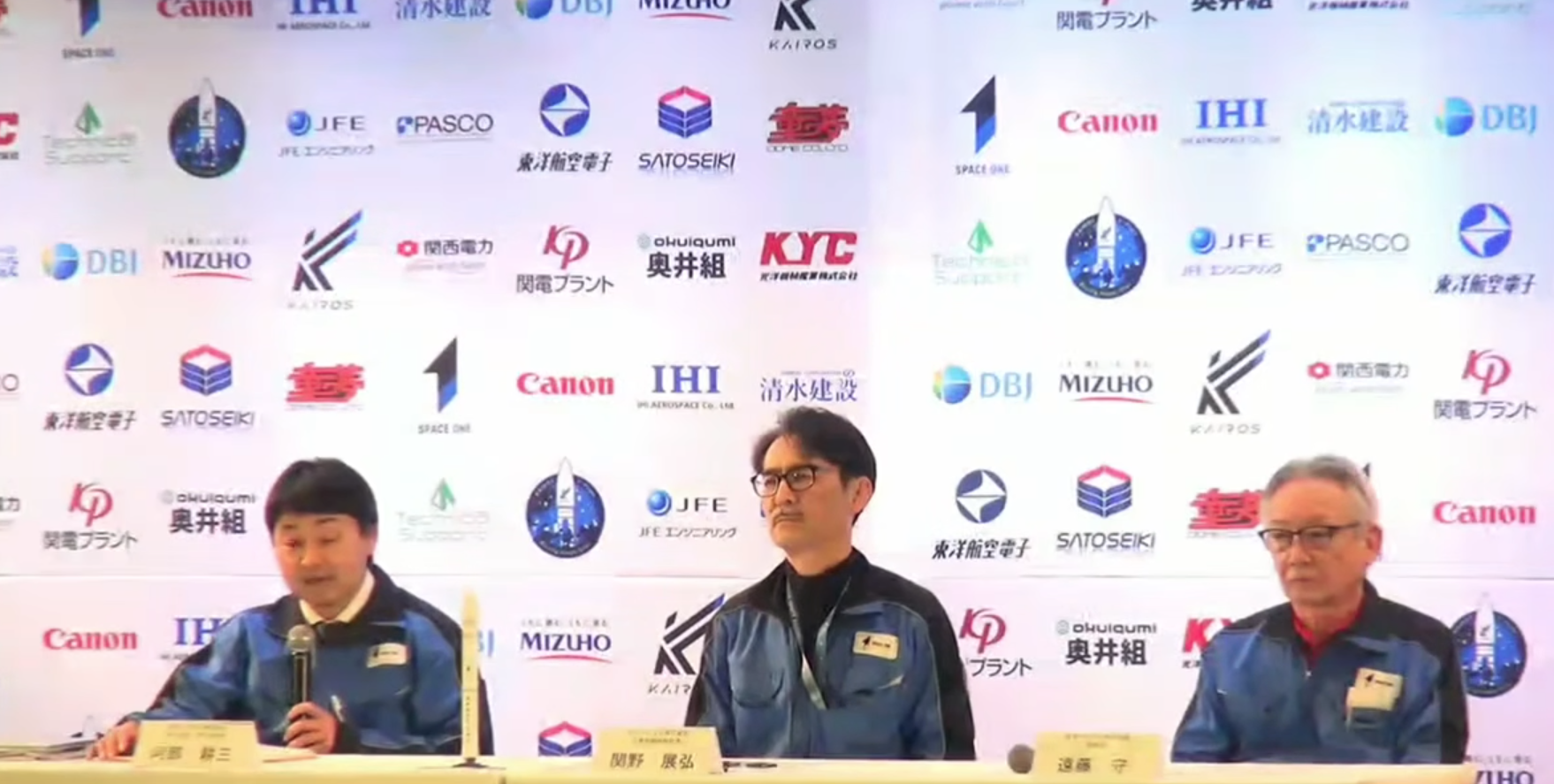
Welcome to Japan Earth Observer (JEO), a free monthly newsletter with a news roundup and one in-depth article about the space, Earth observation and geospatial industries in Japan.
In this news roundup from late February and early March, we’ve got several new funding and contract announcements, the HTV-X cargo separation from the ISS, another KAIROS rocket failure, Chinese export controls, and much more.
On to the news…
News & Announcements
💱 Contracts and Funding
- Japan's Ministry of Internal Affairs and Communications (MIC) (総務省) is going to subsidize development of anti-jamming tech that can protect satellite communications. MIC wants to see testing in summer 2026 with devices developed by FY2028 and available in the marketplace by 2033. France, the Netherlands, and Ukraine have suffered repeated attacks on their telecom and broadcasting services over the past couple of years with Russia as the suspected culprit.
- Why does this matter? The concern driving this R&D effort is not an academic one. Technically, Russia and Japan are still at war; they never signed a peace treaty after World War II. Further, Russian and Chinese combat jets regularly violate Japanese air space. Combined with the potential for hostilities over Taiwan or the Senkaku Islands, it seems prudent for Japan to learn a bit from what's happening in Europe and anticipate similar problems closer to home. The financial support will be channeled through the Space Strategy Fund and will be aimed at supporting development of telecom equipment, materials, and encryption software that will eventually be deployed as part of dual-use satellite communications infrastructure.
- Mitsubishi Electric (MELCO) (三菱電機株式会社) landed another major contract [Space Connect] with the Japanese Ministry of Defense (JMoD) (防衛省) to develop and manufacture a "Next-Generation Defense Satellite Communications System" that will become the successor to the current Kirameki-2 X-band defense communications satellite. ¥123.53 billion (~US$ 800 million). Kirameki serves as core communications infrastructure for the Japan Self-Defense Force (SDF), and the current one will reach the end of its design service life in 2030. MELCO will aim to advance the current state-of-the-art with anti-jamming resistance, improved interoperability with allied and partner nations, and the ability to reconfigure communication parameters on-the-fly. MELCO will leverage its DS2000 geostationary satellite bus as the foundation. JMoD isn’t putting all of its eggs in one communications basket, however, and plans to build a multi-layered communication network combining GEO and LEO satellite constellations to reduce dependency on single platforms and improve resilience against jamming and interception threats.
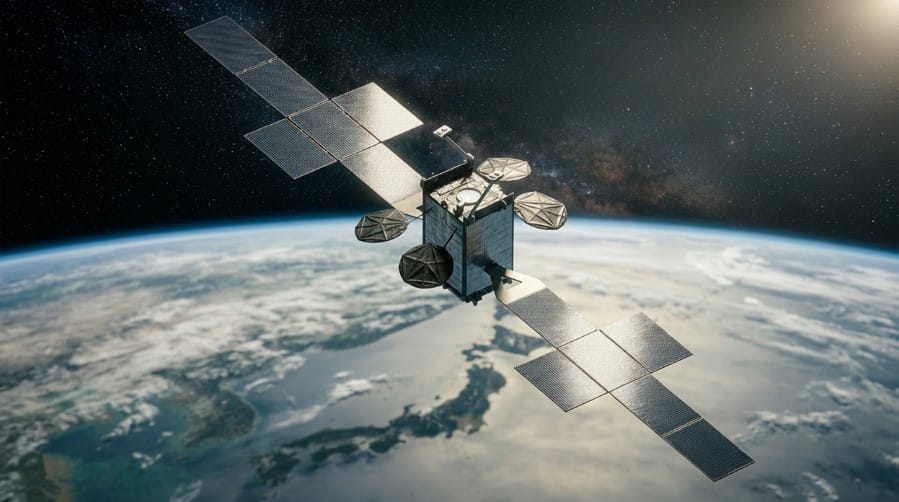
Next generation defense communications satellites. Source: JMoD
-
Mitsubishi Electric (MELCO) (三菱電機株式会社) led a new Series C investment round in PLD Space of $209 million aimed at ramping up production of the Miura 5 launch vehicle. MELCO was joined by the Spain Ministry of Science, Innovation, and Universities and the Spanish public funds management company Cofides. This brings PLD Space's total fundraising to $400 million aimed at developing a rocket that can place a metric ton of payload into LEO. PLD wants to launch 30+ times per year by 2030 from the Guiana Space Center in Kourou, French Guiana. MELCO is not just an investor; they will secure access to new supply of launch vehicles they can sell across Japan and Asia.
-
Rakuten Mobile and the University of Tokyo Graduate School of Engineering have been awarded a 5-year ¥11 billion (~US$ 71.9 million) award to Rakuten and University of Tokyo to advance AI-enhanced direct-to-mobile satellite communications using a novel approach to frequency sharing. Rakuten and Univ of Tokyo Graduate School of Engineering have been collaborating on a joint R&D project since 2021. This ongoing work, partially funded by NICT, is focused on improving IoT device network coverage in mountainous areas, remote islands, The new award will extend this research by developing dynamic frequency sharing protocols; machine learning models to deal with interference, Doppler effects, and traffic load balancing; seamless handover on consumer grade smartphones; and disaster resilience. So LEO direct-to-device satellites + 5G + frequency sharing + AI/ML in order to extend coverage to remote or difficult locations.
Rakuten Mobile is a relatively late entrant to the Japanese mobile network market, launching just six years ago in 2020. But by building on cloud native tech, the OpenRAN standard, and embracing a digital first approach, they have racked up 10 million subscribers (about 4-5% market share). That's still a distant fourth place behind the three big players (NTT Docomo, KDDI, and Softbank), but it's a solid record, and their low cost structure has already enabled them to turn an operating profit.
- Why does this matter? This Space Strategy Fund announcement fits into their narrative of mobile network innovator, but what about the space part? Is Rakuten going to build its own LEO satellite network? Good question. They might not need to because they are also a major investor in and strategic partner with AST SpaceMobile, which already has six ginormous BlueBird satellites in orbit and wants to have 45 to 60 by the end of 2026. These satellites use AT&T and Verizon spectrum to provide direct-to-device mobile broadband service. While Starlink has 9,000+ satellites, of which 650 have direct-to-device capability, AST is going for smaller numbers of satellites with gigantic (2,400 sf) phased array antennas that can handle 2,000 simultaneous connections per satellite at up to 120Mbps speeds. AST SpaceMobile is publicly traded, but it still has several major institutional investors including Vanguard, BlackRock, Alphabet/Google, and Rakuten Group. And Rakuten remains the largest shareholder at 10-11%. The R&D support from the Space Strategy Fund is likely to help them leverage that AST SpaceMobile partnership
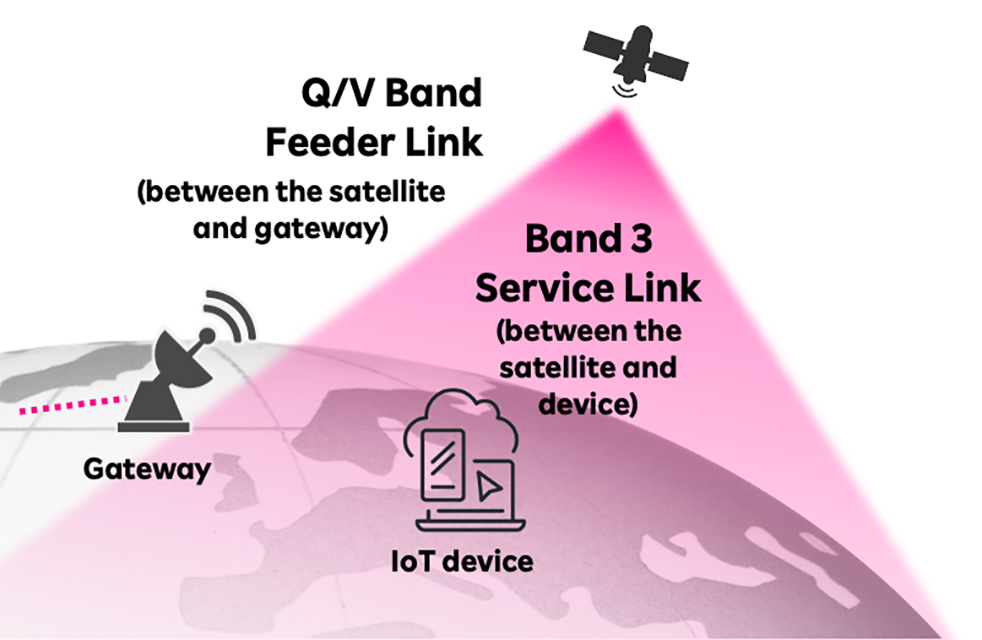
Diagram of the Rakuten Mobile frequency sharing concept. Source: Rakuten Mobile
- BULL Co. (株式会社 BULL) signed an MOU with Indian space startup XDLINX Labs [XDLINX] to integrate BULL's post-mission satellite disposal system into XDLINX satellite platform. The agreement will begin with an in-orbit demonstration of the technology before full integration with future XDLINX satellites.
- Why does this matter? I think insurance companies and national regulations will begin requiring integration of deorbit and disposal technology for all new satellites in the coming years. Japan has several companies working on active debris removal (Astroscale, Orbital Lasers, and Power Laser are a few), but companies like BULL and Axelspace (D-SAIL) that develop devices that can be integrated into every satellite are positioning themselves to serve what could become a substantial global market.
- Aeronext (株式会社 エアロネクスト) has been awarded a contract by JAXA to design and manufacture an autonomous mapping drone to recognize objects floating in the ocean such as observation balloons and reentry and recovery modules from sounding rockets. JAXA currently uses GPS and visual search. A drone would provide a much wider field of view, and the objective of the research will be to reduce time spent searching. The project has rapid turnaround and is expected to be completed by March 2026.Aeronext has an in-house wind tunnel, which will accelerate development.
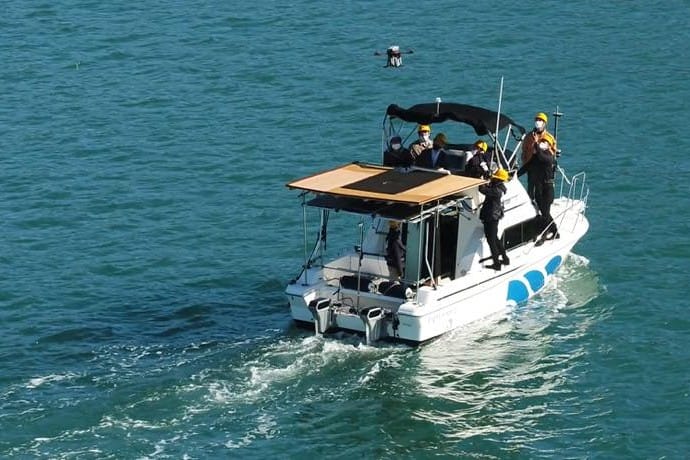
A drone precisely landing on a moving autonomous ship. Source: Aeronext
- Innovative Space Carrier (ISC) (将来宇宙輸送システム株式会社) closed a capital funding and partnership deal with JAL Engineering Co., Ltd. (JALEC), a maintenance subsidiary of Japan Airlines. The two firms have been collaborating on developing an operations framework for reusable rocket systems, leveraging JALEC’s deep expertise on aircraft maintenance and operations and apply it to rocket maintenance, repair, and overhaul.
- Space Shift (スペースシフト) was awarded some funding to suport two projects:
- The Tokyo Metropolitan Government awarded some subsidy funds to develop an illegal fishing vessel detection system by integrating multiple SAR sources. Detecting fishing and other vessels that deliberately turn off their AIS transponders is a global challenge. My fusing data from multiple SAR satellites, Space Shift to develop a better maritime surveillance solution.
- JAXA's Earth Observation Research Center (EORC) awarded funds to support an R&D project aimed at algorithm development using data from JAXA's advanced radar satellite ALOS-4 (PALSAR-3). The research will aim to improve signal processing and geophysical analysis, ultimately enhancing the accuracy and utility of ALOS-4 data products
- Frontier Innovations, a venture capital firm, added four new limited partners (LPs) to its Fund No. 1, including Regional Economic Vitalization Corporation of Japan (REVIC), K4 Ventures, North Pacific Bank, and San-in Godo Bank. FI investment portfolio currently includes BULL, Space Quarters, Tenchijin, Power Laser, Letara, Musashi Sky Plus, iQPS, and Ridge-i.
- Space Data (株式会社スペースデータ) inked a strategic partnership with CYPHIC Co., a Tokyo-based electronic warfare startup, to jointly develop advanced security solutions that combine electronic warfare tech with digital twin and physical AI capabilities.
- Why does this matter? Everyone is chasing those juicy defense and intelligence contracts.
- Warpspace (ワープスペース) has been busy:
- They closed a Series C funding round led by SPARX Asset Management's "Space Frontier Fund” aimed at accelerating commercialization of its HOCSAI optical communications modem and digital twin products. Warpspace’s components are used by satellite manufactures to support high-capacity data transmission.
- Warpspace was awarded a JAXA Space Strategy Fund (宇宙戦略基金) contract to develop and test techniques to accelerate adoption of satellite optical communications across the industry.
- And they were awarded a separate JAXA contract to do a concept study on a developing a Moon-Earth optical communication relay system (月面活動に向けた光通信システム概念検討業務) that will support lunar surface operations.
- Toyota Motor's VC unit is joining NVIDIA to invest US$1 billion in Yann LeCun's new AI research lab [Nikkei Asia], Advanced Machine Intelligence (AMI). LeCun is a legend in AI circles, and he has been leading AI research at Meta/Facebook for more than a decade, but he left in late 2025 to start AMI. He's convinced that we're collectively investing far too much on LLMs, and if we're going to see continued progress with AI, we need to be building more models of the physical world. He's not the only one that feels this way. AI pioneer and fellow legend, Fei Fei Li, has started World Labs. NVIDIA has developed its own Omniverse model. Mujin is building an AI-based OS for industrial robots. John Hanke's Niantic Spatial, Google DeepMind's Genie and SIMA, and a new startup founded by Jeff Bezos and Vikram Bajaj Project Prometheus have all joined the fray. Successful development of 3D world models trained to operate based on the characteristics of the physical world could help with scientific discovery, industrial automation, robotics, and a range of other activities that LLMs cannot currently address. For Toyota the interest is likely factory automation as well as autonomous vehicles.
- A team lead by Tellus (株式会社Tellus) has been awarded a JAXA Space Strategy Fund contract [SPACE SHIFT] under the theme “Advanced Technologies to Accelerate Utilization of Earth Environment Satellite Data”. Tellis will develop the satellite data platform and compute infrastructure elements while other team members Degas Co., NEC, and SPACE SHIFT will provide AI and satellite data analytics. The team aims to develop an AI foundation model using Japanese environmental satellite data and other datasets, platform infrastructure, and a monetization and profit-sharing framework for data contributors.
- SUiCTE Co., a startup developing semiconductor image sensors and cameras for satellites, closed a seed funding round of ¥140 million (~US$ 933,000 [SpaceMedia], with investors including Quantum Leap Ventures and Incubate Fund. Founded in 2024, SUiCTE is led by imaging sensor researchers from Shizuoka University. The funding will be used to formally launch commercial development of satellite-grade semiconductor image sensors and cameras, building toward a domestic supply infrastructure for space sensing technology and global market expansion.
- Sakana AI announced a slew of new investment and strategic partnerships:
- Strategic partnership with Datadog, a cloud monitoring and security platform, aimed at collaborating to pursue joint research, contribute to open source software, and pursue work with large enterprises.
- Strategic investment from Citigroup (shockingly, this is apparently Citi’s first ever investment in a Japanese company). The investment will help Sakan accelerate international expansion and product development related to financial services. Sakana has existing strategic partnerships with other major financial services firms, including Mitsubishi UFJ Financial Group (MUFG) and Daiwa Securities Group and investment from Spain’s Santander Group.
- Strategic investment from Salesforce Ventures that will support evaluating potential integration of Sakana AI’s enterprise AI technology with the Salesforce platform. Salesforce has been an active investor in Japan’s technology ecosystem since 2011.
- Strategic investment from Google that will enable Sakana to more easily use Google Gemini models while still allowing Sakana to use others. Sakana will also be able to make its products available on the Google Cloud infrastructure for financial and government customers, where security concerns are significant.
-
Why does this matter? Co-founder and CEO, David Ho, is a former Googler that left in 2023 to start Sakana AI. Sakana was already valued at ¥400 billion (~US $2.6 billion) in November 2025 [Nikkei Asia] after raising a Series B round of ¥20 billion (~US $133 million) in new funds from Mitsubishi UFJ, Santander Group, Shikoku Electric Power, In-Q-Tel, and other U.S. venture capital firms, making it the most valuable unlisted company in Japan. Other investors have included Nvidia, Mizuho Financial Group, and Sumitomo Mitsui Financial Group.
Despite the recent fundraising success, Sakana has only a tiny fraction of the resources of its U.S. rivals, and it has taken a different approach to building its large language models (LLMs). Rather than developing new general intelligence models from scratch, it has developed LLMs that combine existing models for specialized purposes at far lower cost. Sakana has built an LLM around the specifics of the Japanese language and is using this to build specialized LLM-based finance models for clients like MUFG and Daiwa Securities. It is also extending its work into defense and manufacturing. This combination of regional and enterprise sector focus is similar to French startup Mistral AI and is proving to be successful; unlike most of the U.S. AI hyperscalers (OpenAI, Anthropic, etc.), Sakana AI expects to turn a profit in 2026 [Nikkei Asia]. Sakana leverages multiple LLMs from other firms, such as Google, OpenAI, and leading Chinese models (like DeepSeek, Kimi, GLM, and Qwen), but the new funding from Google will likely grease the skids to using Google Gemini.
-
Space Strategy Fund Announcements in February 2026
| Theme | |
|---|---|
| 宇宙輸送 Space Transportation | Awards |
| Technologies for ensuring safety of crewed space transportation systems |
|
| Iwatani Giken | Pressurized cabin and crew systems (ECLSS) for general purpose crewed spacecraft |
| Space Systems Development Co. | Pressurized cabin ECLSS technology to ensure the safety of crewed space transportation |
| Innovative Space Carrier | Technologies for visualization, detection, and evacuation to support the safety of crewed space transportation |
| Mitsubishi Heavy Industries | Demonstration of anomaly detection and emergency evacuation to ensure the safety of crewed space transportation |
🛰️ Technology and Infrastructure
- JAXA’s HTV-X1 cargo ship, docked at the ISS since October,departed without incident on 6 Mar 2026. Following the release from the ISS, the HTV-X1 will enter a three-month free-flight phase dedicated to technology demonstration missions, comprising four experiments: H-SSOD (HTV-X Small Satellite Orbital Deployer), Mt. FUJI (MulTiple reFlector Unit from Jaxa Investigation), DELIGHT (DEployable LIGHtweight planar antenna Technology demonstration), and SDX (Space solar cell Demonstration system on HTV-X). These demonstrations aim to validate key technologies for future space infrastructure including deployable antennas, advanced solar cells, and small satellite deployment mechanisms. The HTV-X will first raise its orbit to 500km to test H-SSOD and Mt FUJI over the next few weeks and then descend again to a lower orbit to test DELIGHT and SDX for two months.
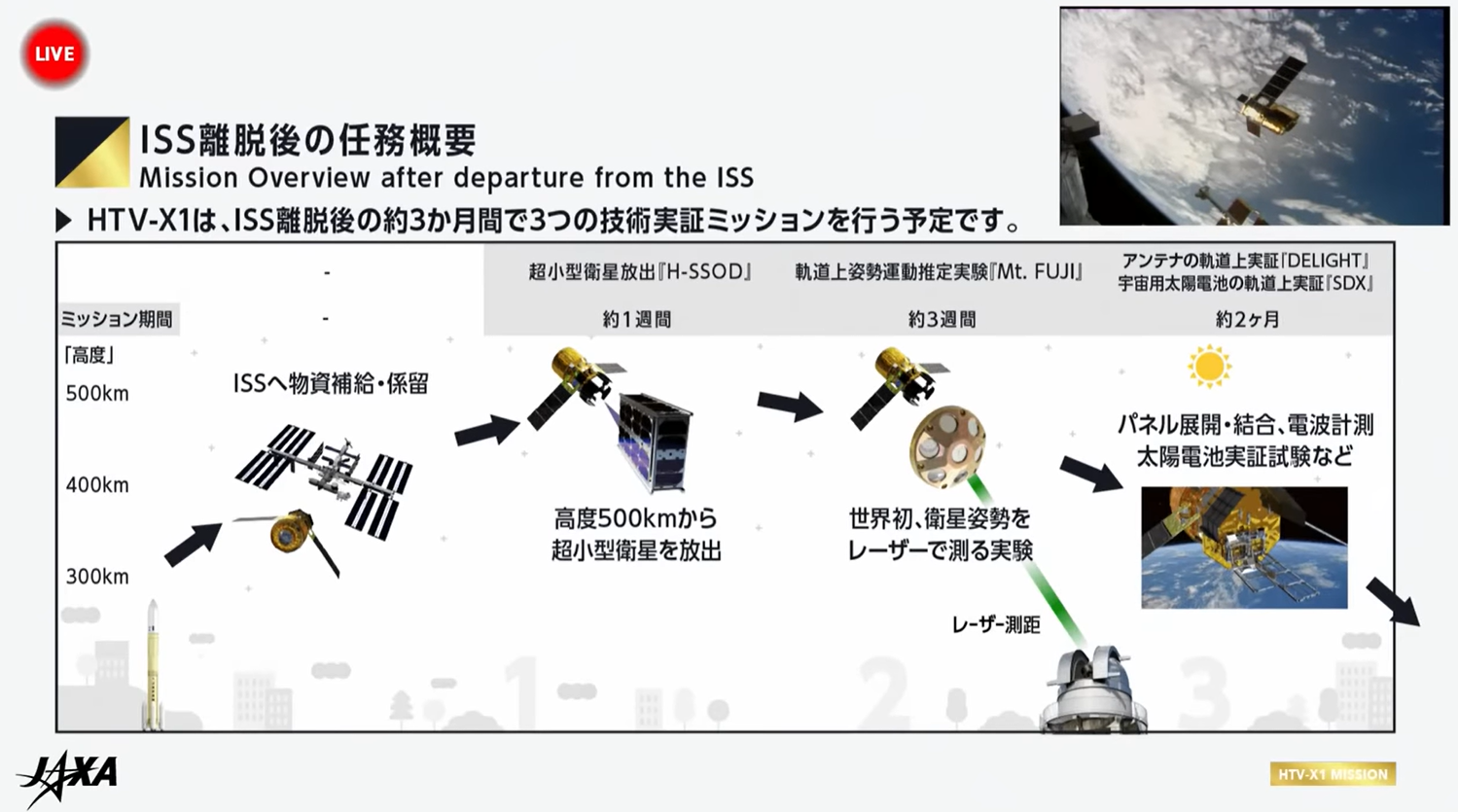
HTV-X1 mission overview after departure from ISS. Source: JAXA
- SPACE ONE’s third launch of the Kairos rocket failed on 5 March [Space.com] about 69 seconds into its flight when the self-destruct flight safety system (自立破壊安全飛行システム) destroyed the vehicle. The cause is not clear as the flight showed all systems operating normally until the self-destruct mechanism activated, so it’s possible the failure was in the mechanism itself. The 18 meter Kairos rocket is designed to lift about 150kg to sun synchronous orbit. The initial stages are solid fueled and the final boost stage is liquid fueled. When Kairos-3 blew up, it was in the middle of the stage one burn, about 29km altitude and due south of the launch point over the Pacific. There were no injuries but five experimental satellites from ArkEdge Space, the Taiwan Space Agency and others were lost.
- Why does this matter? With the JAXA flagship H3 rocket grounded after a January launch failure, Japan currently has neither public nor private launch options, and given the desire to both have a sovereign domestic launch capability and the capacity to support a 30 launch per year cadence, this must be a distressing juncture.

The initial moments after the KAIROS-3 launch. Source: Spaceport Kii Regional Cooperation Council
- Insurance for Rocket Scientists: When the new parliament convenes again in February, the government will introduce a bill to loosen the rules on rocket mishap damage payouts [Nikkei Asia]. It's not uncommon for seemingly minor laws and regulations to shape an entire industry, and this is a story about how a nuance in an insurance law designed to support rocket development is making it harder for rocketry startups to get off the ground (ha ha). Designing and building rockets is hard and carries a fair amount of risk. Rockets often explode, particularly in the early stages of developing a new one. So rocket launch companies purchase private insurance to cover potential damage or injury caused by a rocket launch, but it's not unlimited, and the cost rises rapidly as the value of the insurance goes up. So in order to support this high risk endeavor, the Japanese government offers to cover excess liability insurance if the amount of damage exceeds that covered by private insurance. Under the current law, excess liability coverage by the government only applies when a rocket is carrying a real satellite payload. But when a new rocket design is being tested, the chance of blowing up is high, and if it fails, you don't want to lose a valuable payload as well. This makes early stage rocket tests more expensive to insure (or mandates that they carry a payload). And the Japanese government wants companies designing and testing new rockets. Rocket companies tend to develop faster when they fail, learn, and iterate rapidly and at low cost. So a small change to the law may save a lot of money and remove a ot of uncertainty for rocket startups. Nice people doing nice things for the rocket scientists.
- In case you are wondering if this type of industry risk-sharing support is unique to Japan, it is not. I haven't done a global survey, but under the Commercial Space Launch Act, the U.S. government offers the same type of support. The FAA (which licenses U.S. rocket launches) requires launch companies to carry insurance for the maximum probable loss (MPL). But if there is a catastrophe and damage exceeds the MPL amount, the government will step in to cover additional claims.
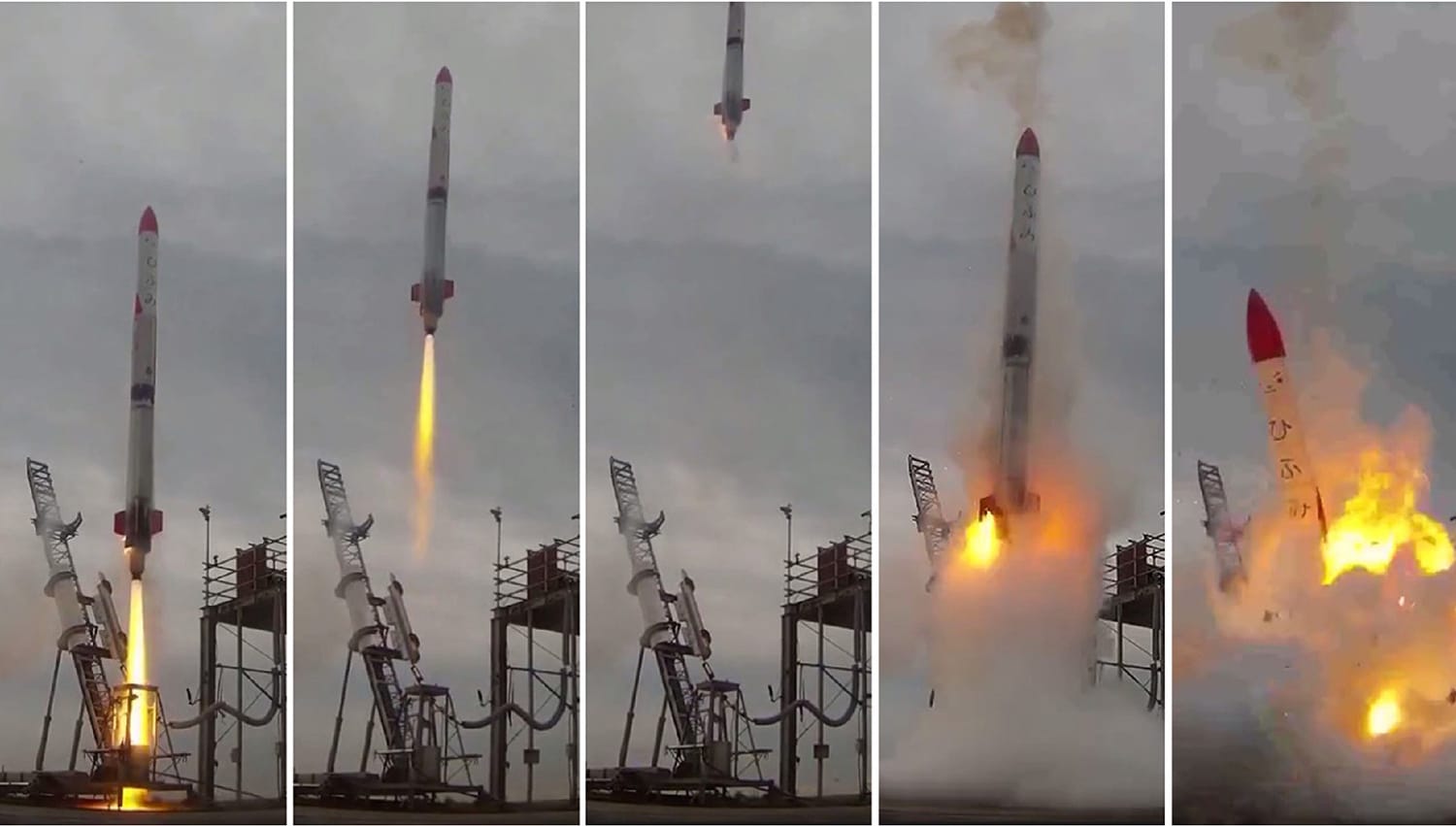
Momo2 rocket failure. Source: Jiji Press
-
ispace (株式会社 ispace) is having engine trouble. They have been developing a new engine called "VoidRunner" in a collaboration with Agile Space Industries (ASI), but they revealed in a recent earnings call that the hot fire test cycles are not meeting the performance and fuel efficiency (specific impulse) ispace needs. They plan to use this engine to support the APEX 1.0 lander (aka Mission 3) its U.S. subsidiary is building for Draper under an US$86 million NASA CLPS contract and expected to launch in 2027. It may also delay Mission 4, being built in Japan and currently expected to launch in 2028. While ispace is saying it won't affect the total contract revenue it expects to earn, it has reduced its FY2026 revenue projections by 40%. And if the schedule slips further, they may have to consider alternative engine options.
On the plus side, in January ispace was awarded a significant contract under JAXA's Space Strategy Fund that will include transfer of precision landing technology used in JAXA's SLIM lander. This ~US$136 million award will become Mission 6. In addition to this funding, the European Space Agency has also awarded the ispace EU subsidiary ~US$76 million to build the MAGPIE payload that will ride on the Mission 6 lander.
- ispace earnings call slides: https://ssl4.eir-parts.net/doc/9348/tdnet/2755603/00.pdf
- ispace earnings call transcript: https://ssl4.eir-parts.net/doc/9348/ir_material_for_fiscal_ym3/198665/00.pdf
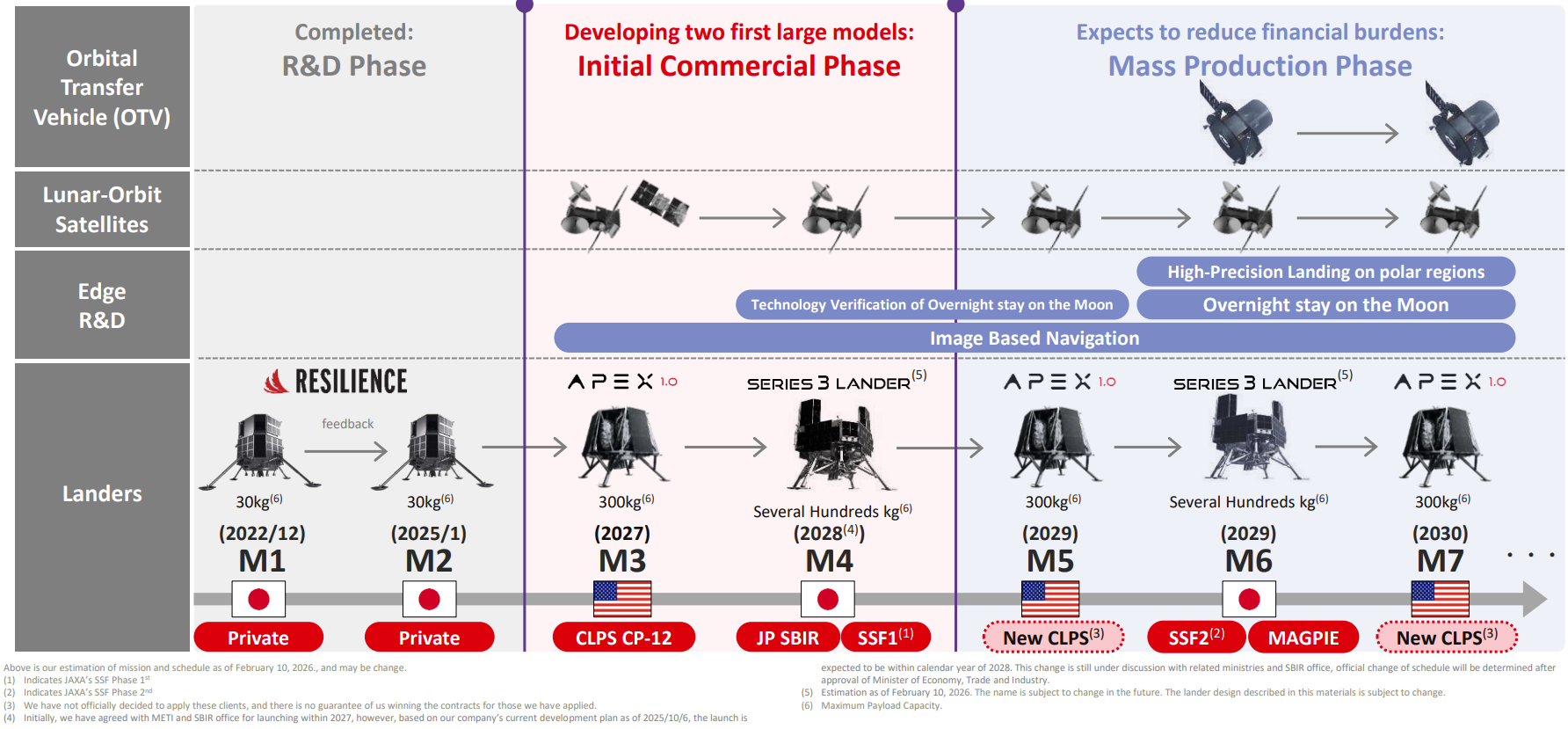
ispace lander development overview. Source: ispace
- MIERUNE (株式会社MIERUNE) has released Kumoy (くもい), a new software tool that extends the open source QGIS platform to help user and teams publish maps to the web and manage data in the cloud. QGIS is a desktop geospatial data visualization and management platform. While it can make use of data stored online, it's not always a seamless process. MIERUNE has been building plugins for QGIS for many years, and they have leveraged this experience to make Kumoy. The new software aims to make team data management collaboration as well as cloud data storage and management seamless. This seems to be aimed at a Japanese audience and MIERUNE has committed to using domestic Japanese data centers for storing data.
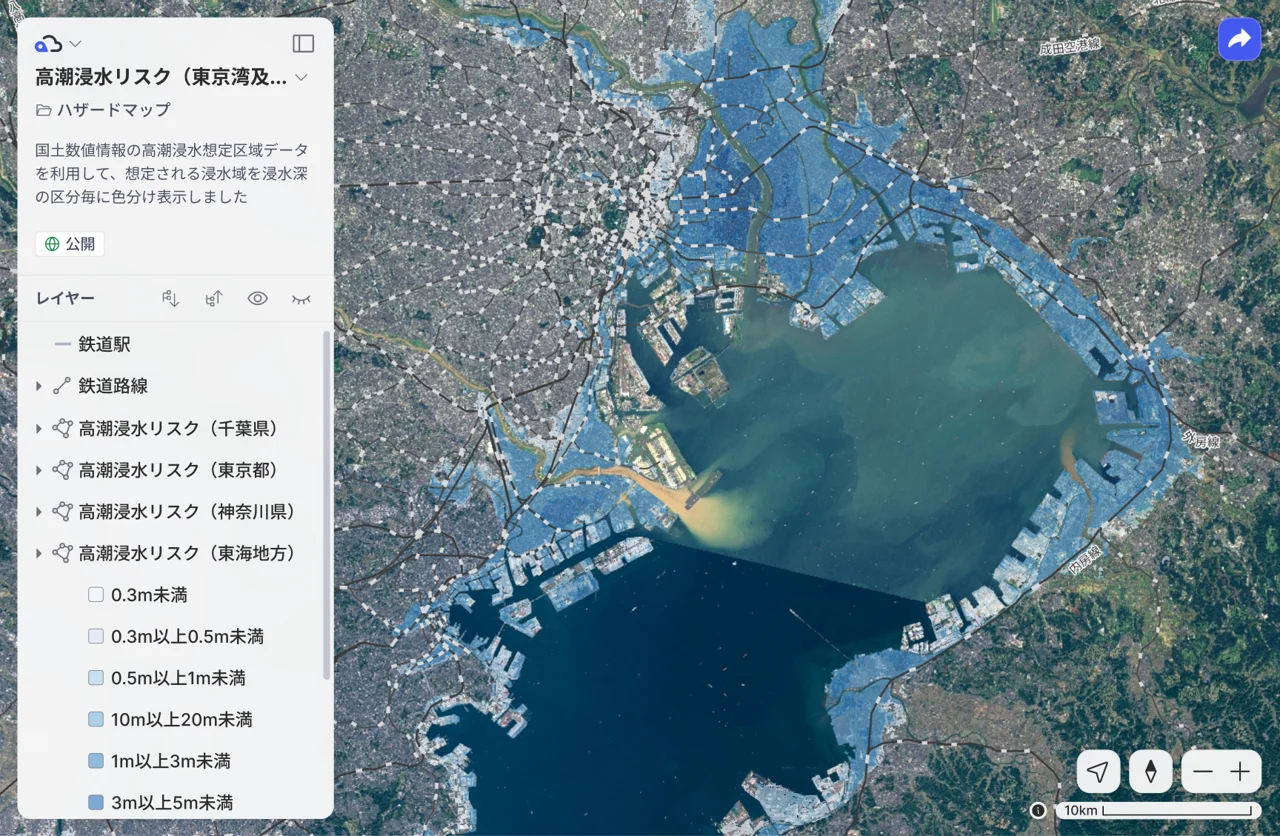
Screenshot of Kumoy application. Source: Mierune
-
Preferred Networks (PFN), a leading Japanese AI firm, released CuPy v14, a major update to its open source GPU-accelerated array computing library. The library is widely used for AI and machine learning workloads within the Python data science ecosystem. The new version adds support for NumPy 2 (a numerical computation library); better compatibility with other GPU-enabled Python libraries like PyTorch; and support for the latest AMD GPUs
-
JAXA plans to carry out flight tests of an experimental reusable rocket RV-X [Aviation Week] on 7 Mar and 14 Mar. The technology has been under development since 2017 with ground engine testing since 2018. RV-X uses hydrolox engines (liquid hydrogen fuel with liquid oxygen as oxidizer) (液体酸素/液体水素) as liquid hydrogen provides higher specific impulse than more conventional kerosene or methane engines. The primary objective is to develop reusable engine technology and work through the complexities of safely handling liquid hydrogen fuel.
Japan has done reusable launch vehicle development in the past. The HOPE-X program aimed to build a 10 ton, 13.4 m reusable space plane that could be launched to orbit atop an H-IIA rocket and then return to Earth for refurbishment and reuse. The concept was similar to the NASA Space Shuttle, but scaled down significantly with no plans for crewed missions. Beginning in 1994 Japan followed an incremental, step-by-step technology development process, developing four prototypes before canceling the program 2003. Similar concepts have since been developed in the U.S. as the Boeing X-37B (~9 m length and 4.5 m wingspan) and in China as the Shenlong space plane [Space.com].
In a separate effort aimed at building a reusable sounding rocket [Wikiepdia] (観測ロケット), starting in 1998 ISAS developed the Reusable Vehicle Testing (RVT) (再使用ロケット実験) concept aimed at launching small payloads (100kg) to 100 km altitude. Four progressively larger and more complex rockets were developed and each tested multiple times. While never put into production use, the work led directly to the current RV-X, which began development in 2017.
The upcoming tests will be short vertical hops at Noshiro Rocket Testing Center (能代ロケット実験場). RV-X will lift off vertically to 10m, move horizontally 15m and then land. The short 7-day turnaround between the two tests is aimed at developing rapid inspection and refurbishment processes that support reusability. These short hop tests are similar to the "Grasshopper" tests in the early stages of the SpaceX Falcon 9 development. Some of the RV-X technology will be integrated into a second test vehicle called CALLISTO [Wikipedia] being developed in collaboration with France space agency CNES and Germany space agency DLR for potential flight testing in early 2027 from the Guiana Space Centre.
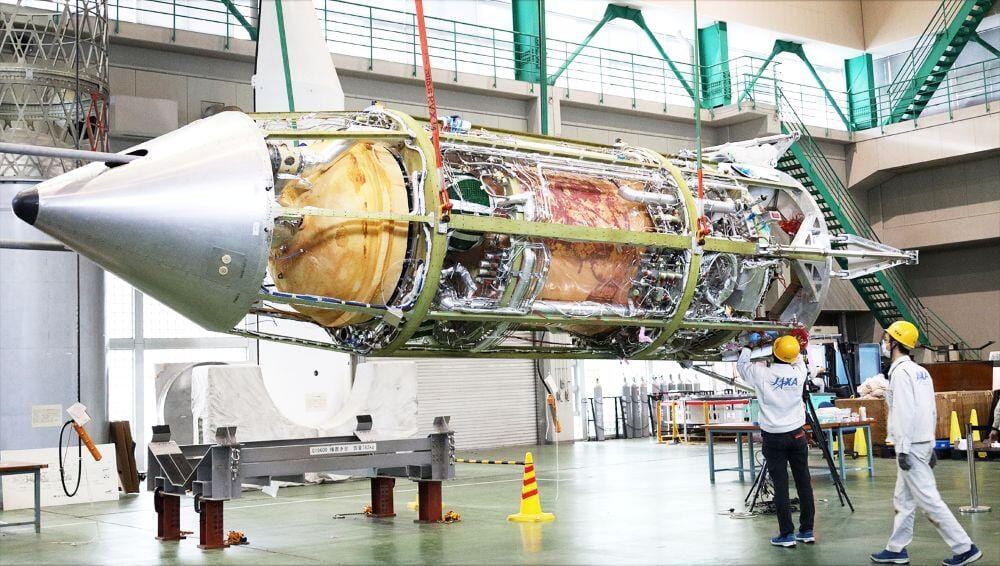
RV-X vertical takeoff/vertical landing test vehicle. Source: JAXA
- ARKEdge Space, AxelSpace, Cross U, and Africa-focused venture capital firm Double Feather Partners have set up a consortium aimed at developing space business opportunities in African markets [ArkEdge]. They want to move beyond the traditional ODA frameworks toward commercially sustainable business models. The first project between AxelSpace and Jethi Software Development in Ethiopia to develop satellite data applications for agricultural productivity, forest conservation, and urban planning is already underway. ARKEdge Space is contributing its expertise in IoT satellite manufacturing and satellite data integration for food security and drought-related applications, and it already has MOUs with three African nations. The consortium plans visits to Africa in April 2026 and plans to report any new outcomes at the "NIHONBASHI SPACE WEEK 2026" event in November 2026..
- Dynamic Map Platform (DMP) (ダイナミックマッププラットフォーム株式会社), a firm that creates high-precision 3D map data for autonomous vehicles and logistics, has completed road coverage in Canada [DMP], bringing the global coverage to 1.8 million km (~1.12 million miles).
- Innovative Space Carrier (ISC) (将来宇宙輸送システム株式会社) has started operations at a new factory facility [ISC] within the Mitsubishi Logistics Corporation (MLC) SPACE LAB in Minamisoma City, Fukushima Prefecture. The new facility will help accelerate development of reusable rocket technologies by establishing a landing technology verification platform and building a local aerospace supply chain in Fukushima. ISC is trying to achieve a launch demonstration by FY2027.
- Side note: the MLC SPACE LAB was opened in 2025 and also hosts a manufacturing facility for ElevationSpace.
- iQPS was able to recover commercial operations on QPS-SAR-5 (“Tuskuyomi-I”). After a communications systems failure in Sept 2024, engineers were able to partially restore some capability in July 2025, but have now restored full image commercial capture capacity. This is kind of extraordinary as it's rare to recover after a major system failure on a small satellite. Kudos to the engineering team. And I bet they got a lot of good data on how to improve future satellites.
- Pale Blue has started operations at its new production engineering facility in Tsukuba [Pale Blue], Ibaraki Prefecture. The new facility will help Pale Blue scale manufacturing capacity of its water ion and Hall thruster propulsion systems. The facility brings the full engineering life-cycle under one roof, including production engineering, cleanroom manufacturing, vacuum chamber testing, vibration testing, final inspection, and global shipping. Consolidating everything in a single facility will reduce lead times and substantially increase throughput to address growing global demand from small satellite operators and integrators.
- Weathernews Inc. (WNI) launched a new enterprise Business Continuity Plan (BCP) service aimed at helping businesses track employee safety during a disaster (安否確認の機能). The new service is not limited to weather and covers a comprehensive set of disaster triggers – earthquake, tsunami, typhoon, heavy rainfall and snowfall, and storm surge – and spans the full BCP timeline from pre-disaster safety confirmation through personnel tracking during a disaster to post-disaster recovery planning. It also leverages Starlink satellite connectivity for scenarios in which the terrestrial cellular networks fail. The system supports location-aware notifications to employees, leverages the "Weathernews" consumer app (50M downloads) as the employee-facing interface, and provides management dashboards overlaying real-time weather data with prioritized personnel location maps.
- AALTO is planning a new high altitude platform service (HAPS) flight operations hub (an AALTOPORT) in northern Australia [Space War News]. It plans to launch its solar-powered Zephyr planes from the new hub and operate them in the stratosphere (20 - 25km) over Australia and the Asia Pacific region. The company's initial testing site was in Kenya, but a northern Australia site would enable it to reach Japan as well as Indonesia, Philippines, and other SE Asia sites far more rapidly. The Zephyr planes are designed to stay aloft for up to 90 days, providing 4G and 5G mobile network coverage that can be particularly useful for both remote locations and disaster scenarios. AALTO is an Airbus subsidiary, but a consortium of Japanese businesses (NTT DOCOMO, Space Compass, Mizuho Bank, and Development Bank of Japan) committed to a US $100 million investment in AALTO in June 2024, and NTT DOCOMO and Space Compass have already supported successful demonstrations of the technology.
- Why does this matter? While the Japanese companies trot out the usual disaster response bromides that are used to justify many projects in Japan, the Zephyr project was originally spun out of the UK Ministry of Defense, and it has clear dual-use applications that would support rapid deployment for intelligence, surveillance and reconnaissance (ISR) purposes as well.
- These are pretty amazing planes. One 60-75kg Zephyr has a 25 m wingspan and can carry a 5-8kg payload. For a mobile communications mission, it can replace 250 cell towers and serve up to 100,000 people across a 7,500 sq km area. With an Earth observation payload, it can capture 18cm high resolution imagery over a 20km x 30km swath.
- Vast announced a $500 million investment round to continue development of its commercial space station, Haven [Vast]. The investment round was led by Balerion Space Ventures and included Japanese firms Mitsui & Co., MUFG, and Nikon as well as IQT, Qatar Investment Authority, Stellar Ventures, Space Capital, Earthrise Ventures and founder Jed McCaleb. Vast is arguably ahead of the other commercial space station developers with a Haven Demo launch and deorbit in 2025 and Haven-1 on track for launch in 2027. The enterprise has already had $1 billion invested to date, but all of it was from McCaleb. So the new financing is really a Series A and includes $300 million in equity and $200 million in debt.
- Why does this matter? The large institutional Japanese investors are significant and now mean that Japanese firms are major investors on every significant commercial space station effort in Europe and North America. It also follows closely on the heels of Vast opening a Japan subsidiary, Vast Japan, lead by former JAXA astronaut Yamazaki Naoko as its first General Manager. The other Japanese partner is Japan Manned Space Systems Corporation (JAMSS), which has signed an agreement to host a scientific research equipment module on Vast's Haven-1 station.
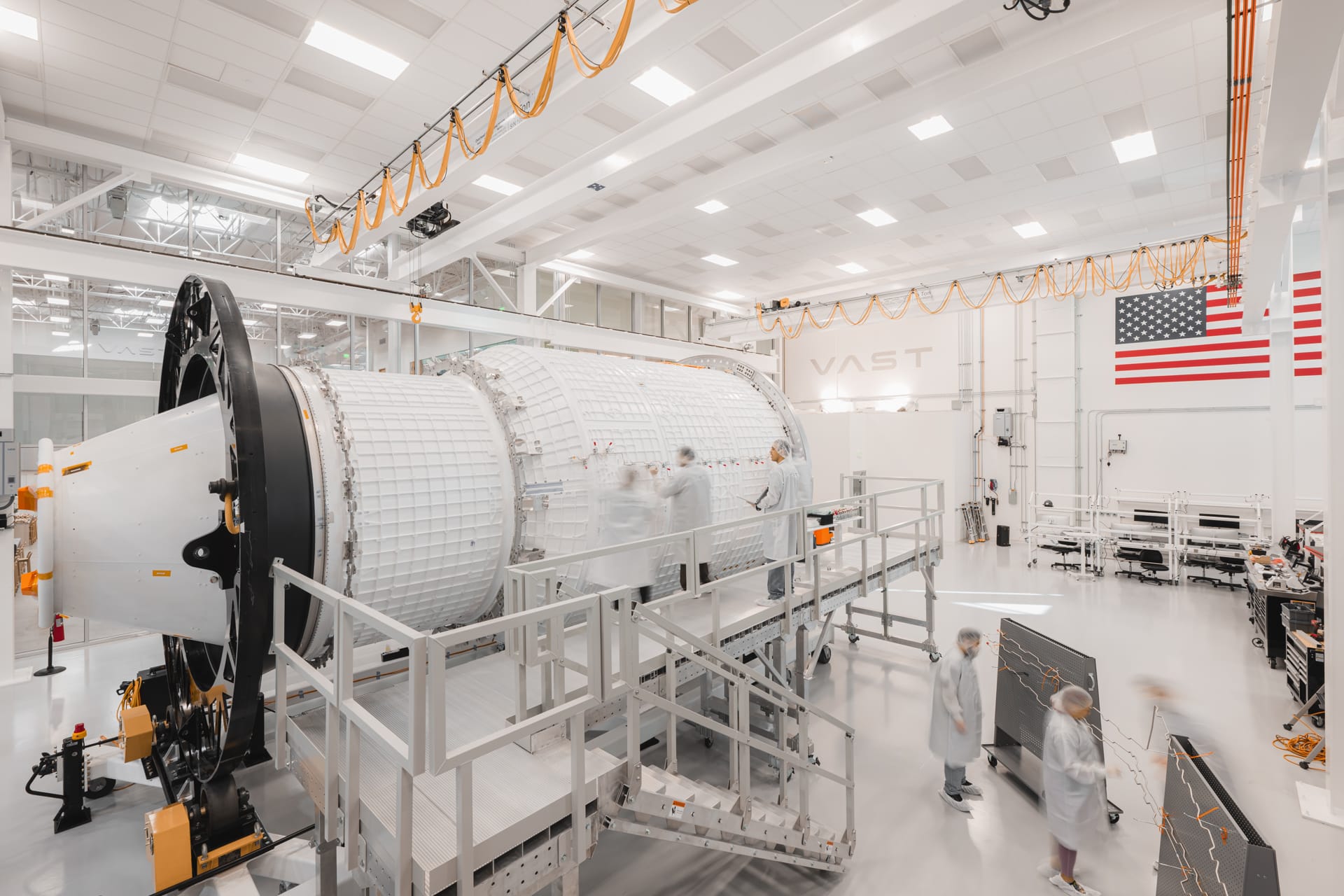
Haven-1 integration process. Source: Vast
🔭 Science
- University of Tokyo Professor Watanave Hidenori has developed a series of data sets and 3D displays of historical events [Cesium/Bentley] using the 3D Tiles open standard and the open source CesiumJS viewer. His effort to turn digital archives into interactive 3D models includes archives at Hiroshima and Nagasaki, Ukraine war damage, the Gaza conflict, and, most recently, the Great East Japan Earthquake. Watanave began his career as an engineer at Sony. As gaming culture exploded in the 1990s, he returned to academia to experiment with telling stories using interactive maps. In the long run, he imagines a global memory map that brings together digital archives from every corner of the planet.

Screenshots of Watanave’s interactive digital archives. Source: Cesium/Bentley
🗺️ International Collaborations
- Space Data (株式会社スペースデータ) announced a collaboration with the United Nations Industrial Development Organization (UNIDO) to support disaster recovery and national resilience in Brazil's Rio Grande do Sul state. The initiative will leverage satellite data, artificial intelligence, and digital twin technology to strengthen the state's resilience against future disasters.
- Tenchijin (株式会社 天地) completed a water pipe leakage risk diagnostic proof-of-concept in the Kingdom of Cambodia, carried out under a JICA-funded water supply project in Phnom Penh. The project combined satellite data, Tenchijin’s AI models, and pipe and leak repair records. The project confirmed that the data is good enough to support a production system and that Tenchijin’s techniques are applicable in other ODA-funded infrastructure programs. That will open a path to international expansion in partnership with JICA.
- SKY Perfect JSAT (株式会社スカイパーJSAT) has become the first Japanese reseller of thermal infrared satellite imagery data from German startup constellr. Thermal imager can support agriculture crop stress monitoring, urban heat island analysis, industrial facility monitoring, and environmental assessments. SKY Perfect JSAT is trying to diversify its business with a portfolio of Earth observation data offerings.

Yokohama harbor as seen from above by constellr thermal infrared sensor. Source: constellr
- The Japanese government is drawing up international recommendations to curb space debris in cislunar space [Straits Times] and is aiming to make the recommendations official at the next gathering of Artemis Accords signatories, possibly in autumn 2026. The Japanese proposal will likely include urging all parties to avoid discarding any objects, carefully selecting lunar location when taking down a satellite or other object, and advance planned for disposal of landers and rovers. It's unlikely that in the current geopolitical environment any consensus will turn this into international law, but from a pragmatic perspective, a set of guidelines that everyone follows would be just as good as a treaty.
- Why does this matter? While there are at least 1.2 million objects orbiting the Earth, much of the satellite and rocket debris around the Earth will eventually decay, particularly in low Earth orbit (LEO) where atmospheric drag will gradually reduce the orbit height unless a satellite or station takes steps to raise the orbit. However, the Moon has no atmosphere and there is no natural mechanism for disposal. So Japan, which is a leader on Earth orbit debris mitigation, wants to develop consensus amongst the spacefaring nations about limiting debris before it becomes a problem.
- The opposite of International Collaboration would be a trade war. On 24 Feb China imposed export controls on a swath of Japanese companies and government agencies and added twenty more to a "watch list". The export control list includes subsidiaries of Mitsubishi Heavy Industries, Kawasaki Heavy Industries, Fujitsu, IHI, NEC, and even JAXA, a government agency. The watch list will require applications from Chinese exporters and includes Itochu Aviation, Fuji Aerospace, Mitsui Bussan Aerospace, Mitsubishi Materials, Sumitomo Heavy Industries, and other major manufacturers. While the announcement is aimed at Japan's defense industry, it covers "dual use" items and that covers pretty much anything related to satellites or rockets, so the potential impact on the civilian space ecosystem is likely to be significant.
📆 Asia-Pacific Conferences & Events
This newsletter is mostly focused on Japan, but I also like to highlight events across the Asia-Pacific region. Some upcoming conferences in 2026 include:
March 2026
- ISAS Sounding Rocket Symposium (観測ロケットシンポジウム) - 12 - 13 Mar - JAXA Sagamihara Campus, Japan (Hybrid)
- Cross U Space Future Forum - 13 Mar - Nihonbashi, Tokyo, Japan
- Committee on Earth Observation Satellites (CEOS) Disaster and Information Services Working Group Meetings - 16 - 20 Mar - Dehradun, Uttarakhand,India
- Commercial Space Conference and Exhibition - 17 - 18 Mar - Shenzhen, China
- Tottori Rover Challenge 2026 (鳥取ローバーチャレンジ2026) - 19 - 21 Mar - Tottori, Japan
- Convergence India Expo - 23 - 25 Mar - New Delhi, India
- Space Technology Conference Central Eurasia (STC) - 30 Mar - 1 Apr, Tashkent Uzbekhistan
- GEO Connect Asia 2026 - 31 Mar - 1 Apr - Singapore
- Drones and Uncrewed Asia 2026 - 31 Mar - 1 Apr - Singapore
April 2026
- 57th Japan Society for Aeronautical and Space Sciences (JSASS) Annual Lectures (日本航空宇宙学会第57期 年会講演会) - 15 - 17 April - Osaka University Toyonaka Campus, Osaka, Japan
- International Conference on Spacecraft Mission Operations (SMOPS) - 8-10 Apr - Bengaluru, India
- International Conference on Advances in Aerospace and Energy Systems (IAES-2026) - 16-18 Apr - Mahendragiri, Tamil Nadu, India
- 11th China Space Day - 24 April - TBD, China - marks anniversary of China’s first satellite launch, Dongfanghong-1 in 1970
May 2026
- Asia-Pacific Regional IAU Meeting (APRIM) - 4 - 8 May - Hong Kong, China
- Asia-Pacific Satellite International Conference - 12 - 13 May - Jakarta, Indonesia
- Global Space and Technology Convention & Exhibition (GSTCE) - 13 - 14 May - Singapore
- International Symposium on Remote Sensing (ISRS) 2026 - 13 - 15 May - Matsue, Shimane-ken, Japan
- CommunicAsia 2026 - 20 - 22 May - Singapore
- Geo-Space Bharat 2026 - 21 - 22 May - Ahmedabad, Gujarat
- SatelliteAsia 2026 (at Asia Tech x Singapore (ATxSG)) - 20 - 22 May - Singapore
- Japan Geoscience Union (JpGU)-AGU Joint Meeting 2026 - 24–29 May - Chiba, Japan
- 3rd SPEXA Space Business Expo (宇宙ビジネス展) - 27 - 29 May - Tokyo, Japan
Recent Videos
- 11th National Space Policy Secretariat Symposium [English] [Japanese] - only available until the end of March 2026
- 2025 JAXA Space Exploration Open Innovation Forum [Japanese]
- SPACE ONE KAIROS-3 launch [Japanese]
- HTV-X1 departs from ISS for experiment mission [Japanese]
- RV-X hop Press Conference [Japanese] -
If you’ve made it this far, thank you for reading. Please be in touch via LinkedIn with any feedback, questions, comments, or requests for future topics. And if you have a friend or colleague that you think would enjoy JEO, please share it!
Until next time,
Robert
The snow is melting
and the village is flooded
with children.
-- Author: Kobayashi Issa (1763–1828) - translated by Robert Hassn
雪とけて
村一ぱいの
子どもかな
yuki tokete
mura ippai no
kodomo kana