JEO 14 - News Roundup - 27 April 2026
In this news roundup, new satellites and technology demos, ispace strategy changes, plus the usual funding and contract announcements. There are also a couple of new sections with notable videos, reports, and datasets.
Welcome to Japan Earth Observer (JEO), a free monthly newsletter with a news roundup and one in-depth article about the space, Earth observation and geospatial industries in Japan.
In this news roundup, new satellites and technology demos, ispace strategy changes, plus the usual funding and contract announcements. There are also a couple of new sections with notable videos, reports, and datasets.
On to the news…
News & Announcements
🛰️ Technology and Infrastructure
- Astroscale France has joined an ESA-funded electromagnetic tether project [SatNews]. The 12-month study is led by PERSEI Space, and it aims to validate so-called "electrodynamic tether" solutions as a mechanism for both moving satellites in orbit and de-orbiting satellites without using propellant. The team also includes Thales Alenia Space Italy. The tether concept would extend a long conductive tether that interacts with the Earth's ionosphere and magnetic field to create "Lorentz force drag" that can either enable a change in orbital plane or deorbit a satellite. A servicing satellite using such a mechanism could move between targets without depleting its fuel.
- Astroscale Japan unveiled ISSA-J1, a new on-orbit inspection mission that will approach and image two Japanese satellite debris objects in different orbits [Astroscale] within a single mission, a first for a private company. The satellite is currently in the assembly phase, with launch planned for 2027. The project will be funded by Japan's Ministry of Education, Culture, Sports, Science and Technology (MEXT) Phase 3 Small Business Innovation Research (SBIR).
- AstroX, the Fukushima developer of a balloon-launched orbital rocket concept called “Rockoon” successfully tested its attitude control technology with a test rig simulating suspension from a balloon. The Rockoon concept aims to reduce the weight, cost, and preparation time to launch a payload to orbit by launching the rocket while suspended from a high altitude balloon. The test suspended a small Kogitsune rocket from a test rig at the Idagawa Experimental Site in Minamisoma City, Fukushima Prefecture. The test focused on the CMG (Control Momentum Gyro) attitude control system that will ensure control under high wind or other unstable conditions.
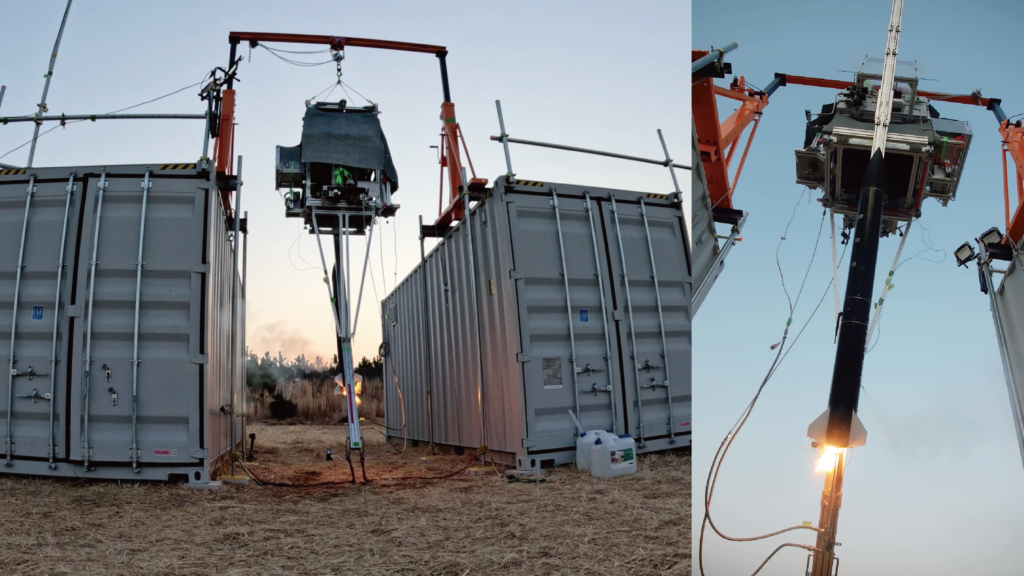
AstroX test rig at Idagawa Experimental Site. Source: AstroX
- Synspective's eighth Strix SAR satellite was launched on a RocketLab Electron [YouTube] from New Zealand on 21 March 7:10a (20 March, 2:10p ET). This launch will be followed by 19 more over the next few years, completing Synspective's planned 27-satellite constellation by 2029. The mission, called “Eight Days a Week” placed the 100kg Strix satellite into a sun-synchronous orbit of 573 km and 50.2° inclination.
- ArkEdge Space (アークエッジ・スペース) successfully deployed a demonstration maritime communications satellite, AE1a [ArkEdge], on the SpaceX Transporter 16 rideshare mission launched on 30 March. The new satellite is designed to operate as part of a three-satellite constellation to support demonstration of new technologies related to maritime communications and situational awareness. The other two satellites, AE1d and AEVa, were launched in January and June 2025, respectively. The satellites are testing features that include AIS signal collection, two-way communication, and antennas for the next generation of AIS, VHF Data Exchange System (VDES).
- Why does this matter? AIS is used by more than 300,000 vessels for ship-to-ship and ship-to-shore communications and most large ships have an AIS transponder that reports position, heading, and status information. However, the AIS bandwidth is limited and while it can support two-way text messaging, its use is limited to safety-critical and operational messages. In highly congested areas, like ports, channels, and straits, the system's capacity is often exceeded, increasing risks of collision. VDES is a major upgrade, offering wider coverage area with satellites, more bandwidth, and greater flexibility in terms of the types of data exchanged, including software updates, weather maps, ice maps, digital charts, and encrypted messaging. VDES will improve safety, help optimize maritime traffic (reducing emissions and fuel consumption), and will eventually enable uncrewed autonomous vessels to operate safely. VDES is currently expected to be required on all SOLAS-certified vessels (all passenger ships with more than 12 passengers and all cargo ships larger than 500 tons) by Jan 1, 2028 and then expanded to other ships in the following years. This will be a whole new marketplace for ArkEdge and the other firms racing to launch VDES constellations.
- JAXA confirmed the successful on-orbit demonstration of the H-SSOD [JAXA] (HTV-X Small Satellite Orbital Deployer) and the deployment of Nihon University's small satellite "Tenkoh-2" (てんこう2) from the HTV-X1 on 11 March. This was the first technology demonstration mission conducted during HTV-X1's approximately three-month post-ISS-departure phase. Integration support for the mission was provided by Space BD. This successful deployment validates HTV-X's new role as a technology demonstration platform beyond its primary cargo resupply function, opening a new commercial small satellite deployment service utilizing HTV-X's autonomous flight capability.
- JAXA also announced that the 6-satellite FY2025 deployment from the ISS Kibo module’s J-SSOD (JEM Small Satellite Deployer) was also completed in February. The J-SSOD is an attachment to the Kibo module that can spit out experimental cubesats. The most recent set included experiments from Gifu High School/University, Shizuoka University, LehmanSatSpaces, Kyushu Institute of Technology, an ESA consortium, and a Hokkaido University consortium. To date, JAXA has launched 105 satellites from the J-SSOD since 2012 [JAXA]. Like the H-SSOD, integration services are provided by Space BD.
- ElevationSpace has signed an MOU with Redwire [ElevationSpace] to explore integrating Redwire's microgravity and biopharmaceutical hardware into ElevationSpace's in-orbit demonstration and return platform. Under the agreement, both companies will share payload experiment interfaces, jointly identify research experiments suitable for ElevationSpace's recovery platform, and increase cross-industry collaboration in the biopharmaceutical sector.
- iQPS (QPS研究所) announced the launch of a joint demonstration with Nittoc Construction (日特建設株式会社) to verify the use of QPS-SAR satellite data for monitoring displacement of cut slopes and embankment faces (法面). Japan faces a growing infrastructure management challenge as aging slopes exhibit internal voids and soil erosion that cannot be detected through visual inspection alone, while budget constraints, personnel shortages, and secondary disaster risks limit conventional on-site surveys. The demonstration uses small trihedral corner reflectors (60 cm per side) installed on an embankment slope at Nittoc's "NITTOC Test Field" in Bando, Ibaraki Prefecture.
- ispace made a series of significant announcements on 27 March
- ispace published the findings of the independent External Review Task Force convened following the failed landing of its RESILIENCE lunar lander during HAKUTO-R Mission 2 on 6 June last year. The Task Force was led by co-chairs Prof. Olivier L. de Weck (MIT Apollo Program Memorial Professor) and Prof. Naohiko Kotake (Keio University/Stanford) and included input from experts at NASA, JAXA, ESA, and Draper Laboratory. The task force applied the CAST (Causal Analysis based on Systems Theory) methodology to conduct a systemic analysis beyond the initial identification of the laser rangefinder as the hardware cause. The review produced seven recommendations across three levels — operations, system development, and management decision-making. In response, ispace announced specific implementation measures including the full integration of JAXA's SLIM TRN expertise (leveraging ispace's selection under Japan's Space Strategy Fund Second Phase for "High-Precision Landing Technology in the Lunar Poles"), expansion of its Flight Operations unit into a combined Test and Flight Operations unit, and establishment of a new Technical Risk Assessment Committee for independent mission-level risk oversight.
- In part 2 of the 27 March news conference, ispace also announced the consolidation of its two parallel lunar lander development programs — the APEX 1.0 (ispace U.S.) and Series 3 (ispace Japan) — into a new unified lander model called ULTRA, incorporating an alternative engine. This decision came after Agile Space Industries' VoidRunner engine failed to meet performance specification and the delays threatened the viability of the APEX 1.0 lander mission. The replacement engine (which was not announced) apparently has a proven track record in prior lunar missions. As a result, ispace-U.S.'s first mission (formerly Mission 3 under NASA's CLPS Task Order CP-12 as part of Team Draper) has been rescheduled from 2027 to 2030 (pending NASA approval). So the next ispace lunar landing (Japan-led, METI SBIR-funded) is renumbered Mission 3 and is aiming for a 2028 launch; the Space Strategy Fund-backed high-precision polar landing mission is renumbered Mission 4 for 2029; and the former U.S. Mission 3 becomes Mission 5 for 2030. A new "Mission 2.5" has been added — a lunar orbit satellite launch targeting as early as 2027 in partnership with U.S.-based Argo Space Corp.
- Organizationally, ispace will consolidate pre-manufacturing development groups under a single global unit reporting directly to CTO Ujiie Ryo, but will maintain separate AIT (Assembly, Integration and Testing) capabilities in both Japan and the U.S. in order to o preserve regional customer flexibility.
- ispace also announced the launch of its "Lunar Connect Service," a new commercial initiative to build a lunar-orbiting satellite network to provide communications, positioning, observation, and Space Situational Awareness (SSA) services to cislunar economy stakeholders. The company plans to deploy at least five lunar orbiting satellites by 2030, with the first satellite targeted for lunar orbit insertion as early as 2027 (designated Mission 2.5) via an agreement with U.S.-based Argo Space Corp. for transportation. ispace has also entered into an agreement with KDDI to jointly develop ground station that support the planned service offering. The Lunar Connect Service will comply with NASA/ESA/JAXA's LunaNet international lunar communications and positioning standards to ensure interoperability with multinational constellation initiatives.
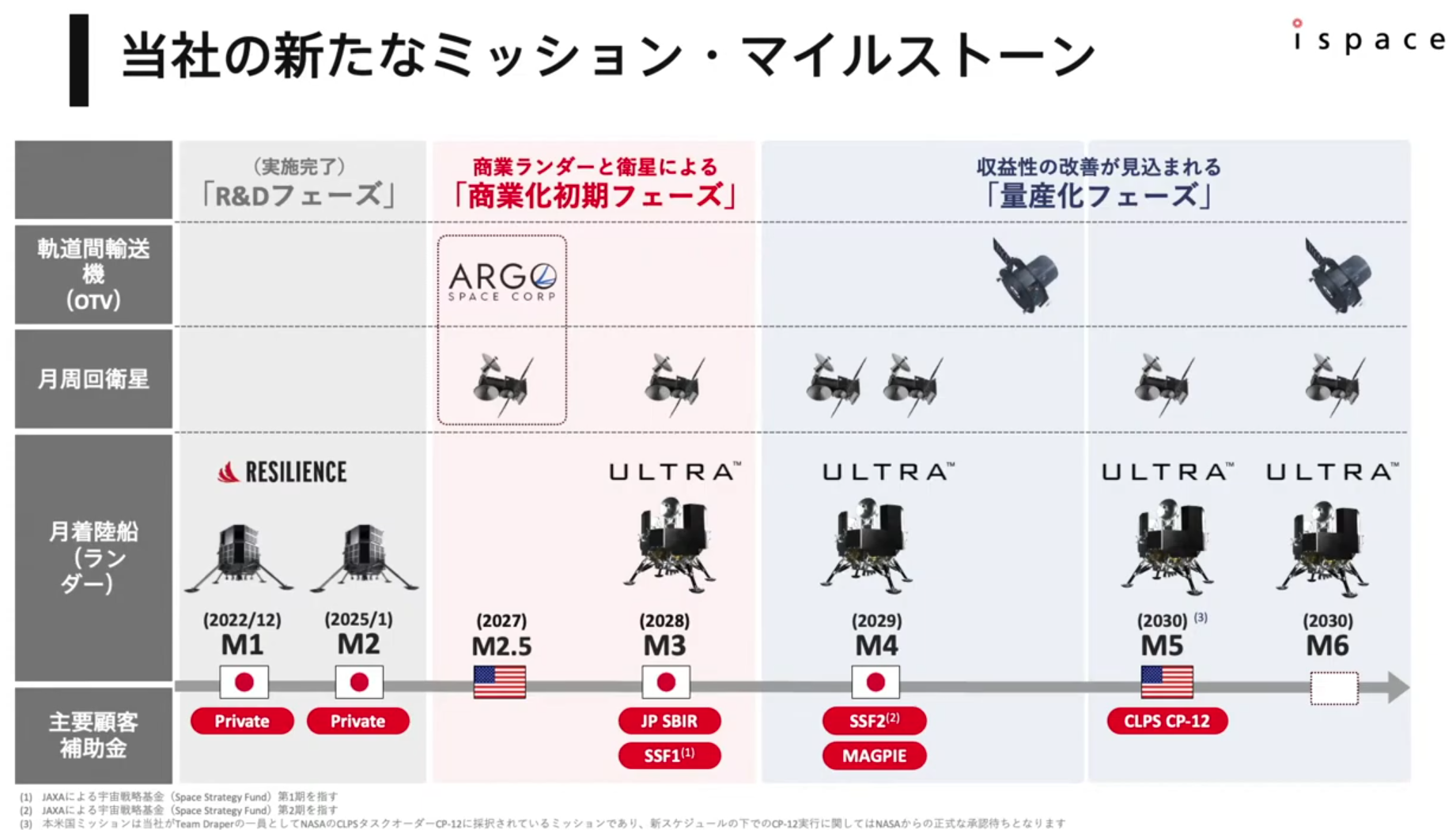
Revised ispace lunar lander milestone schedule. Source: ispace
- Japan LEO Shachu, a public private venture backed by MHI and Mitsubishi Electric, completed the System Definition Review (SDR) [Japan LEO Shachu] for both an Japanese Low Earth Orbit (LEO) module for a future space station and a future version of the HTV-X cargo vessel called HTV-XC. The SDR process validates overall system design philosophy, key specifications, system architecture, interface definitions, and verification approaches against mission requirements. With the SDR complete, the next step will be the Preliminary Design Phase, in which each subsystem's basic design will be refined and key interfaces, functions, and performance specifications will be finalized.
- Why does this matter? This work is aimed at enabling Japan to play a key role in a future low-Earth orbit economic zone centered on commercial space stations after the ISS de-orbited.
- Ocean Eyes is rolling out two new paid premium features for its OEView [Ocean Eyes] marine conditions app. "Bigeye Tuna Map" (メバチマグロマップ) highlights sea areas with high fish aggregation potential, and "Hazard Map" (危険度マップ), displays dangerous or high-risk sea areas on a map based on wind, wave, and ocean current data, providing safety-first navigation support for fishers before departure.
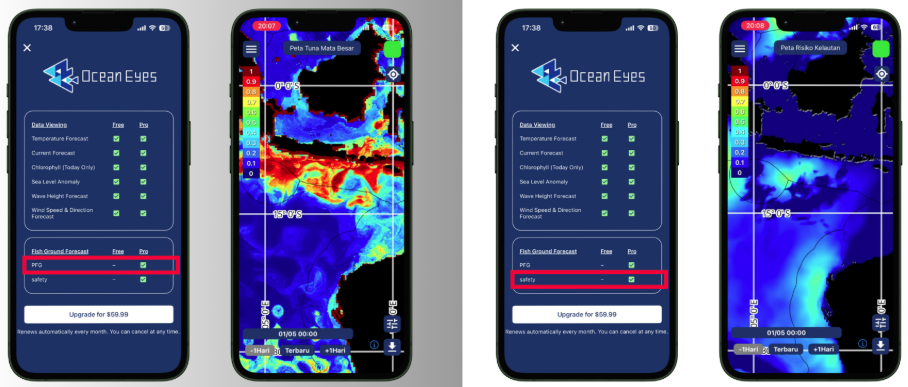
Screensshots of new tuna hunting and hazard mapping features. Source: Ocean Eyes
- Sakana AI wrapped up a research project [Sakana AI] for Japan's Acquisition, Technology and Logistics Agency (ATLA) Defense Innovation Research Institute focused on developing an integrated AI system capable of processing large volumes of multimodal data generated across land, sea, and air domains, including drones. A key technical deliverable was a Small Visual Language Model (SVLM) optimized for high-speed operation on edge devices with limited compute capacity (like drones or mobile terminals) enabling rapid autonomous situational awareness and information organization in the field.
- Why does this matter? Sakana AI is one of Japan’s AI leaders. While it might be considered a frontier AI model research lab, it operates on a much smaller scale than Open AI, Anthropic, and Google, and has focused on developing specific applications of AI to industry. This contract marks a significant expansion of Sakana AI's defense and intelligence vertical, which the company has identified alongside financial services as a priority sector. A dedicated domestic defense team has been assembled to implement the company's cutting-edge AI research in operational defense contexts.
- Japan's Ministry of Defense (JMoD) (防衛庁) formally stood up the Japan Air Self-Defense Force's new "Space Operations Corps" (宇宙作戦団) at Fuchu Air Base on 28 March 28, upgrading the former Space Operations Group in a ceremony. The new Corps has more than doubled in size from 310 to 670 personnel and it now focuses on Space Domain Awareness (SDA), including collision avoidance with debris, tracking of suspicious satellites, and assessment of adversarial counter-space capabilities. Another reorganization is planned for FY2026, which will rename the Air Self-Defense Force (JASDF) as the "Aerospace Self-Defense Force" (航空宇宙自衛隊) and establish a new "Space Operations Command" (宇宙作戦集団).
- Why does this matter? This is more than a name upgrade. WIth potential adversaries like Russia and China demonstrating more aggressive behavior by by naval, air, and space forcees, Japan’s moves to upgrade the importance of its space-related defense functions mirrors similar moves across all of the advanced democracies with space defense resources.
💱 Contracts
- Astroscale UK has contracted a launch vehicle for its ELSA-M spacecraft that will deorbit a OneWeb satellite. And the winner is... Isar Aerospace. Isar is a curious choice as the first launch of their Spectrum rocket in March 2025 failed 30 seconds into the flight. They are gearing up for their second Spectrum launch, but attempts in March and April were both scrubbed and the next attempt has been delayed until at least May. I imagine Isar will need some time to fully demonstrate launch capability to LEO. However, Isar has developed a highly automated manufacturing process and once it can nail the launch, it will likely be able to scale up quickly. Astroscale is a global leader in the rendezvous proximity operations (RPO) necessary to approach and deorbit dead satellites, rocket parts, and other debris. For the ELSA-M mission the Astroscale spacecraft will attempt to approach, dock, de-orbit, and release a defunct Eutelsat OneWeb satellite as part of a broader effort to reduce debris in low Earth orbit (LEO). The UK Space Agency and ESA are funding part of the mission, but Astroscale is putting up much of the funding necessary to support it.
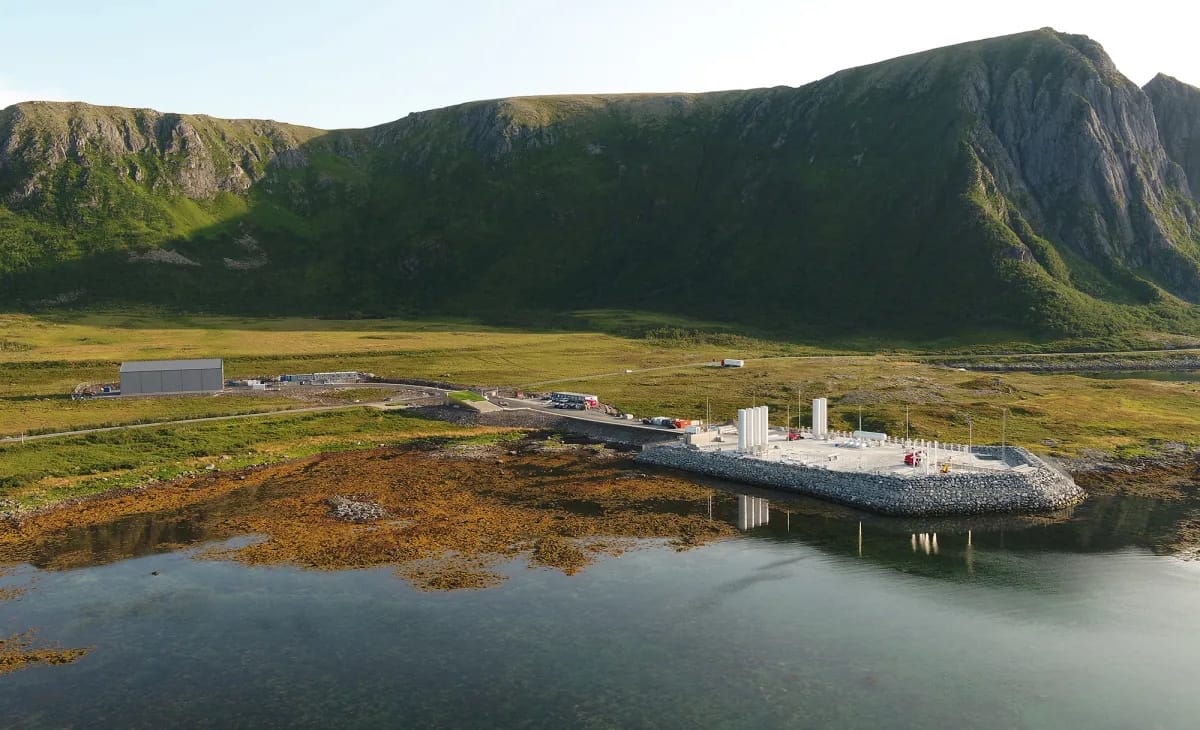
Andøya Spaceport, Norway. Source: Andøya Space
- Astroscale has signed an MOU with Sumitomo Mitsui Finance and Lease (SMFL) and its subsidiary SMFL Mirai Partners to explore the development of a satellite leasing and secondary-use market [SMFL]. SMFL and Astroscale aim to combine satellite leasing with on-orbit servicing – debris removal, inspection, life extension/refueling, and in-orbit manufacturing/repair – to develop joint service offerings that would reduce barriers to entry for new space industry participants.
- Synspective has signed a data distribution agreement with NSG UP42, Saudi Arabia’s leading commercial space services provider. This will provide expanded access to new market for Synspective’s SAR data. ispace recently announced a new Saudi subsidiary as well.
- Space Compass has signed an agreement with Swissto12 to provide a small geostationary satellite based on its HummingSat platform that will serve as a hub for a new optical data satellite communications service. Space Compass is a joint venture of NTT and Sky Perfect JSAT aimed at making the new optical network available by 2030. Weather and other EO satellites in LEO would use the geostationary satellites as a relay for transmitting data to the ground far more rapidly than they could by using radio signals directly to the ground.
- Axelspace is involved in three consortia that have been selected for Space Strategy Fund (宇宙戦略基金) projects:
- Under the "Technology to Enhance Observational Capabilities for Next-Generation Earth Observation Satellites" (次世代地球観測衛星に向けた観測機能高度化技術); Axelspace will advance sensor and imaging technology development for future generations [Axelspace] of its small EO satellite constellation. The project will focus on CO2 emissions and absorption monitoring using satellites and passenger aircraft. The other team members include Myojo Electric, ANA Holdings, and JIJ Corporation.
- A consortium led by RESTEC and including Axelspace, PASCO, New Space Intelligence (NSI), and Synspective was selected under the topic "Implementation Acceleration of Satellite Data Utilization Systems" (衛星データ利用システム実装加速化事業). Axelspace’s part of the work will focus on calibration, validation, and correction methodologies for optical sensors (see RESTEC note below for more on the project).
- A four-organization consortium led by Cross U (クロスユー) and including Axelspace, Double Feather Partners, and ENKOPA Lab was selected for a project supporting innovative financial mechanisms (衛星データ×金融スキーム) to address social challenges in African nations. This marks a strategic expansion of Axelspace's existing Africa-oriented satellite data business.
- RESTEC landed two Space Strategy Fund awards:
- Develop and deploy new methodologies for evaluation, calibration, validation, and correction (Cal/Val) of domestic small EO satellites. RESTEC will lead a consortium that includes PASCO, New Space Intelligence (NSI), AxelSpace, and Synspective. The work will address inter-satellite hardware variability and temporal degradation that impede consistent data quality across small satellite constellations with workstreams that include (1) unified quality evaluation methodologies optimized for small satellites; (2) cross-satellite calibration and correction for multi-source composite use; (3) adaptation of large-satellite Cal/Val techniques to small satellites; and (4) development and publication of user/operator guidance documents. The initial phase of the project will run through September 2030.
- Build a high resolution geospatial foundation AI model to improve administrative efficiency in local government (mapping fixed assets for tax assessment). They’ll work with AeroToyota.
- iQPS (QPS研究所) signed a contract with Japan's Ministry of Defense (JMoD) under the program "Advance Demonstration of Common Key Technologies Required for Utilization of the Space Domain" (宇宙領域の活用に必要な共通キー技術の先行実証), valued at ¥751 million (~US $5 million) running 2026 - 2029. This contract is a follow-on to a previous award for prototype satellite development under the same program, and covers the on-orbit demonstration of a satellite that iQPS is developing and manufacturing.
- ispace and South Korean space robotics company Unmanned Exploration Laboratory (UEL) signed a Payload Service Agreement (PSA) [ispace] to transport UEL's SCARAB two-wheeled, 2-kg class micro-rover to the lunar surface aboard ispace's new ULTRA lunar lander as part of Mission 3 (targeted for 2028). The mission would mark the first Korean-developed rover to operate on the Moon's surface, highlighting growing commercial aerospace collaboration between Japan and Korea. The SCARAB rover is designed to acquire image data during the lunar day, generate 3D imagery of the lander in a "lander-selfie rover" configuration using two cameras, and accommodate up to 200g of additional payloads via an internal bay.
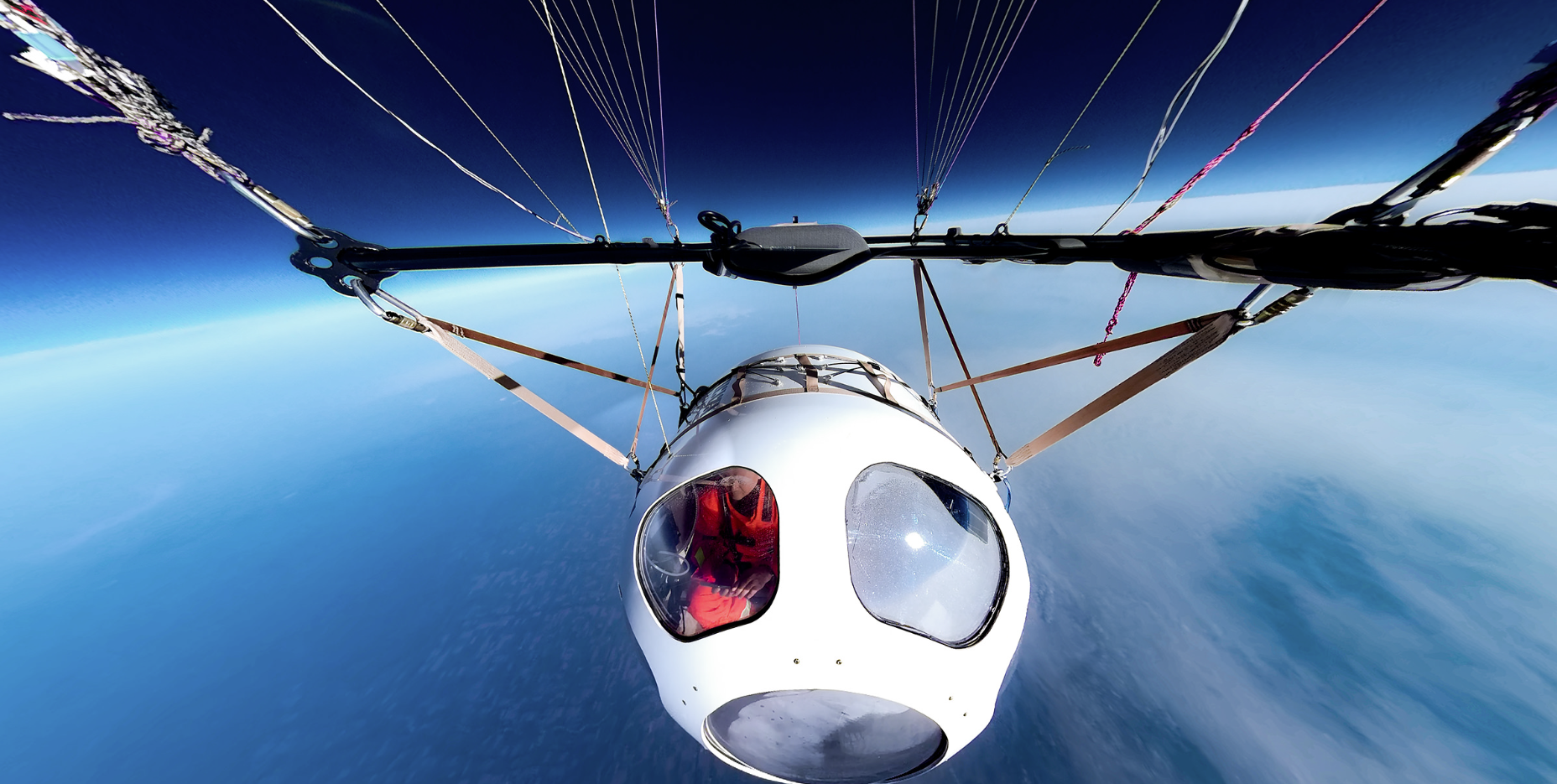
- Iwaya Giken (岩谷技研), a Hokkaido-based company developing commercial crewed stratospheric balloon flights was selected for a JAXA's Space Strategy Fund award to develop a proposed "Universal Pressurized Cabin System for Crewed Spacecraft". This is a direct evolution of the pressurized cabin technology it has been developing for a “space tourism” offering that would use suborbital rocket-launched crewed vehicles. The other partners on the project are Shin Nihon Air Technologies, Japan Airlines (JAL), and Mitsubishi Heavy Industries (MHI). Iwaya Giken is also slated to support two related JAXA-funded projects on anomaly detection/emergency evacuation and safety visualization and detection technologies.
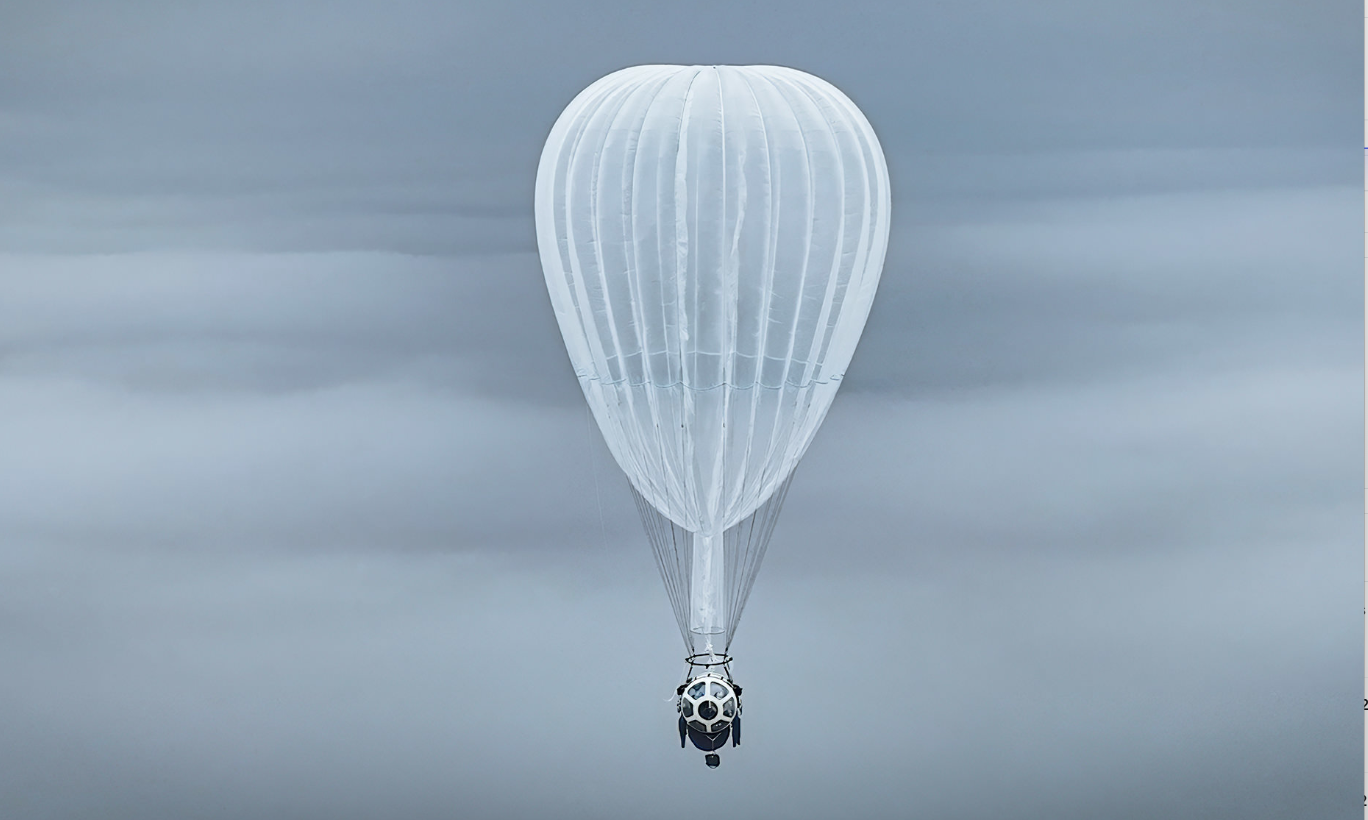
Iawaya Giken stratospheric balloon. Credit: Iwaya Giken
- The Ministry of Education, Culture, Sports, Science and Technology (MEXT) announced the results of its SBIR Phase 3 stage-gate evaluation for the "Development and Demonstration of Private Rockets" theme [SpaceConnect], advancing two of three companies from Phase 2. Interstellar Technologies (IST), with its liquid methane-fueled small satellite launch vehicle ZERO was awarded a Phase 3 grant with a funding ceiling of ¥7.37 billion (~US$ 50 million). Interstellar received high marks for its partnership with Toyota for mass-production know-how and its strong risk management culture. Space One, with its enhanced liquid methane upper stage for its Kairos rocket, received a Phase 3 award with a ceiling of ¥4.46 billion (~ US$ 30 million). Innovative Space Carrier (ISC), developing a reusable small-satellite launch system, did not advance to Phase 3 but was granted a Phase 2 timeline extension.
- Asia Air Survey and Adsol Nissin Co announced a partnership aimed at advancing digital twin-based smart city development. The two companies have collaborated since 2013 on GIS systems for forestry, disaster prevention, rail, and energy sectors. The new partnership will combine Asia Air Survey's aerial survey and spatial data expertise with Adsol Nissin's GIS, AI, IoT, and satellite data capabilities to build a “Smart City Integrated Platform Service” or "Urban OS" by leveraging 3D and spatial-temporal data aligned with Japan's national PLATEAU 3D urban model initiative. The integrated platform will support real-time urban infrastructure monitoring, traffic and pedestrian flow optimization, disaster risk management, urban planning, and environmental monitoring. Once establishing a domestic market, they plan to expand internationally.
- ispace has signed a Payload Service Agreement (PSA) with the University of Leicester valued at GBP 3 million (~¥ 647 million) to deliver a Raman Spectrometer designed to characterize regolith to the lunar surface.
💴 Equity Funding
- Kick Space Technologies Co., a space startup spun out of Kyushu Institute of Technology (KyuTech), has raised ¥60 million (~US$ 387K) via J-KISS convertible notes [Space Media] from venture capital firms and other investors. Founded in July 2025, the company provides mission design, satellite engineering, testing, and operations services for small satellites, as well as hardware and software products.
- Japanese telecom firm KDDI participated in a seed funding round of Sophia Space [Sophia Space], a U.S. orbital computing startup. Sophia is developing TILE, a modular in-orbit computing platform for AI and other data-intensive workloads.
- Solafune has raised US $30 million in Series A funding to support international expansion and development of its integrated intelligence platform that combines satellite and geospatial intelligence with open source and signals intelligence. The funding is a mix of new capital and debt financing with the capital investment led by Globis Capital Partners and joined by Boost Capital, Rice Capital, GREE Ventures, Mitsubishi UFJ Capital, Mizuho Capital, Resona Capital, Chiba Dojo Fund, and others. The debt component is from Mizuho Bank, MUFG Bank, Sumitomo Mitsui Banking Corporation, and others.
- Solafune's primary clients have been Japanese government defense, policing, and intelligence agencies as well as foreign governments and international development agencies in Africa. They see opportunities for expansion in Southeast Asia, South America and the Middle East, continuing their focus on the Global South. They have also operated a series of satellite imagery data analysis competitions that attract hundreds of participants each and focus on developing new models and algorithms.
- QPS Holdings, the parent company of iQPS will issue new shares via third-party allotment to three strategic investors: SKY Perfect JSAT Corporation (スカパーJSAT), Mitsuiwa Corporation Group Holdings (ミツウロコグループホールディングス), and Mitsui Sumitomo Insurance Co., Ltd. (三井住友海上火災保険). This new capital raise is intended to fund satellite manufacturing and launch costs toward the company's goal of building a 36-satellite QPS-SAR constellation by 2030. iQPS currently operates 9 SAR satellites as of March 2026. The financing builds on existing funding from a JAXA Space Strategy Fund grant of up to ¥21.2 billion, and approximately ¥8 billion raised through a new share warrant issuance to SMBC Nikko Securities.
- Kokusai Kogyo and ZENRIN are making new investments in Satellite Data Services Co. (衛星データサービス株式会社), which will begin operating as a standalone operating company in April 2026. Existing investors include a bunch of heavy hitters: Mitsubishi Electric, ID&E Holdings, MUFG, PASCO, Asia Air Survey, SkyPerfect JSAT, and RESTEC. SDS will offer satellite remote sensing data analysis services for national land management, disaster situational awareness, agricultural and building monitoring, and climate change-related impacts.
- Orbital Lasers, a space laser and optical technology startup founded in 2024 as a spin-out from SKY Perfect JSAT, has closed a Series A funding round of ¥3.02 billion (~ US $20 million) through a third-party share allotment and J-KISS convertible equity, bringing total equity raised to ¥3.92 billion (~US $26 million). The round was backed by nine investors including SPARX Asset Management, JIC Venture Growth Investments, Mitsubishi UFJ Capital, Mizuho Capital, SMBC Venture Capital, and SKY Perfect JSAT. The funds will be used for development of three technologies: high-performance laser transmission, high-resolution photon reception, and optimized satellite bus systems. The firm also has an R&D contract with JAXA for design and prototyping of a compact satellite LiDAR system, and a contract with JMoD to develop space laser range finding technology for on-orbit monitoring and defense of domestic satellites.
- Space Data (株式会社スペースデータ) has created a new division, SPACEDATA INVESTMENT(スペースデータ インベストメント), focused on partnerships, investments, and acquisitions in existing terrestrial industries that have technology relevant to the space industry. This represents a bit of a strategic pivot toward financial and corporate development tools as a mechanism to accelerate the commercialization of space technology. Space Data did not disclose fund size or other financial details.
🔭 Science
- JAXA astronaut Furukawa Satoshi retired at the end of March. After being selected as an astronaut by JAXA's predecessor, NASDA, in 1999, he flew on ISS missions in 2011 and 2023-24, accumulating a full year in space. Furukawa originally trained a medical doctor, and he will become a professor at Kyorin University School of Medicine (杏林大学医学部). JAXA held a final press conference with Furukawa [YouTube] to commemorate his retirement.
- A research team at Tokyo Metropolitan University and the National Astronomical Observatory of Japan used data from the ESA’s now retired Gaia satellite [Wikipedia] to study the thousands of so-called “solar twins” [Space.com] – stars with similar age and other characteristics – within 1,000 light years of the Solar System. They found a cluster of 1,551 stars with similar ages of 4 - 6 billion years. Previous research has suggested that our sun was born more than 10,000 light years closer to the galaxy’s center and then migrated outward to its current position. The new research suggests that our sun may be part of a larger group of stars that migrated away from the galactic core around the same time. Because the inner regions of the galaxy are thought to be far more hostile to life, the migration away from the center may have been a factor enabling life to safely form on Earth. The Gaia satellite program plans a much larger release of data later in 2026, and this team plans to continue the research with this more extensive data set.
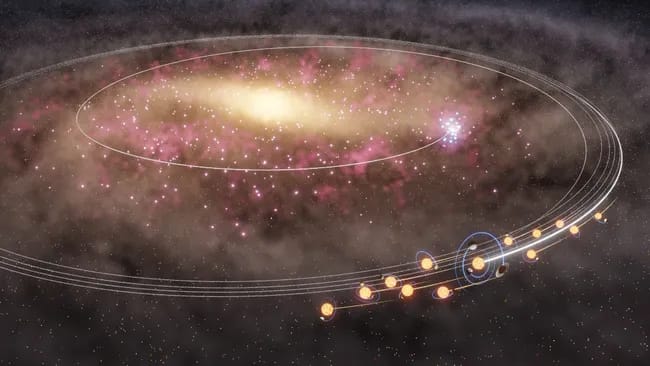
Stars similar to our sun migrated as a group from from the center of our galaxy, approx. 4 - 6 billion years ago. Source: National Astronomical Observatory of Japan
🗺️ International Collaborations
- ispace signed an agreement with GISTDA, the Thailand space agency, to carry out a feasibility study for a life-sciences payload [ispace] to be transported to the lunar surface on a future ispace lander.
- Japan and France are increasing their space defense ties [NIkkei Asia]. The head of French Space Command, Major Gen. Vincent Chusseau, visited Japan in mid-March and met with the Japan Ministry of Defense, the Self-Defense Forces, and the Air Self-Defense Force's Space Operations Group to discuss future cooperation. Japan's Space Operations Group defense unit operates from within the Air Self-Defense Force. The number of personnel allocated to the unit has been growing rapidly, from 310 to 670 in FY2025 and to 880 people in FY2026.
- Why does this matter? Among the European countries, France probably has the most sophisticated space defense system with both military reconnaissance and communications satellites. Japan operates its own space-based defense communications and reconnaissance infrastructure that is comparable in extent and ambition. Both nations also have complex, mature aerospace industrial capacity, and there are plenty of opportunities to collaborate and carry out joint training and development. I view this as part of both governments’ efforts to diversify their alliance relationships and be less reliant on the United States.
- Following the visit from French Space Command, a summit between Prime Minister Takaichi and French President Macron featured another rare earths collaboration deal and several space-related announcements. Japan got the memo on rare earths vulnerability more than 15 years ago and had been pursuing mining, processing, and recycling initiatives since then. France has access to rare earth ores but, like most countries outside China, doesn't have the refining capacity. Japan will work with France on a public-private venture aimed at building a refining facility in southwest France with the goal of beginning operations by the end of 2026. The space-related deal announcements included:
- IHI Aerospace and ArianeGroup signed an MOU to jointly operate a land-based monitoring station at IHI's site in Aioi, Japan. The station will use three optical sensors to observe, track, and analyze objects orbiting the Earth -- both debris and satellites -- to enhance space situational awareness.
- PASCO and Airbus will deepen their long-standing cooperation on satellite data.
- Astroscale and French satellite maker, Exotrail, signed a contract to carry out a deorbiting mission.
- JAXA and CNES, France's space agency, will provide funding to companies that participate in joint Japan-France space technology development projects.
- ispace and Thailand's national space agency GISTDA (Geo-Informatics and Space Technology Development Agency) signed an MOU to study the feasibility of a Thai-developed life-science payload to be delivered to the lunar surface. GISTDA will lead project planning, execution, and evaluation, while ispace will provide technical interfaces between the life-science payload and its lunar lander. The project aims to advance Thailand's participation in the Artemis Program. The agreement builds on a prior MOU between ispace, GISTDA, and mu Space.
🎥 Videos
JAXA
- Space Strategy Fund Year 3 Information Session - https://www.youtube.com/watch?v=F1ULnBWMT0A
- H3 Rocket Captive Fire Test
- Furukawa Satoshi astronaut retirement press conference [Japanese]
📝 Reports and Datasets
- RESTEC released some reports:
- Technical Report: ESA Copernicus/Sentinel [Japanese]
- Case Study: Yamaguchi/Hofu Satellite-based Parcel Inspection Field Surveys [Japanese]
- Case Study: Gifu Prefecture used AI-based satellite image analysis to reduce administrative burned of surveying crop planting conditions for subsidy allocation under the Agricultural Income Stabilization Policy and reducing on-site visits by 80-90% [Japanese]
- Weathernews launched a new Maritime Weather Dataset API [English] [Japanese], targeting the global shipping market. It is based on a new proprietary Global Meteorological & Wave Prediction System that achieves approximately 23% improvement in significant wave height forecast accuracy, outperforming both the European Centre for Medium-Range Weather Forecasts (ECMWF) and the U.S. National Centers for Environmental Prediction (NCEP). The new system ingests more than 80 ensemble forecast scenarios from major meteorological agencies worldwide and fuses them with weather satellite data and Weathernews' proprietary onboard vessel observation data, delivering 0.125-degree grid (~10–15 km mesh) forecasts for wind, waves, currents, sea ice, and tropical cyclone tracks at up to 15-day lead times with 6-hourly update cycles. The API dataset includes two packages: 1) Meteorological & Oceanographic Data covering ~2,300 major global ports and open-ocean routes; and 2) Voyage Data, available only to operators using the company's SeaNavigator weather-routing platform (which includes route performance, fuel consumption, CII/CO₂ emissions metrics, charter-party warranty assessments, and voyage simulation outputs).
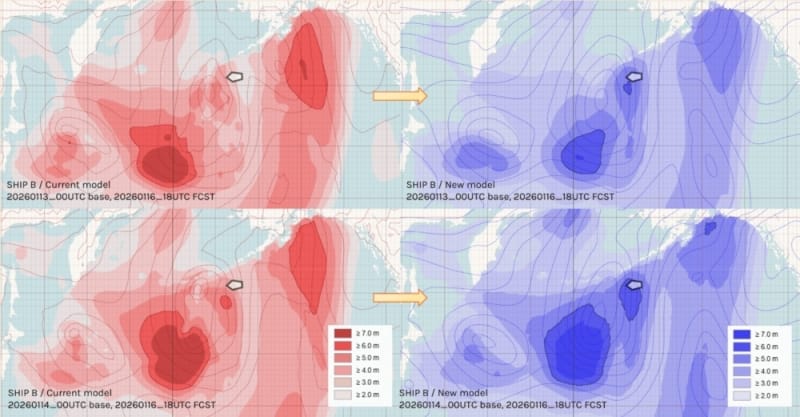
Wave height forecasts before (left) and after (right) improved by 23%. Source: Weathernews
📆 Asia-Pacific Conferences & Events
This newsletter is mostly focused on Japan, but I also like to highlight events across the Asia-Pacific region. Some upcoming conferences in 2026 include:
May 2026
- Asia-Pacific Regional IAU Meeting (APRIM) - 4 - 8 May - Hong Kong, China
- Asia-Pacific Satellite International Conference - 12 - 13 May - Jakarta, Indonesia
- Global Space and Technology Convention & Exhibition (GSTCE) - 13 - 14 May - Singapore
- International Symposium on Remote Sensing (ISRS) 2026 - 13 - 15 May - Matsue, Shimane-ken, Japan
- JAXA Space Strategy Fund Commercial Crewed Spaceflight LEO Workshop (商業有人低軌道ワークショップ)- 14 May - Nihonbashi, Tokyo, Japan (hybrid)
- CommunicAsia 2026 - 20 - 22 May - Singapore
- Geo-Space Bharat 2026 - 21 - 22 May - Ahmedabad, Gujarat
- SatelliteAsia 2026 (at Asia Tech x Singapore (ATxSG)) - 20 - 22 May - Singapore
- Japan Geoscience Union (JpGU)-AGU Joint Meeting 2026 - 24–29 May - Chiba, Japan
- 3rd SPEXA Space Business Expo (宇宙ビジネス展) - 27 - 29 May - Tokyo, Japan
June 2026
- Indo Pacific GeoIntelligence Forum - 2 - 3 June - New Delhi, India
- 4th China Digital Earth Conference - 6 - 8 June - Qingdao, China
- 10th Shanghai International Aerospace Technology and Equipment Exhibition (AIREXPO SHANGHAI 2026) - 10 - 12 June - Shanghai, China
- Australian Space Summit and Exhibition - 17 - 18 June - Sydney, Australia
- 58th Fluid Dynamics Conference / 44th Aerospace Numerical Simulation Symposium (第58回流体力学講演会 /第44回航空宇宙数値シミュレーション技術シンポジウム) - 24 - 26 June - Tottori, Japan
- Aeromart Hyderabad - 29 June - 1 July - Hyderabad, Telangana
July 2026
- SPACETIDE 2026 - 6 - 9 July - Tokyo, Japan
- IEEE Space 2026 - 19 - 21 July - Bengaluru, India
- 19th Australian Space Forum - 21 - 22 July - Adelaide, Australia
If you’ve made it this far, thank you for reading. Please be in touch via LinkedIn with any feedback, questions, comments, or requests for future topics. And if you have a friend or colleague that you think would enjoy JEO, please share it!
Until next time,
Robert
I would like to be born
a person as small
as a violet.
–- Natsume Sōseki (1867–1916) - translated by R.H. Blyth
すみれ程
な小さき人に
生れたし
Sumire hodo
na chiisaki hito ni
umaretashi