JEO 21 - News Roundup - 23 Sept 2026
Topping this news roundup, H3 Flight 9 launches QZS-7, Sarmony disc satellites, and an experimental CRAFT project, plus the usual funding and contract announcements, science, international collaborations, and conferences.
Welcome to Japan Earth Observer (JEO), a monthly newsletter about the space, Earth observation and geospatial industries in Japan.
Topping this news roundup, H3 Flight 9 launches QZS-7, Sarmony disc satellites, and the experimental CRAFT project, plus the usual funding and contract announcements, science, international collaborations, and conferences.
On to the news…
News & Announcements
H3 Flight 9 Launches QZS-7
H3 Flight 9 launched from Tanegashima early on Tue, August 11 putting the QZS-7 (Michibiki-7) satellite into a transfer orbit (GTO) that will enable it to reach geosynchronous orbit. The satellite will raise its orbit over roughly two weeks to geostationary orbit (~36,000 km). After provisioning, service is expected to start in approximately 6-7 months.
This launch was a big deal. It was not only the first launch after return-to-flight of the H3 in June, it was another major component on Japan’s journey to GPS self-sufficiency. JAXA is also highlighting the Advanced Satellite Navigation (ASNAV) system that it will support. The QZS-6 satellite, launched in early 2025, also had an ASNAV antenna as a demonstration. The ASNAV antenna supports augmented positioning signals.
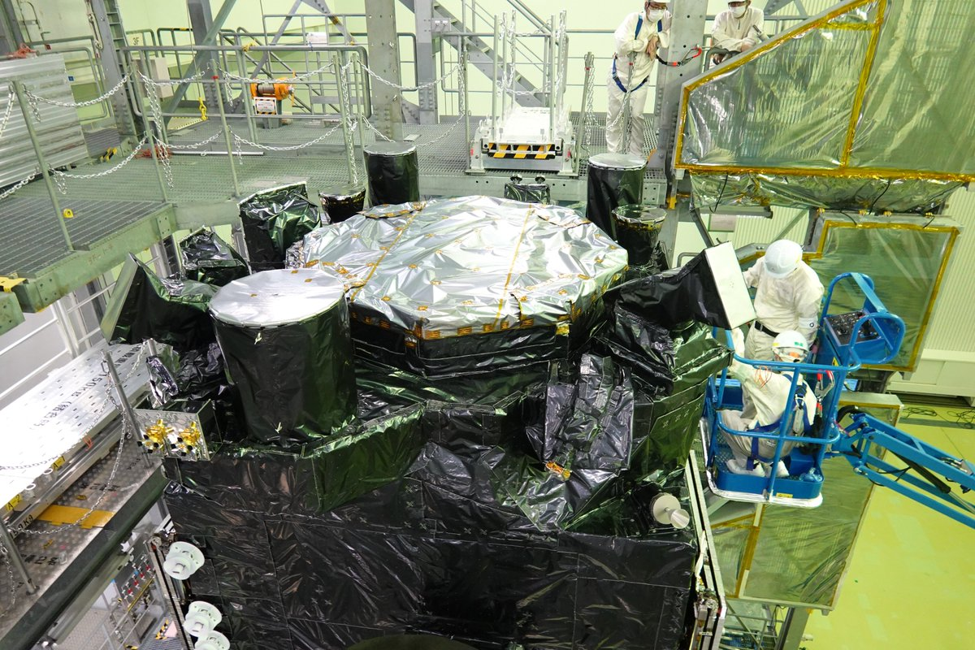
QZS-7 being prepared for launch. Source: JAXA
QZS-6 and QZS-7 are sister satellites in other ways. Both are based on the highly efficient Mitsubishi Electric DS2000 satellite bus. This bus uses "gridded electrostatic ion engines" running on Xenon gas for small adjustments and chemical thrusters for both orbital insertion and larger orbital adjustments.
QZS-7 also carries a U.S. Space Force camera called SACHI - Space Awareness Camera Hosted Instrument. The camera was developed by MIT Lincoln Laboratory for the U.S. Space Force. The camera functions as a passive search sensor designed to track objects and monitor satellite behavior in GEO orbit. Data captured by the camera is securely transmitted to Schriever Space Force Base in Colorado Springs and shared with Japan. Like the ASNAV, the same camera was also launched on QZS-6.
QZS-6 and QZS-7 have different orbits from the other QZS satellites. QZS 1 to 4 were in highly inclined figure 8 orbits over the Asia Pacific. QZS-6 operates in a Geostationary Orbit (GEO) with an inclination of 0 degrees and sits parked over the equator at the 90.5° East longitude slot. QZS-7's orbit is similar but slightly different. It has a Quasi-Geostationary Orbit (QGEO) at 185° East (175° West) longitude, but it effectively remains over the same region.
The satellites get all of the attention, but the ground segment is equally important. The QZSS ground segment is built for significant redundancy and distributed geographic tracking across East Asia and the Oceania regions, including monitoring stations in Guam, Canberra Australia, Bangalore India, Bangkok Thailand, Hawaii, and in Japan, a telemetry station at JAXA headquarters in Tsukuba and a telemetry, tracking, and command (TT&C) station in Okinawa.
One of Japan's goals with the QZSS is to both increase positioning accuracy and to remove its dependency on the U.S. GPS system. This would require a minimum of 7 satellites - 5 in QZO orbit and 2 in GEO orbit; this would enable at least 4 satellites to always be in range.
The loss of QZS-5 in the December launch failure has been a major setback. The three 3rd generation satellites - QZS-5, QZS-6, and QZS-7 - introduced a "Precise Ranging Payload" (PRP) Architecture - which enabled Inter-Satellite Ranging (ISR). This meant that the satellites would be able to ping one another to automatically measure distances and calculate clock drift autonomously in space. QZS-5 was designed to be the primary emitter/source of the tracking signals, which QZS-6 and QZS-7 would receive. Without QZS-5 acting as the anchor for these pings, the system is fundamentally compromised and will have to wait for a replacement spacecraft to be fully operational.
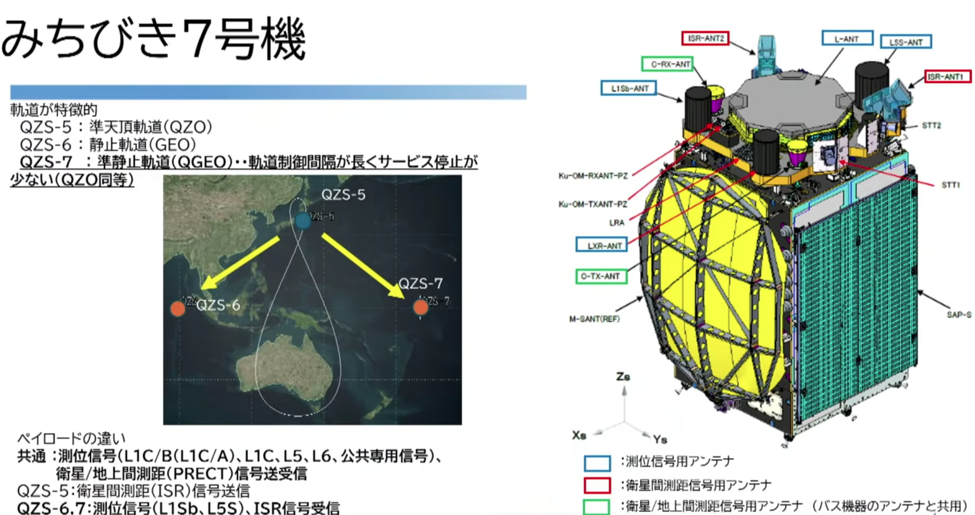
QZS-7 satellite antenna layout and deployment diagram. Source: JAXA
From 7 to 11. Japan had already taken the decision to expand to an 11-satellite architecture by the 2030s in order to add significant redundancy. JAXA must now build a replacement QZO satellite to fill the void left by QZS-5 before they can build toward the 11-satellite timeline. In the meantime, QZS-3 will also need to be replaced. At the press briefing last week, the Cabinet Office estimated completing QZS-8 will take 5 years, delaying a 7-satellite constellation until 2031. But presumably, Mitsubishi Electric will start concurrently building enough satellites for the full 11-satellite constellation, so once the first one is done, the others can follow more quickly. In the meantime, the Japanese government will make some minor tweaks to the positioning of the QZSS satellites in order to mitigate a bit of the impact of the missing QZS-5 satellite.
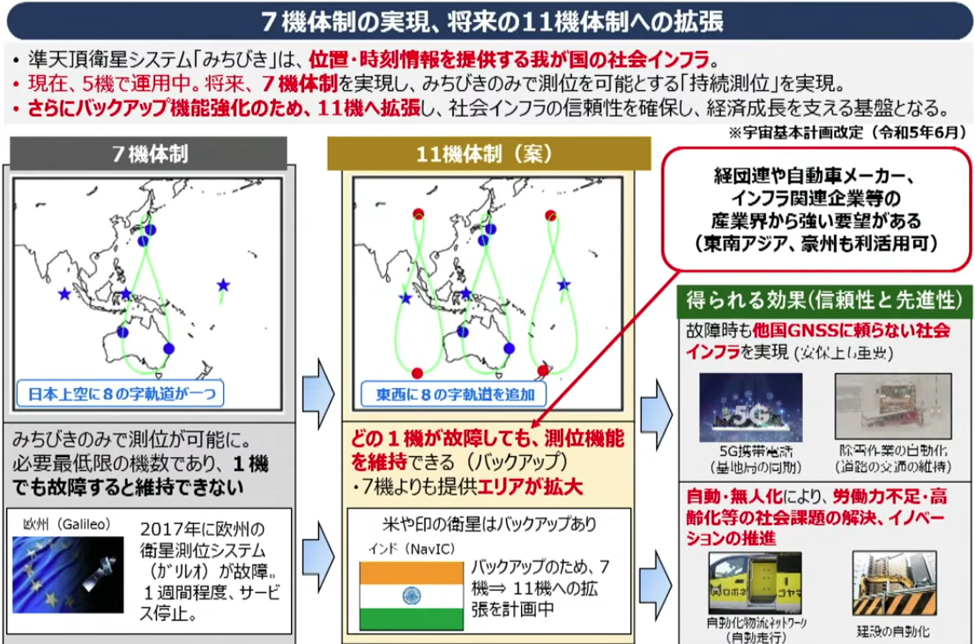
Configuration change from 7-satellite system to 11-satellite system. Source: JAXA
Sarmony signs Space One KAIROS to launch SAR demo
Sarmony is a Japanese startup started in August 2025 that is developing compact X-band SAR satellites for operation in very low Earth orbit (VLEO) of 300-350km using a new SAR DiskSat technology that reduces costs while providing high resolution and wide observation swaths. Sarmony wants to build a SAR constellation with global coverage, and they have received a huge tranche of funding from the Japanese government to help them do it: a ¥12 billion (~US $75 million) Space Strategy Fund award in March this year. The deal with Space One aims to launch the demo satellite on the KAIROS rocket in 2028 and then a second demonstration satellite in 2030 before beginning to build out its planned 48-sat constellation. Of course, that means the KAIROS rocket has to make it to orbit, which is still a work in progress.
A note about the satellite bus. DiskSat is a new satellite bus being developed by The Aerospace Corporation, a U.S. company that has received its own subsidies from NASA and the U.S. Space Force. The flat design aims to reduce cost and enable more satellites to be launched on a single flight. The thin disk design means that it can be flown edge-on and have much lower atmospheric drag than a conventional boxy or cylindrical satellite. This will be particularly important for the VLEO orbital configuration Sarmony is proposing. Further, the flat size maximizes surface area for solar panels and each satellite can deliver 200W of power. The disc-shaped satellites are loaded into a mechanical dispenser before launch and then ejected one at a time into orbit. Up to 20 such DiskSats can be loaded on a small launch vehicle such as Rocket Lab's Electron (or the proposed KAIROS launcher). This is not a new approach as Starlink satellites are also a flatpak-ed design and are similarly stacked for loading onto a SpaceX Falcon 9 or Starship.
The DiskSat technology was developed in collaboration with NASA and U.S. Space Force [NASA] and four demonstration satellites were successfully sent to orbit in December 2025. Sarmony is licensing the technology from The Aerospace Corporation and adapting it significantly to create the "SAR DiskSat" design and will manufacture the new satellites in Japan. The basic DiskSat design is only a little over a meter in diameter. Following launch and orbital insertion, SAR DiskSat will unfold a larger 0.9-meter by 3.6-meter flat planar radar array. Sarmony has developed a unique antenna deployment mechanism as well, what they call "flat passive slow array antenna". The design reduces the number of moving parts as well as RF interference. Further, while the SAR antenna is on one side of each panel, solar cells can be mounted to the opposite side, increasing the power supply of the satellite. Sarmony outlines the details of their approach in a paper delivered at this year's Small Sat Conference [Digital Commons] and suggests they can achieve an X-band SAR antenna capable of 100km swaths and 1.2Ghz bandwidth. In the demonstration, they plan to launch the ~90kg satellite to 390km and then descend to 350km for testing. The VLEO orbit will reduce the satellites expected lifetime to only two years, but the closer proximity to the Earth’s surface will also reduce the signal-to-noise ratio by 6x [Note.com] and provide those clearer radar images at lower power.
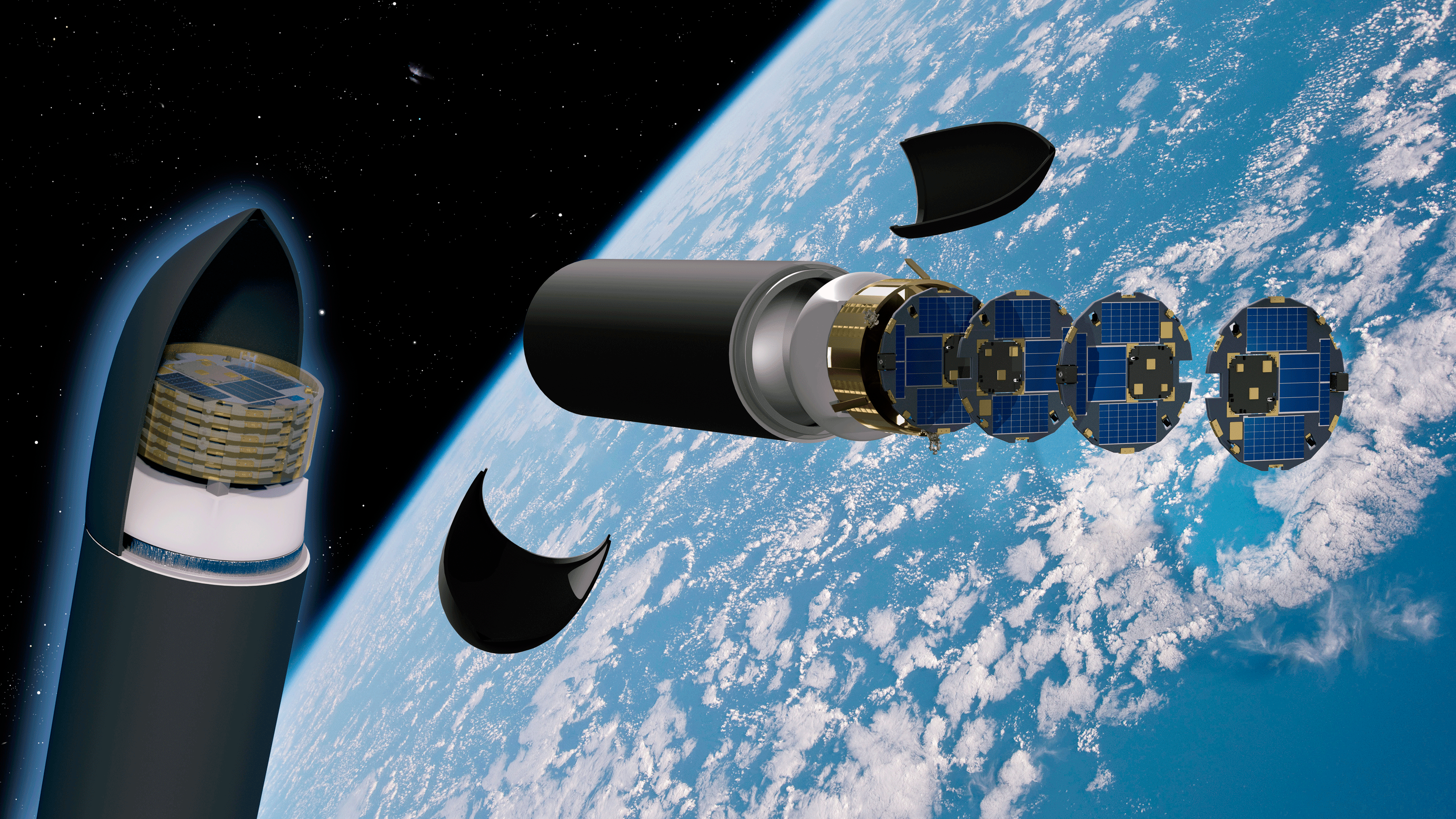
Illustration of the DiskSat concept. Source: NASA
Mjolnir fuel tank will be integrated in experimental CRAFT
MJOLNIR SPACEWORKS (MSW) announced that its weldless aluminum fuel tank technology will be adopted [Mjolnir] for Institute of Space and Astronautical Science (ISAS) (宇宙科学研究所) next-generation space transportation demonstration vehicle, known as Compact Reusable Air-assist Flight Test rocket (CRAFT). This is a big deal for Mjolnir. ISAS is a division inside JAXA and the decision to use the new technology is a validation of Mjolnir's viability and credibility. Mjolnir has already delivered a flight model of a liquid oxygen (LOX) tank and has completed partial prototyping of a liquid hydrogen (LH2) tank.
But ISAS has an even bigger agenda. It is pursuing development of a new class of rocket based on the idea of "atmospheric-assisted flight", which actively uses the air to enhance propulsion performance.
While liquid-fueled rockets have evolved with many incremental innovations over the past 60+ years, the basic liquid rocket engine has not changed that much. Liquid rockets carry fuel and an oxidizer, which are mixed in the engine and burned to generate thrust by expelling the resulting gases. Rockets normally have to carry all of the oxidizer that they need. But what if they could draw oxygen from the air, similar to an aircraft engine? If they could do this, the amount of oxidizer they need to carry could be drastically reduced. In the rocketry jargon, this is known as an "air-breather engine", and while demonstrator aircraft have been developed with scramjets, a practical rocket engine has never been built. To make this work, a vertically ascending rocket would use the air-breathing engine from takeoff and then switch to conventional liquid oxidizer when it can no longer acquire enough oxygen from the air.
So ISAS is working on something called the ATRIUM engine. It is a hybrid engine that combines an air-intake turbo engine and a conventional rocket engine, switching between them based on the altitude. The same mechanism could be used by a reusable rocket for a vertical landing. Air turbo engines also generate less noise and vibration, so it would provide a quieter launch and landing. So it would be a smaller, quieter rocket.
So ISAS will be using Mjolnir's weldless fuel tank to build the Compact Reusable Air-assist Flight Test rocket (CRAFT) with the experimental ATRIUM engines. Pretty interesting.
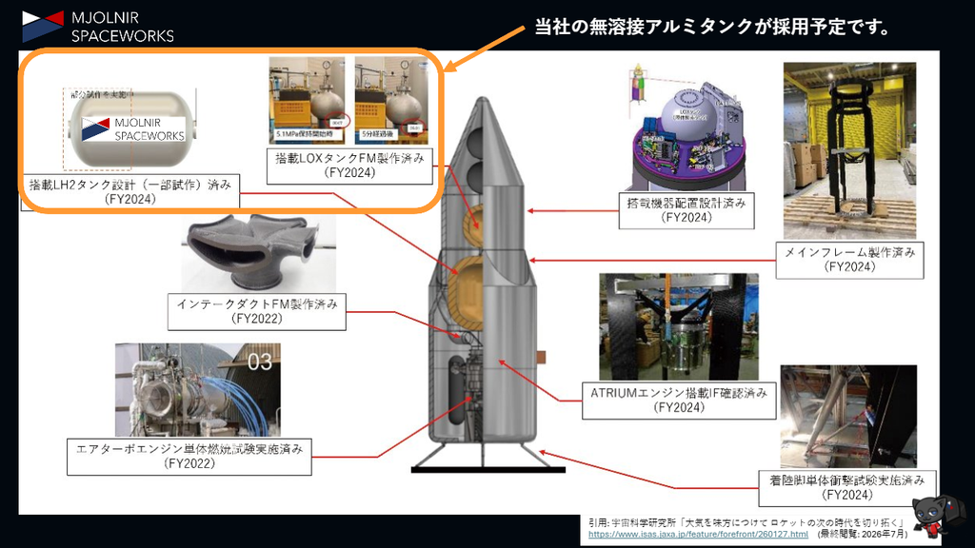
ISAS CRAFT concept for an air-breather rocket engine. Source: JAXA/ISAS
Japan plans competitive launch-services program modeled on US commercial initiatives
Nikkei Asia is reporting that the government is designing a program to increase Japan's launch cadence and foster a domestic commercial launch sector [Nikkei Asia], explicitly modeled on US commercial launch policy. Details on budget, timeline, and implementing agency not yet specified.
Tokyo's growth strategy for the space industry focuses on three areas: 1) rockets and launch sites; 2) satellites and services, and 3) lunar exploration and low Earth orbit technology. The government plans to invest 14.3 trillion yen ($91.2 billion) by fiscal 2040 to foster the space industry, both public and private.
It's possible this will be too little too late. Japan already has a few startups building rockets and other launch technology, but Europe, India, Korea, and other countries are aiming at similar goals. The U.S. launched 192 rockets in 2025 and China launched 91, while Japan only launched 3 rockets. Japan is a great place to launch from - oceans on either side make it easier to design safe flight routes and it has good sites both close to the equator and further north. But NASA started its commercial space launch program 20 years ago and while SpaceX, Vulcan, and Blue Origin have all made it to orbit, only SpaceX does it regularly and many other startups have gone under or are still struggling to launch; Japan has some has some rocket startups at advanced stages, but Europe has 12 plus three more in the UK. Japan will have to work hard to catch up. But if it can pull it off, there is tremendous demand across Asia and Oceania for launch services that don't involve the U.S. or China. We'll have to see what details emerge on the specifics of this initiative.
🛰️ Technology and Infrastructure
- Rocket Lab launched several Japanese SAR satellites
- On a mission Rocket Lab called 'The Grain Goddess Provides' Rocket Lab launched Mikura-I (iQPS names their satellites after ancient Japanese gods). The new satellite was launched to 575 km and a mid-inclination orbit of 42°. This was the 8th QPS-SAR satellite launched by an Electron. This launch had originally been planned for July 1 but was aborted.
- Rocket Lab also launched or QPS-SAR-18 "SUSANOO-II" to an orbit of 575km and mid-inclination angle of 42°. Susanoo-no-Mikoto is the god of storms, strong winds, lightning and thunder so Rocket Lab called this mission "The Lightning God Defends"
- iQPS and Synspective are racing each other to build out their planned constellations with iQPS aiming for 24 satellites by 2030 and Synspective aiming for 30.
- Following the return to flight and QZS-7 launch success, Mitsubishi Electric is gearing up to double its satellite manufacturing cadence from 2-4 to 6-8 per year [Nikkei Asia]. MELCO is Japan's top domestic large-satellite manufacturer. They build not only the QZSS satellites but also the ALOS and GOSAT series of EO satellites, the Himawari series of weather satellites, the HTV-X cargo spacecraft, and many others. The cargo vessel is unique, but the satellites are built around its highly reliable and flexible DS-2000 bus, which can provide 15+kW of electric power to payloads in the 3-5 ton range. Over the past 25 years, of the satellites weighing 1 metric ton or more, MELCO has been the prime contractor on more than 60% of them. The company completed a new satellite manufacturing facility at its Kamakura Works facility that will give it a theoretical capacity of 18 satellites per year, but that capacity remains largely unused today.
- The Japanese government is going to roll out a new strategy for centralizing management of rocket launch needs across government agencies [Japan News]. At least three different ministries operate satellites. The Ministry of Land, Information, Transport and Tourism (MLIT) operates the Himawari weather satellites. The Daichi advanced land observation satellites are operated by the Ministry of Education, Culture, Sports, Science and Technology, and the Cabinet Secretariat operates intelligence satellites and the QZSS positioning system. Up until now, each ministry has developed its own launch plans and placed orders for rockets. Under the new plan, the Cabinet Office will compile satellite launch plans in 5 year blocks and then submit a lump sum budget request. The goal is to provide more predictability for commercial rocket developers.
- I'm not actually sure how this will work. Obviously for large satellites (more that 1 ton) building the satellites is a multi-year process, so laying out a 5 year plan might help aggregate demand. However, for smaller satellites, the entire development cycle might be less than a year, and I'm skeptical that it will be straightforward to develop 5 year plans for launch needs to a sufficient degree that they can consolidate orders. Mark me as skeptical.
- The Japanese government will request ¥23.5B for launch facilities [Nikkei Asia]. Japan wants to get to 30 launches per year by the early 2030s and it's going to start by increasing the H3 launch cadence to 6-8 per year. That isn't possible with the current facilities at Tanegashima, so the Ministry of Education, Culture, Sports, and Science will request ¥23.5 billion (~US $148 million) for FY2027, an eight-fold increase from the ¥2.9 billion in FY2026. The funds will accelerate facilities and infrastructure improvements at Tanegashima, including renovation to rocket assembly facilities, construction of more fuel storage tanks, and repurposing facilities previously allocated to the now-retired H-IIA rocket. In addition to the Tanegashima upgrades, JAXA also wants to see more private launches from other spaceports and have enough capacity to both serve domestic needs and attract international customers.
- The Kumamoto Earthquake has catalyzed a number of analytical and data access responses:
- Terra Lab + Sagri have collaborated on AI-based building damage analysis [Sankei Shinbun]. They have combined Sentinel-1 SAR damage estimation, aerial imagery, and AI building-damage classification with the results being validated for government and emergency-service use. The workflow uses SAR for broad screening, transferring to 7cm aerial imagery for building-level detail, AI automated damage extraction, and finally transfer to local authorities.
- Sagri announced it has aggregated ground displacement and subsidence data to determine per-parcel-level impact [Sagri] on individual farmland plots.
- iQPS has done more than a dozen emergency SAR observations for the Kumamoto earthquake in collaboration with SKY Perfect JSAT and Nippon Koei.
- The Geospatial Information Authority (GSI) used ALOS-2 and ALOS-4 InSAR maps along the ~35 km Kumamoto displacement boundary [CNET Japan] from near Mifune to Yatsushiro. Field comparisons show ~1.9–2.1 m offsets at several sites along the Hinagu fault.
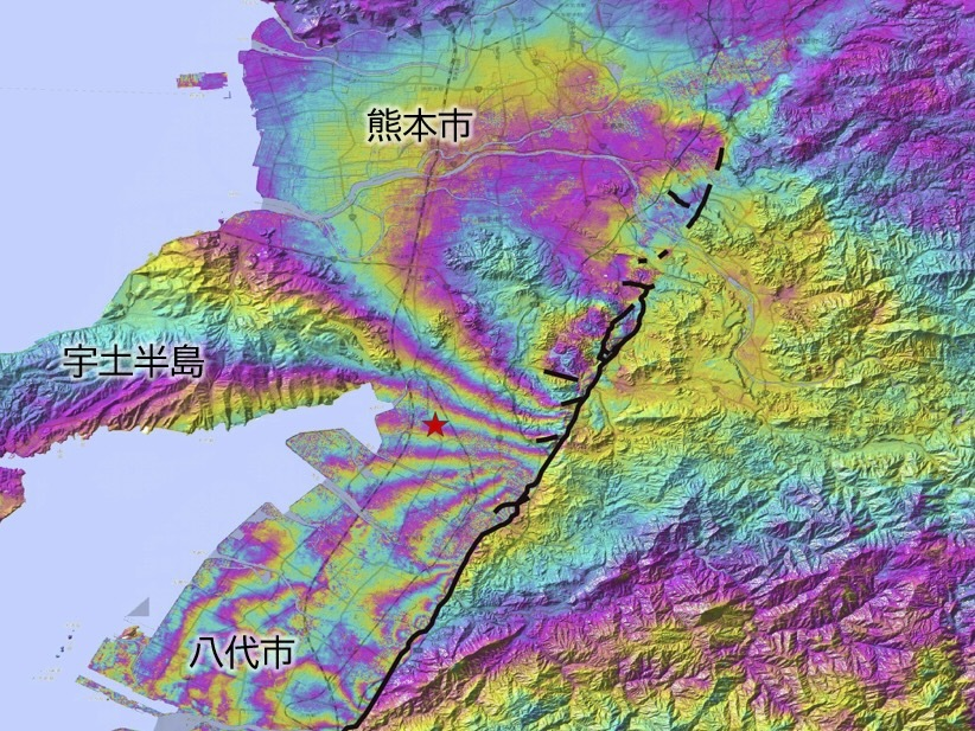
2026 Kumamoto Earthquake displacement boundary. Source: GSI
- Fusic is launching a proof-of-concept (PoC) for a cloud-based ground control system designed to support operations across multiple satellites simultaneously, aiming to streamline and reduce the cost of satellite fleet management for smallsat operators.
- Furuno confirmed that it has successfully received live Xona Pulsar LEO-PNT signals and stable reception during a GPS-spoofing test at Fukushima Robotic Test Field [Jiji]. The test used a commercial GNSS antenna with modified receiver firmware. Furuno, which makes high precision GPS receivers, signed an MoU with Xona in February to do technical validation of LEO PNT signals that could operate independently of the standard GPS/QZSS/Galileo signals in mid-and geostationary orbit. Because an LEO positioning and navigation constellation would be far closer to the ground, the signal would be both stronger and could be made more difficult to spoof. Japan's QZSS is already more resilient and precise than the GPS and Europe's Galileo, but in a near future with autonomous trucks and cars, we will need backups, and constellations of LEO positioning satellites could play a key role.
- Synspective and Spectee have developed a new flood extent estimation method that combines Synspective SAR imagery with Spectee's AI analysis [Synspective] from social media images, videos, and text. SAR handles rural areas where social media is sparse; social media handles urban canyons where high-rises block SAR. Synspective and Spectee announced their joint development agreement in July 2025, and this is the concrete result along with validation from testing against a heavy rainfall event in Amakusa City, Kumamoto. Their results matched the official ground surveys by the regional civil engineering bureau. They are targeting sales for emergency response, evacuation guidance, and disaster certification issuance.
- Synspective has announced it's opening a European office in Munich [Synspective]. Munich is a hub for aerospace and satellite innovation in Germany. The office will be led by Iain MacInnes, who previously served with the Sales and Customer Experience team at Vantor (formerly Maxar).
- Synspective has signed commercial reseller agreements with four geospatial technology providers in South America [Synspective]: DreamGIS SAS (Colombia), Globalgeo Geotecnologias Ltda (Brazil), Linkapsis Geodesia E Ingeniería SpA (Chile), and Servicios en Tecnología de la Información IMAGINE-IT LTDA (Chile). Many parts of South America have challenging geographical and environmental conditions like heavy cloud cover, dense forest canopy, and complex mountainous terrain are all common conditions that limit the utility of imagery. If you want to do time-critical or continuous Earth observation SAR technology is pretty helpful. These are nonexclusive agreements, so Synspective will retain some operational flexibility if they need to make other arrangements for a given scenario
- Rakuten Mobile and AST SpaceMobile have started their first direct-to-consumer satellite communications service in Japan. This won’t initially be a widely available service, but AST was up against an international regulatory timeline that required it to offer a service that will support unmodified 4G and 5G smart phones. This has enabled Rakuten Mobile to start offering sat-based coverage that will compete against Starlink offerings from KDDI, Softbank, and NTT Docomo. Rakuten is a strategic shareholder of AST Spacemobile, holding more than 5% of shares. In order to better support coverage in Japan, AST SpaceMobile successfully launched 3 more of its Bluebird satellites on a Falcon 9 at the end of July.
- Weathernews (ウェザーニューズ) had several significant announcements:
- They announced the launch of a new "Low-Altitude Weather Data API" (低高度気象データAPI) [Weathernews] targeted at private companies and government agencies operating drones. The API is designed to supply granular, low-altitude atmospheric data to support safer and more efficient drone operations. Flying drones beyond visual line-of-site (BVLOS) requires fine-grained wind and weather conditions near the ground. A data service with low altitude weather data will enable integration into the applications and control software used by drone pilots. This capability will also help support so-called "one-to-many operations" where a single drone pilot monitors and controls multiple drone aircraft from a remote location. The new API can provide data from the ground surface to 4,500m in 10m altitude intervals and at 250m horizontal resolution. Further, it is updated every 10 minutes.
- They also announced that the Japanese government has granted official weather forecasting business authorization (気象予報業務許可) to issue 24-month extended weather forecasts. This regulatory milestone allows the company to expand its forecasting service offerings into long-range (two-year horizon) predictions to support agriculture, energy, and infrastructure planning sectors that rely on extended climate outlooks.
- Weathernews also announced that they are adapting their "Soratena Pro" sensor suite for use in Southeast Asia [Weathernews]. The Soratena Pro is a compact, high-performance weather IoT sensor designed to Asian telecom standards. The objective in SE Asia is to help address the region's severe shortage of ground meteorological observation infrastructure in the midst of intensifying climate-driven extreme weather. Weathernews has already proven the Soratena Pro platform domestically in Japan and it is approved by the Japan Meteorological Agency (JMA) for use in official forecasting operations. The SE Asia version will initially prioritize Thailand and Vietnam, where Weathernews already holds MoUs with national meteorological agencies, with commercial sales to enterprises and municipalities. The initiative aims to build dense, low-cost observation networks across data-sparse regions of Asia to improve localized disaster forecasting and support agriculture and infrastructure applications.
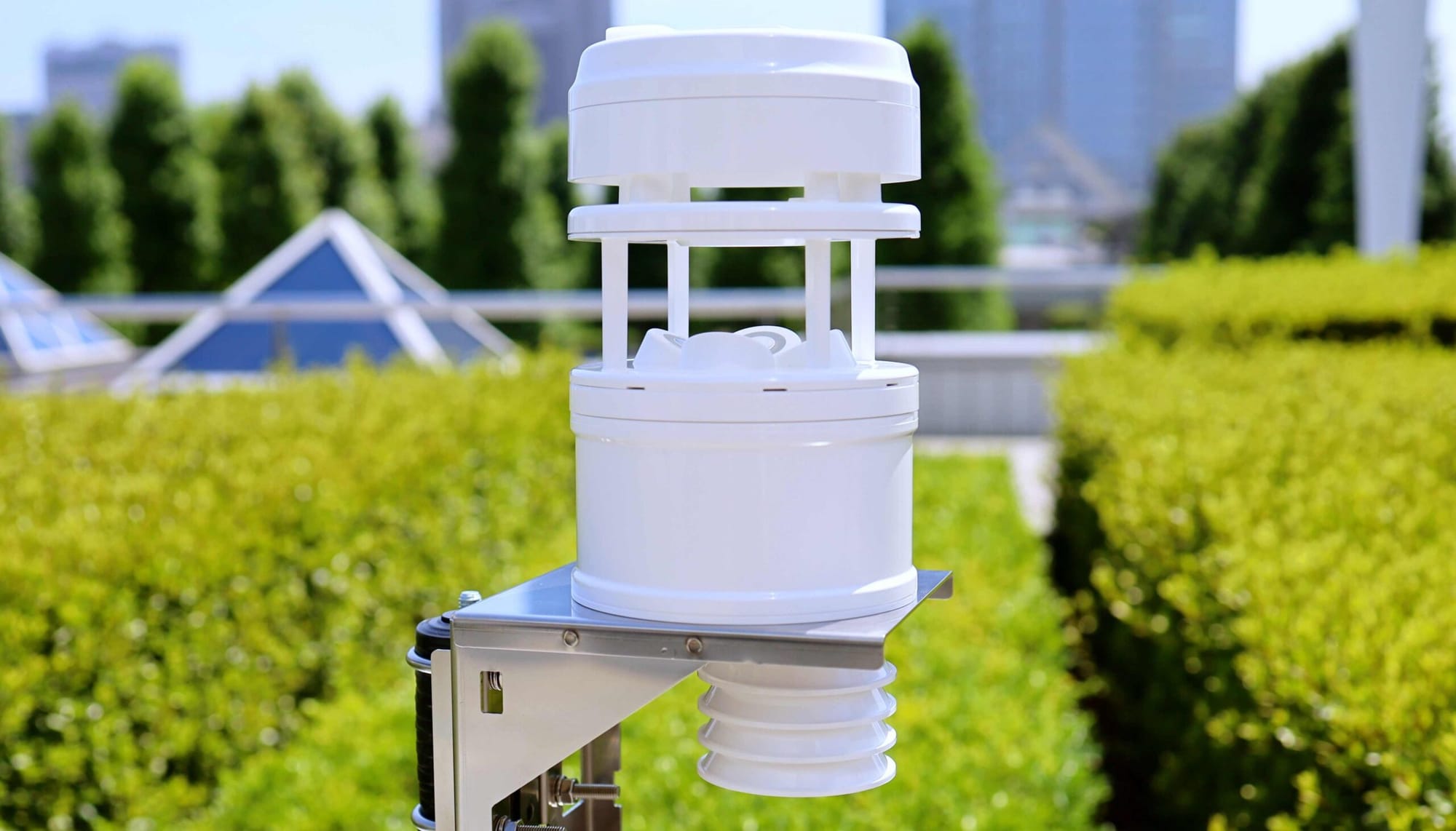
Soratena Pro sensor suite. Source: Weathernews
- Finally, they have developed a new proprietary software tool called "ROI Generator" that uses generative AI with the company's weather data [Weathernews] to rapidly estimate the economic damage caused by weather-related disasters (typhoons, heavy rain, heatwaves) and then calculate the cost-effectiveness of using weather information to mitigate such losses. Example outputs include an estimated ¥3.7 - 11.1 billion in economic damage from the August 2026 Chiba Storm and up to approximately ¥24 trillion (~€133 billion) in losses from the 2026 European heatwave. Weathernews plans to continue testing and validating the software with railway and expressway operators to support corporate and municipal business continuity planning and climate-adaptation investment decisions.
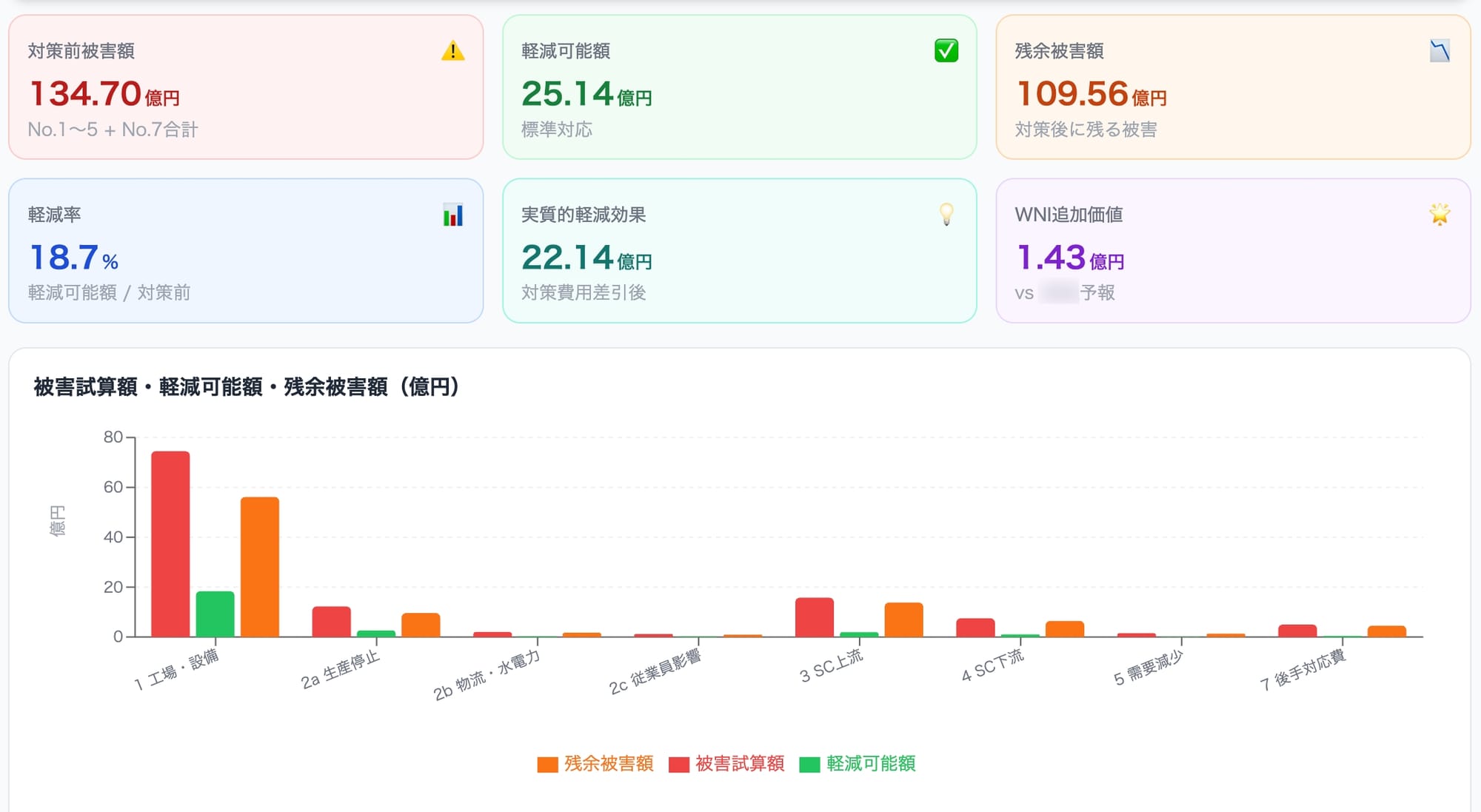
Weathernews ROI Generator screenshot. Source: Weathernews
- Sakana AI announced an update to its Sakana Translate service, integrating the new-generation Sakana Namazu model into its translation engine. The update replaces the underlying translation model with the newer Namazu series. Sakana AI is positioning its AI tooling as a Japan-focused, sovereignty-oriented LLM optimized for domestic language tasks. The new model does a better job in the majority of scenarios when tested head-to-head against the most common LLM translation engines. You can try it out at https://translate.sakana.ai/
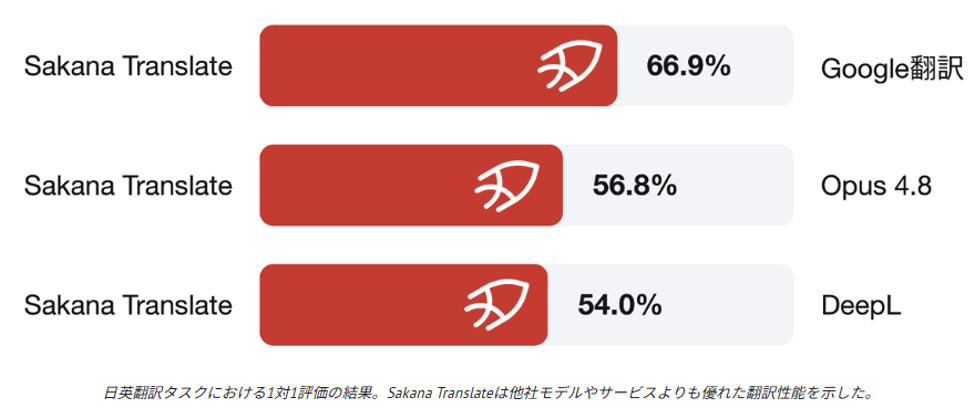
SakanaAI translation comparison chart. Source: SakanaAI
💱 Contracts
- Redwire and Kanematsu have signed a formal agreement that will have Kanematsu, a trading company, serving as Redwire's commercial presence in Japan [SatNews] for its orbital power generation, microgravity manufacturing payloads, and other space operations.
- Japanese microsatellite developer Jinsei (尽星) has signed a contract with Taiyo Technorex for ground environmental testing of space-grade flexible printed circuit (FPC) cables [SpaceMedia], supporting qualification of critical wiring components for microsatellite platforms.
- Synspective has signed a deal with NTT Data and NTT DOCOMO to improve disaster response. The three companies will work together to support faster assessment of damage in disaster-affected areas [Synspective]. Satellite imagery will be used to evaluate conditions such as flooding, landslides, and road access. The initiative will combine Synspective's imagery (which can be used to observe at night and in poor weather) with optical imagery from NTT Data. DOCOMO will combine the imagery with data on base station damage and information released by public agencies in order to support more rapid restoration of communication services.
- Solafune has secured two contracts with the Japan Ground Self-Defense Force (JGSDF) to develop and enhance AI-based capability assessment models for disaster response [Solafune] (damage estimates, operational routes, and response strategies) and logistics operations such as medical care and casualty evacuation. The announcement reflects continued expansion of Solafune's work with Japan's Ministry of Defense/JGSDF on satellite-imagery-driven AI analytics.
- Sakana AI has signed a contract with Japan's Ministry of Defense (JMoD) for AI agent technology to support data collection efficiency, analytical capability, and data management.
- NTT DoCoMo announced it has signed a new contract for SpaceX's next-generation Starlink Mobile V2 satellites to expand its docomo Starlink Direct service. The current DoCoMo-Starlink contract is limited to messaging and some minimal app data via Starlink Mobile V1, and it was only just launched at the end of June. The upgraded Starlink Mobile V2 service, which is targeted for FY2028 launch, will add voice calls, high-speed internet, and direct IoT device connectivity in areas without good terrestrial coverage (mountains, remote islands, maritime areas). The upgraded service will rely on newer satellites that can offer approximately 20x the per-satellite data capacity vs the first generation. In order to make this possible SpaceX has designed new phased-array antennas capable of thousands of spot beams from each satellite. These new satellites are not yet in orbit and SpaceX planning to begin launching them via Starship in 2027 at a rate of up to 50 satellites per launch
- Japan's Orbitorus has signed an MOU with Luxembourg's Mission Space to integrate orbital risk intelligence (collision/conjunction prediction) with space weather and radiation environment monitoring [SpaceMedia] for satellite operators. The partnership will combine Orbitorus's orbital intelligence with Mission Space's space environment monitoring to provide risk analytics to customers in Japan and Europe.
💴 Equity Funding
- Letara, a Hokkaido-based startup developing hybrid spacecraft propulsion systems, announced it has raised ¥2.6 billion (~US 17.4 million) in a pre-Series A round [Letara] that builds on a previous seed round of ¥1.8 billion. Letara was founded in 2020 by Co-CEOs Hirai Shota and Landon Thomas Kamps. Kamps was a professor and Hirai was a doctoral student at Hokkaido University at the time. The funds will be used to accelerate development of its low-cost, next-generation hybrid engine.
- What is Letara building? A hybrid engine combines elements of a solid rocket motor and a liquid rocket engine. In this case, they are developing an engine that uses a plastic plus a chemical oxidizer. The result provides the thrust of a liquid engine but is not explosive, so it is much safer to handle than either liquid or solid motors. In addition to being safer, it is cheaper and the development cycle is faster. Letara’s early work focused on maneuvering thrusters, but they have since extended this to the higher thrust required for launch engines as well, and in April 2025, they announced a partnership to provide engines for Innovative Space Carrier with a launch target of 2028.
- Global Innovation Labs (GIL), a U.S. venture capital firm created by SRI International, is setting up a joint venture with Z Venture Capital, a Japanese subsidiary of LY, operator of the LINE messaging app. The fund, which will focus on AI, space, robotics, and defense [Nikkei Asia], will start with ¥3 billion yen (~US $19 million) and ¥5 billion of assets under management and will then work to raise additional capital from Japanese financial institutions and commercial enterprises. SRI International owns an array of intellectual property and technology innovations that it would like to potentially license to Japanese firms for development. The new fund expects to invest in 20-25 startups over the next 10 years. Japan will be GIL's first overseas outpost, but they would like to launch similar funds in South Korea, Singapore, India, and Taiwan. Japan has been attracting other VC firms. Alumni Ventures opened its first Asian outpost in Japan last year and Andreessen Horowitz has also announced plans for a Tokyo office.
- New Space Intelligence (NSI), a satellite data services provider based in Ube, Yamaguchi, received an investment [SpaceMedia] from Iyogin Capital. The funding, the amount of which was not disclosed, will be used to develop NSI's satellite data pipeline and core technology, develop new services and products, expand hiring, and support domestic and international business expansion. NSI also expects to leverage Iyogin Capital's regional network across the Chugoku and Shikoku regions with enterprises and municipal governments.
🔭 Science
- Researchers at Kyoto University have developed a new tomography method by reconstructing atmospheric-density variation and they have done so in a creative way: by analyzing the tiny variations in energy loss from atmospheric drag [Kyoto Univ.] based on orbital data (also known as "ephemeris") from roughly 1,200 Starlink satellites. The new technique combines orbital mechanics, upper-atmosphere science, and AI-assisted data processing. This could enhance techniques for orbit prediction and collision avoidance.
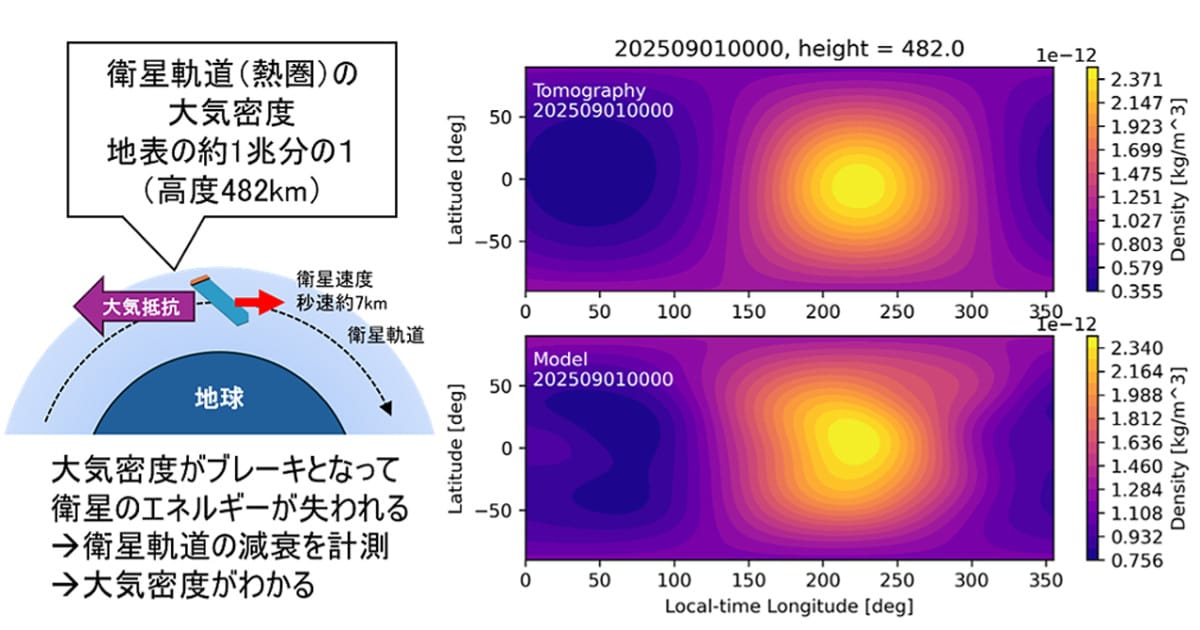
Kyoto University atmospheric density mapping from Starlink satellites. Source: Kyoto University
📝 Reports and Datasets
- JAXA + AIST have released an open-source SAR foundation model [X] trained on ALOS-2 satellite data, plus a land-use/land-cover classifier fine-tuned on JAXA-LULC labels. The model weights are released on HuggingFace and the source code is on GitHub. This is the first public ALOS-2 foundation model, and it can be directly applied to transfer learning tasks.
📆 Asia-Pacific Conferences & Events
This newsletter is mostly focused on Japan, but I also like to highlight events across the Asia-Pacific region. Some upcoming conferences include:
September 2026
- Planetary Exploration Workshop 2026 (惑星探査ワークショップ 2026) - 24 Sep - Sagamihara, Japan
- 2nd OPENS International Scientific Workshop (第2回 OPENS国際科学ワークショップ) - 28 - 29 Sep - Sagamihara, Japan
- Japan-Cambodia Space Economy Co-creation Symposium 2026 - 28 - 29 Sep - Hyatt Regency, Phnom Penh, Cambodia
- EARTHBRAIN Technology Conference - 29 Sep -
- 25th Australian Space Research Conference (ASRC 2026) - 29 Sep - 1 Oct - Adelaide, Australia
October 2026
- New Zealand Aerospace Summit 2026 - 1 - 2 Oct - Christchurch, New Zealand
- 39th MEWS - JAXA Microelectronics Workshop 2026 - 1 - 31 Oct - Tsukuba, Japan
- Code for Japan Summit 2026 - 3 Oct - Chiyoda-ku, Tokyo
- 12th International Seminar on Aerospace Science and Technology (ISAST) - 6 - 8 Oct - Yogyakarta, Indonesia
- IEEE Asia-Pacific Geoscience and Remote Sensing Symposium (AP-GARSS 2026) - 11 - 14 Oct - Qingdao, China
- 47th Asian Conference on Remote Sensing (ACRS 2026) - 12 - 16 Oct - New Delhi, India
- Space Summit Asia-Pacific 2026 - 13 - 14 Oct - Narita/Tokyo, Japan
- Hokkaido Space Summit - 14 - 16 Oct - Obihiro, Hokkaido, Japan
- Space Innovation Challenge 2026 - 26 Oct - Bangkok, Thailand
- Space for Island Nations Conference (SINC) - 26 - 28 Oct - Malé, Maldives
- 10th Global Moon Village Workshop & Symposium - 26-27 Oct - Bangkok, Thailand
- Asia-Pacific International Symposium on Aerospace Technology (APISAT 2026) (第64回 飛行機シンポジウム) - 27 - 29 Oct - Sapporo, Japan
- 32nd Asia-Pacific Regional Space Agency Forum (APRSAF-32) - 27 - 30 Oct - Bangkok, Thailand
- UN/Pakistan International Conference on Leveraging Space Technology for EW4All, Climate Action and Disaster Risk Assessment - 27 - 31 Oct - Islamabad, Pakistan
- JSASS Annual Meeting 2026 - 28 - 30 Oct - Sapporo, Japan
- Thailand Space Expo 2026 - 28 - 31 Oct - Bangkok, Thailand
November 2026
- IAU Symposium 409 - Innovative Research and Techniques in Astronomy Communication - 2 - 6 Nov - Mitaka, Japan
- Asia-Pacific Space Community Council (APSCC) - 3 - 5 Nov - Denpasar Bali, Indonesia
- Committee on Earth Observation Satellites (CEOS) 40th Plenary - 3 - 6 Nov - Hobart, Tasmania, Australia
- 12th UNISEC-Global Meeting - 4 Nov - Online
- TASTI 2026 (TASA Taiwan) - 8 - 11 Nov - Tainan, Taiwan
- 2nd Nano-satellite IoT Constellation Program Workshop - 8 Nov - Tainan, Taiwan
- 3rd Deep Space Workshop - 8 Nov - Tainan, Taiwan
- 9th Asia-Oceania Space Weather Alliance Workshop - 8 - 11 Nov - Tainan, Taiwan
- 10th Mission Idea Contest Preliminary Workshop (PreMIC 10) - 9 Nov, Tainan, Taiwan
- 15th Nano-Satellite Symposium - 9 - 11 Nov - Tainan, Taiwan
- SPIE Asia-Pacific Remote Sensing 2026 - 9 - 12 Nov - Yokohama, Japan
- Advancing Earth Observation Forum 2026 - 9 - 12 Nov - Hobart, Tasmania, Australia
- 70th Space Science & Technology Conference (第70回 宇宙科学技術連合講演会) - 10 - 13 Nov - Utsunomiya, Japan
- China International Aviation & Aerospace Exhibition (Airshow China) - 10 - 15 Nov - Zhuhai, China
- International Workshop on ATM/CNS (IWAC 2026) - 17 - 19 Nov - Tokyo, Japan
- JAXA Space Debris Workshop 2026 (第12回スペースデブリワークショップ) - 18 - 20 Nov - Tokyo, Japan
- Indo Aerospace Expo and Forum - 18 - 21 Nov - Jakarta, Indonesia
- International Lunar Sample Research Symposium 2026 - 20 - 23 Nov - Hong Kong, China
- Locate26 - 24 - 26 Nov - Melbourne, Australia
- 10th Digital Earth Summit - 24 - 26 Nov - Melbourne, Australia
- 13th Hayabusa Symposium / Space Materials Science Symposium (第13回 宇宙物質科学シンポジウム) - 24 - 27 Nov - Sagamihara, Japan
- FOSS4G Hokkaido 2026 - 28-29 Nov - Kita Hiroshima, Hokkaido, Japan
- CEOS WGCV SAR Calibration & Validation Workshop 2026 - 30 Nov - 4 Dec - Perth, Australia
- Asian Microgravity Symposium 2026 (AMS2026) - 30 Nov - 4 Dec - Hyogo, Japan
- Nihombashi Space Week 2026 - 30 Nov - 12 Dec - Tokyo, Japan
If you’ve made it this far, thank you for reading. Please be in touch via LinkedIn with any feedback, questions, comments, or requests for future topics. And if you have a friend or colleague that you think would enjoy JEO, please share it!
Until next time,
Robert
The daytime lingering heat
changes into
the chill of the night.
-- Masaoka Shiki (正岡 子規, 1867–1902) - translated by Burton Watson
昼中の
残暑にかはる
夜寒哉
hiruma no
zansho ni kawaru
yosamu kana