JEO 22 - News Roundup - 27 Oct 2026
Topping this news roundup, Nancy Grace Roman telescope launch plus an analysis of launch decisions in the post Falcon 9 era.
Welcome to Japan Earth Observer (JEO), a monthly newsletter about the space, Earth observation and geospatial industries in Japan.
In this news roundup, we lead off with the Nancy Grace Roman telescope launch plus an analysis of launch decisions in the post Falcon 9 era and the usual funding and contract announcements, science, international collaborations, and conferences.
On to the news…
News & Announcements
Nancy Grace Roman telescope flies with critical Japanese parts
The Nancy Grace Roman telescope has successfully launched on a SpaceX Falcon Heavy rocket. The Roman telescope has a similar sized 2.4m primary mirror to the venerable Hubble space telescope but it has 100x wider field of view via its 300 megapixel Wide Field Instrument and can survey billions of galaxies, carry out gravitational micro-lensing searches for exoplanets, and use the coronagraph to directly image exoplanets. It launched 9 months ahead of NASA's original May 2027 plan and is expected to work for 5 years with an optional 5 year extension. After conserving fuel in its orbital transfer maneuvers, it may be possible for it to operate for 20 years.
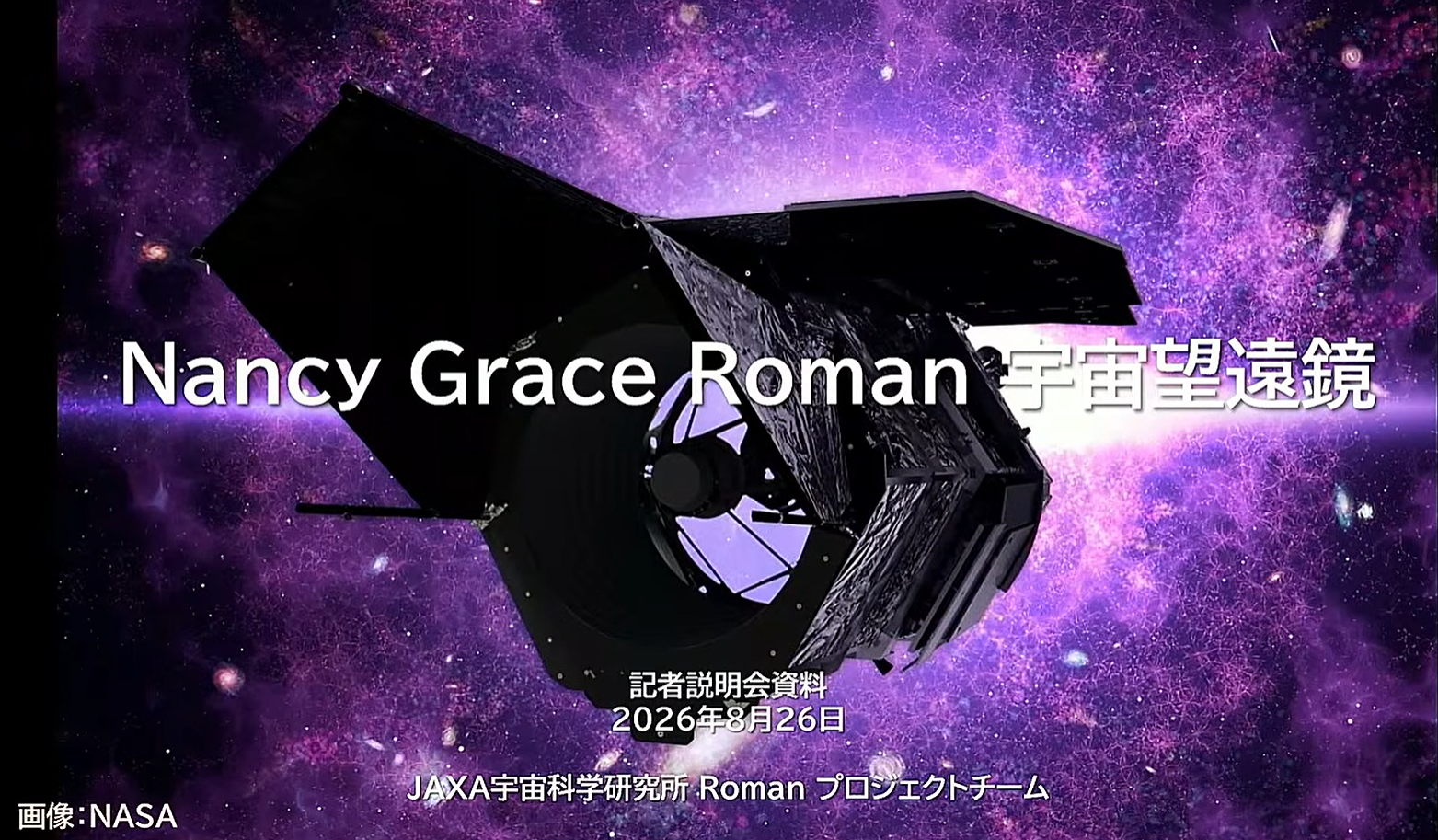
The successful launch of the Roman Space Telescope has been a chance for JAXA to highlight Japanese contributions to the effort. Three Japanese precision optics companies contributing components to its observation instruments:
- Natsume Optics (Nagano) - fabricated the precision optical substrate for the coronagraph mask using an ultra-high-precision polishing and coating techniques developed with Hokkaido University
- Kogaku Giken (Kanagawa) - manufactured the Wollaston prism that enables polarization-based observation proposed by the Japanese team - they did this with design support from University of Tokyo Astrobiology Center and Optcraft
- Sankyo Kogaku Kogyo (Tokyo/Akita) - produced the focusing lens for polarization observation
- JAXA's Misasa Deep Space Ground Station will receive about 25% of the data sent by Roman
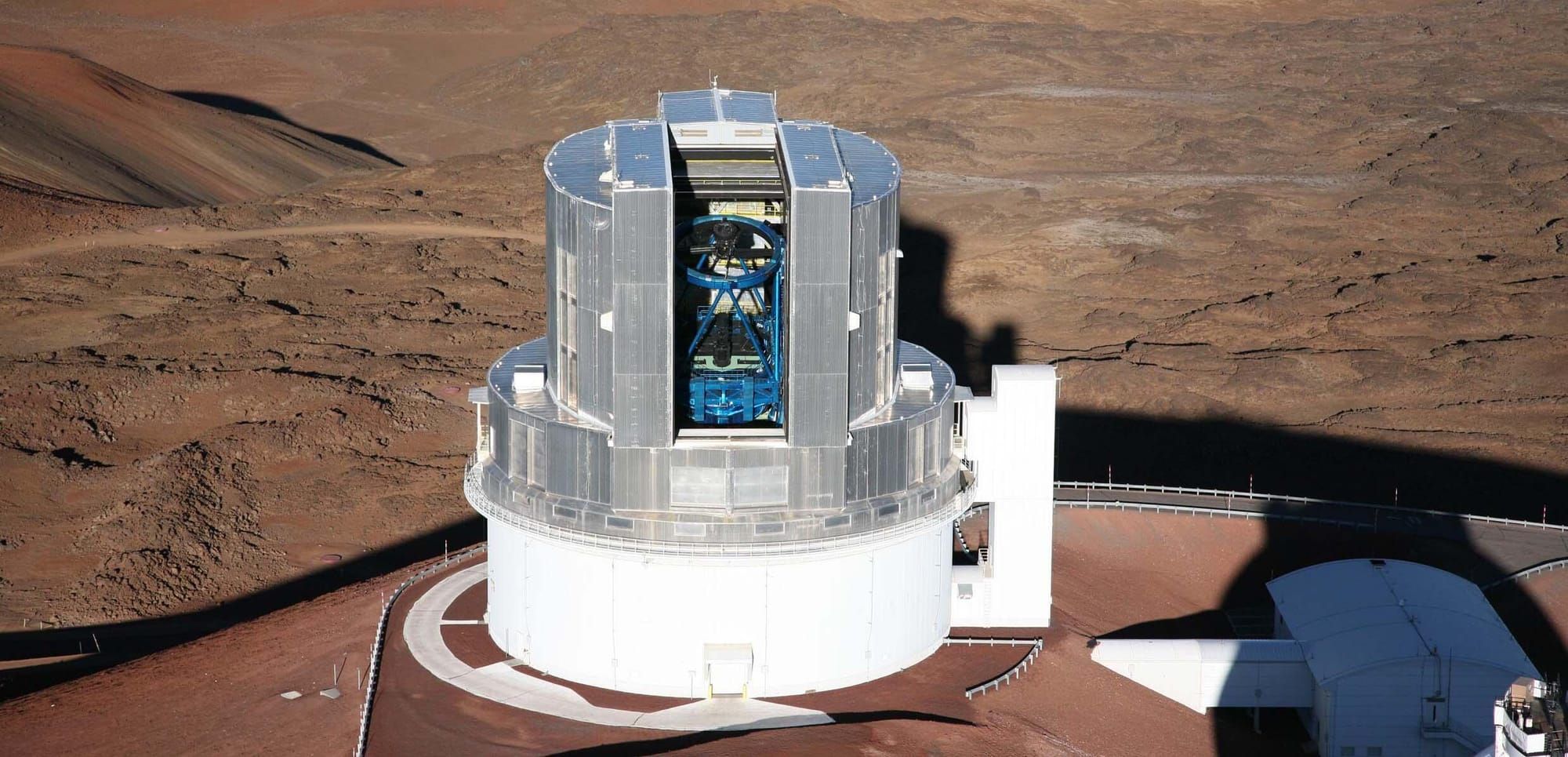
- Subaru Telescope coordinated observation - The Subaru Telescope is a massive 8.2m instrument installed on the Mauna Kea peak on the Big Island of Hawaii. It has complimentary capabilities to the Roman telescope and coordinated observations are expected to produce better results than other instruments could do on their own. The Subaru telescope is reserving 100 nights of telescope time to complement Roman observations
- Osaka University PRIME Telescope at the Sutherland Observatory in South Africa has four of the same instruments as the Roman telescope and will provide coordinated gravity microlensing observations to assist with planning similar Roman observations. Osaka University is also sharing historic data from its MOA telescope in New Zealand providing 12% of observation capacity on the PRIME telescope to US observers
The Roman telescope will spend the next three months transiting to the Sun-Earth L2 point ~1.5 million km from Earth and then begin deployment, instrument alignment, and calibration. We can expect the first images to arrive in early 2027.
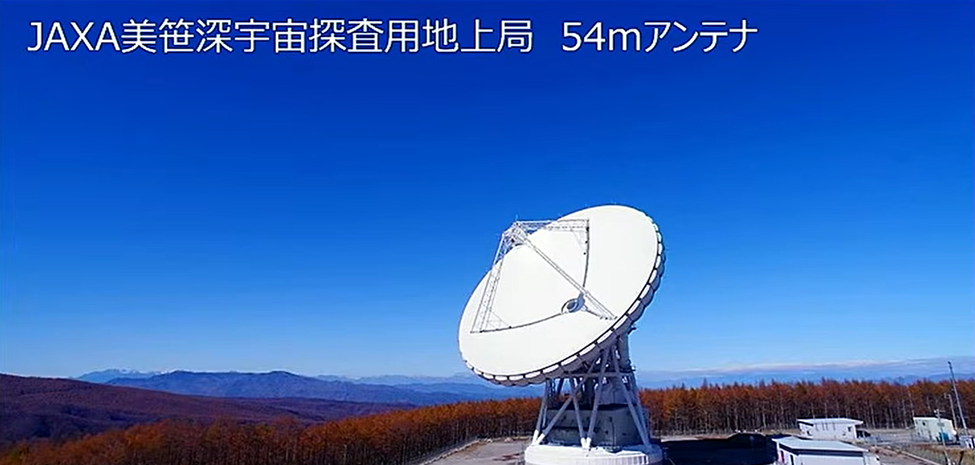
JAXA's Misasa Deep Space Ground Station. Source: JAXA
Mitsubishi Electric leads PLD Space funding round
Spanish launch company, PLD Space, closed a 108 million funding round [European Space Flight] that was led by Mitsubishi Electric. This was technically not a new round. PLD Space, which is developing the Miura 5 rocket, closed a Series C round of €180 million in March. The new funding is an extension of that round, which had also been led by Mitsubishi Electric. The funding will be used to accelerate production of the launch vehicle and infrastructure and bring the company closer to full commercial operation. This week's announcement comes only a week after the ESA's award of €158.9 million contract to PLD Space as part of the European Launcher Challenge. The inaugural launch of the Miura 5 from Kourou in French Guiana is currently expected by the first half of 2027.
What does this mean: This is clearly not a passive financial investment by MELCO. But it's also not an obvious one either. MELCO's flagship satellite bus is the DS-2000, which usually ends up with satellites in the 4,000 - 5,000kg size range. The Miura 5 is designed to launch payloads of 500 - 1000 kg. Now, PLD Space plans a Miura Next rocket that will both be reusable and support payloads of 4,500 - 13,500kg (depending on the orbit) as well as Heavy and Super Heavy versions in the future. That is more like the typical satellites that Mitsubishi Electric manufactures. However, Miura Next is probably years away from flying.
However, there might be another explanation. MELCO's press release about the PLD investment cites "securing smallsat launch resources and advancing the satellite observation solution services business" (小型衛星の打ち上げリソースを確保し、衛星観測ソリューションサービス事業を推進). MELCO is the lead partner in a new joint venture, called TriSat Constellation, with SkyPerfect JSAT, Mitsui, Synspective, iQPS, and Axelspace awarded a ~¥323.2 billion contract by the Ministry of Defense (防衛省) to build out a new defense and intelligence constellation. This joint venture needs to hit a significant launch cadence by 2027-2028 timeframe, and relying on the low volume H3 or currently grounded Epsilon rockets isn't going to cut it. And during that same time frame, Falcon 9 launches will be winding down. So I think we could potentially see this as a hedge against the constrained smallsat launch capacity over the next few years.
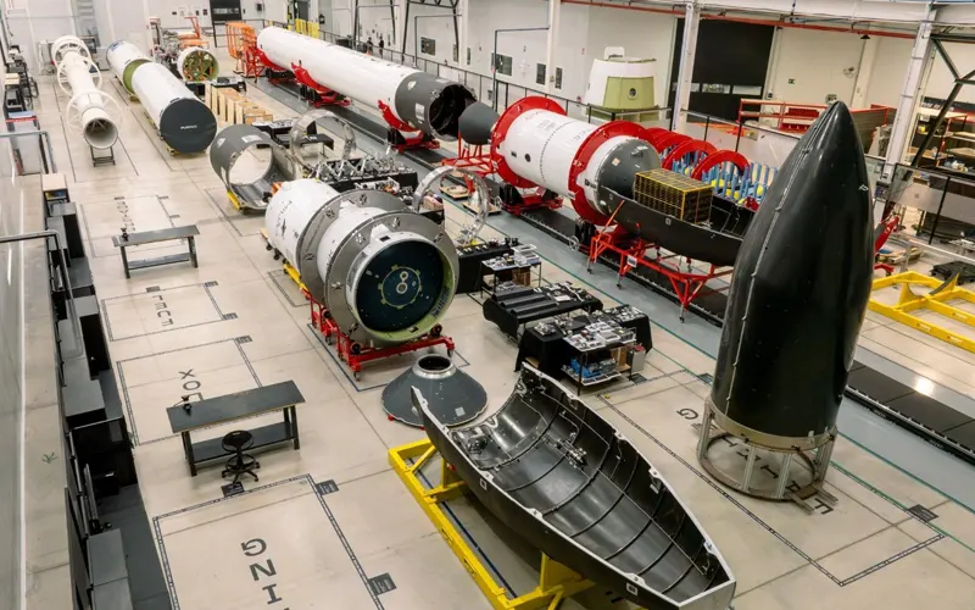
Miura 5 rocket under construction. Source: PLD Space
Astroscale selects Isar to launch ADRAS-J2 mission
Astroscale Japan has selected Germany's Isar Aerospace to launch the high profile ADRAS-J2 mission in FY2027. This mission is a followup to the ADRAS-J mission, which approached and inspected an expended second stage of a Japanese H-IIA upper stage left over from the 2009 launch of the GOSAT satellite. ADRAS-J2 will not only approach a large piece of space debris but attempt to capture and deorbit it. If successful, it will be the first time an RPO mission will clear a large object (in this case 11m length and 4m diameter).
This mission is funded under a Commercial Removal of Debris Demonstration (CRD2) contract with JAXA worth ¥13.2B (~US $82M). The Japanese government is trying to build a commercial active-debris removal (ADR) market, and this will be a showcase mission. In March, Astroscale’s UK subsidiary signed a contract with Isar to launch the ELSA-M in-orbit demonstration mission aiming to capture satellites fitted with magnets to enable their capture.
The decision to launch on Isar's Spectrum rocket represents Astroscale doubling down on Isar. Earlier this year Astroscale's UK subsidiary also signed a contract with Isar to launch its ELSA-M mission in FY2028. The ADRAS-J2 schedule still gives Isar some time to make multiple test launches and demonstrate some reliability and still hit Astroscale's schedule, but given the time required to design and manufacture these payloads, these two decisions to use Isar feel like “bet-the-company” moves.
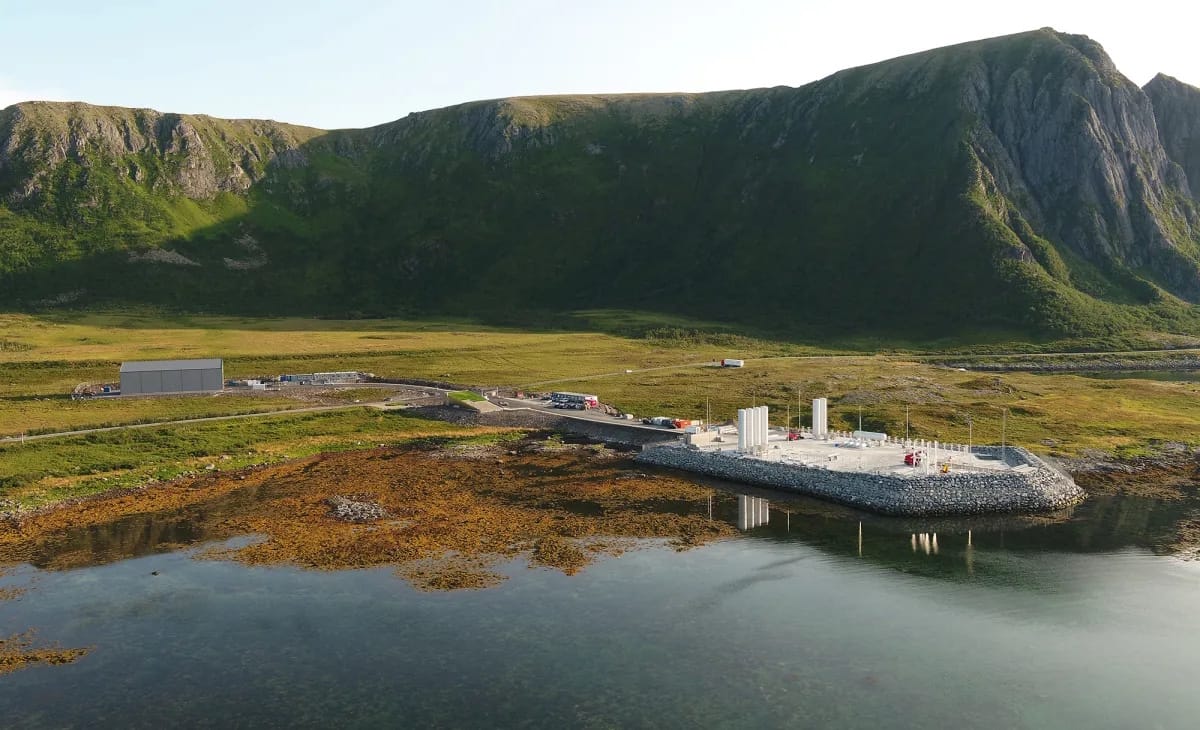
Andøya Spaceport. Source: PLD Space
So why choose Isar?
First, we need to consider what Astroscale needs for ADRAS-J2. Its deorbit target is the second stage rocket body used to launch GOSAT into a sun-synchronous orbit (SSO) passing over the poles at 560 - 600km at 98.2° inclination. This orbit matters because while many orbits can be reached more efficiently from equatorial launch sites, high inclination SSO orbits are more easily reached from launch sites closer to the poles.
So what are the domestic Japanese options? H3 is far too big (unless it is a rideshare launch) and Electron-S is both too small and is still grounded. Space One Kairos has not had a successful launch yet and doesn’t have the payload capacity anyway. Innovative Space Carrier (ISC) hasn't flown yet and is also too small.
So let's look further afield to other potential international launch providers. The table below excludes a few heavy lift rockets like the Ariane 6 (booked out for years and far too large), Starship (even larger), ULA Vulcan Centaur (grounded far too large) and Blue Origin (grounded, far too large and booked for at least the next year).
| Launch Vehicle | Payload Capacity | Launch Site | Notes |
|---|---|---|---|
| Stoke Space Nova | 3 - 7 tons | SLC-14, Cape Canaveral Space Force Station | Too large, inaugural flight not expected until 2027 |
| Falcon 9 | 5.5 - 22.8 tons | LC-39A at Kennedy Space Center, SLC-40 at Cape Canaveral Space Force Station, and SLC-4E at Vandenberg Space Force Base |
Too large, limited access; rideshare flights are ending soon |
| Firefly Alpha | 1 ton (630 kg SSO) | Vandenberg | Poor launch record; limited capacity to SSO |
| Rocket Lab Electron | 300kg (200kg SSO) | Mahia Peninsula, New Zealand | Too small |
| Rocket Lab Neutron | 3 - 7 tons | Mid-Atlantic Regional Spaceport | Too big and 2027 launches are tied up in testing and caling |
| MaiaSpace | SSO: 500kg reusable/ 1,500kg expendable |
Former Soyuz Launch Complex (ELS), Guiana Space Centre (CSG), Kourou, French Guiana |
Inaugural flight in late 2027 |
| PLD Space Miura 5 | 900 - 1000kg (450-540kg SSO) |
Guiana Space Centre (CSG), Kourou, French Guiana |
Inaugural flight in 2027 |
| Isar Aerospace Spectrum | SSO: 1 ton | Andøya, Norway | This is the right size for Astroscale's payload and the right location for SSO launch |
So that leaves Isar. It launches from a northern location and claims approximately 1,000kg to SSO orbit. Is it a risk? Sure. But it's the risk that makes sense based on what Astroscale needs in 2027 and 2028.
And after several months of delays, Isar Aerospace has finally had a successful launch of its Spectrum rocket [SpaceConnect] from the Andøya Spaceport, achieving its first orbital launch and payload delivery. This has to come as both a relief and reinforcement of their decision. Japanese firm ElevationSpace has also contracted with Isar for its "Aoba" ELS-R orbital return mission.
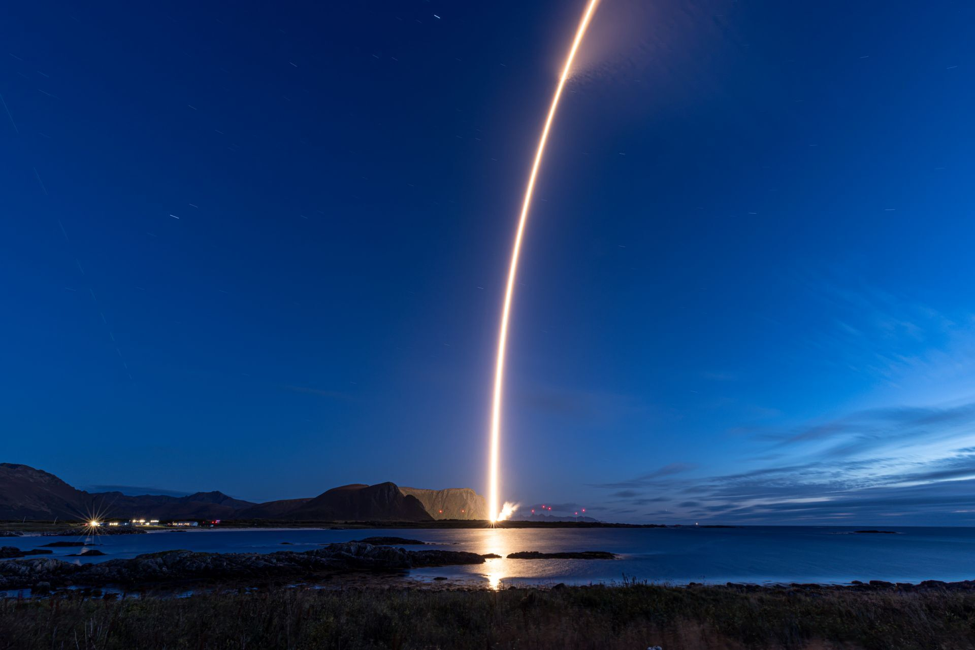
Isar launch from the Andøya Spaceport in Norway. Source: Isar Aerospace.
MHI assembles H3 rideshare launch customers for 2027
I haven't seen an MHI press release but four different companies have recently made announcements that they will launch satellites on an H3 rideshare mission in 2027.
- First, ExoLaunch is a Germany company that buys rocket launch capacity [ExoLaunch] and then provides launch preparation, logistics, and integration services for small satellites. They also manufacture a deployment module called EXOpod, an orbital transfer vehicle called EcoTop Space Tug and mission management software called EXOtrack.
- ElevationSpace will also have a slot on an H3 rideshare in 2027 for its ELS-R microgravity manufacturing and recovery vehicle [ElevationSpace]. The first ELS-R (also known as "Aoba") will launch on an Isar Aerospace Spectrum. The second will be for this H3 rideshare mission.
- iQPS announced that it will use an H3 rideshare to launch three of its satellites [iQPS]. iQPS already has several launches contracted with Rocket Lab Electron. They have also announced a deal with MaiaSpace for launches starting in 2029. The agreement with MHI to use the H3 spreads its bets across three different providers over the next few years. iQPS is still aiming for a 24-satellite constellation by 2028, but it has announced plans to expand this to 36 satellites by 2030, and the combination of Maiaspace and the H3 will help it meet that objective.
- Finally, Synspective has contracted for launch of two of its StriX satellites in 2027 [Synspective], also targeting a mid-inclination orbit to enable high-frequency observation over Asia-Pacific.
At least a couple of these, and, most likely, the whole effort is being subsidized by JAXA's Space Strategy Fund (SSF)
This series of announcements brings together two developments from the last few months. First, with a decline in the availability of SpaceX Falcon 9 rideshare flights and several nascent rockets waiting to prove themselves, there is currently a shortage of small and mid-sized launch vehicles available in 2027 and 2028, at least for the time-being. Second, with the H3 having completed its initial few launches and having successfully returned to flight after a December failure, JAXA has cleared Mitsubishi Heavy Industries to offer the rocket for commercial use. The Japanese government is also investing in improving the launch facilities to support a higher launch cadence from Tanegashima.
ArkEdge will develop LEO-PNT satellites
ArkEdge Space is embarking on an in-house project to develop and demonstrate a Low Earth Orbit Positioning, Navigation and Timing (LEO-PNT) system [ArkEdge] using dual-band positioning signals in the L6 and C1 bands. This is not an entirely new project. JAXA has already funded ArkEdge to do an engineering feasibility study of a standalone LEO approach to positioning [GPS World] as well as develop concepts for a lunar positioning system. In addition, it has been cultivating partnerships with overseas firms: TrustPoint, RIN, and FrontierSI. What is new is concrete plans. ArkEdge will develop two 6U demonstration satellites that will integrate an orbit, time determination, and positioning payload and launch to a ~550km sun-synchronous orbit in FY2028. The goal will be end-to-end technology validation including signal generation, broadcast to ground, position processing, and integration with existing positioning signals such as GPS and QZSS. QZSS already broadcasts an L6 band and the C6 band supports less ionospheric delay, a smaller antenna, and the potential for expansion via ongoing global spectrum allocation discussions.
What does this mean? The current public positioning and navigation infrastructure – GPS, Galileo, Michibiki, and others – relies mostly on satellites in orbits 20,000km and higher. While highly effective, the signals from these higher orbits are weak and subject to both jamming and spoofing, a scenario that is becoming increasingly common in Europe and the Asia-Pacific. In addition, almost every component of our society’s critical civilian and defense infrastructure – from transportation to emergency services and supply chains – relies heavily on these vulnerable positioning and navigation signals. As a consequence, there are multiple efforts afoot to develop mechanisms to either shore up existing satellite positioning signals or provide alternatives that will make the overall system more resilient. The Japanese Michibiki system is already a supplement to the U.S. GPS system and includes more resilient signals. Another potential solution is development of a satellite positioning system that operates in LEO (2,000 km or less) with stronger radio signals. This is one the goal at which ArkEdge is aiming.
Curiously, the U.S. Space Force recently announced it is ending its own effort [GPS World] to build a smaller, lower-cost, low Earth orbit navigation satellite constellation, known as Resilient GPS (R-GPS), without saying how it's going to deal with the spoofing and jamming problem.
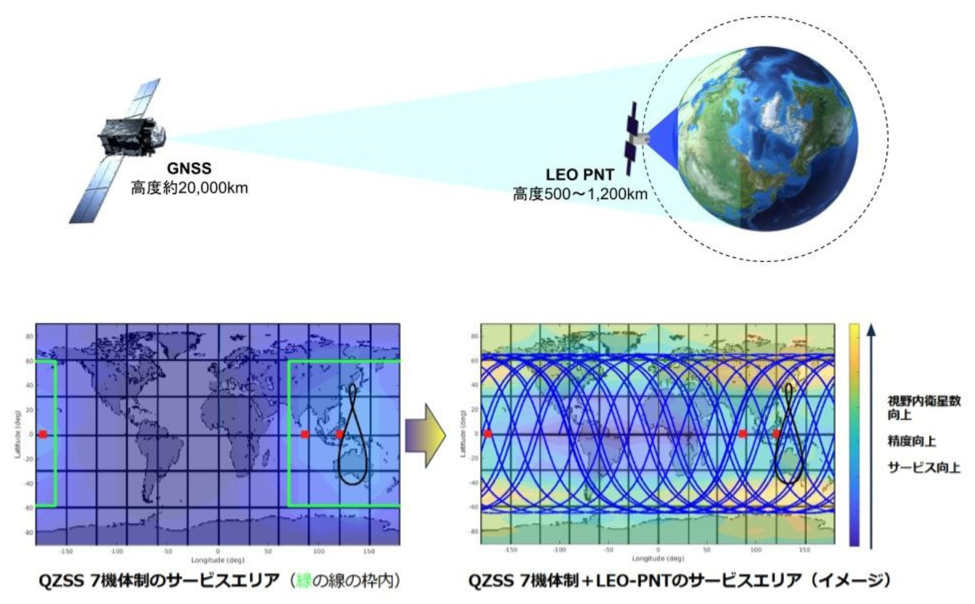
Diagram of the 7-satellite QZSS (Michibiki) system supplemented with LEO PNT. Source: ArkEdge Space
Sharp is building a universal satellite antenna
Sharp Electronics is developing a new antenna that will be able to connect to multiple satellite communications networks [Nikkei Asia], enabling users to use different networks with the same antenna. SpaceX Starlink, AST SpaceMobile, SES, Iris2, and Amazon Leo are all separate global satellite communications networks. China and Russia are also building one or more networks as well. Each provider generally distributes its own antenna for subscribers that use the service. Sharp is looking forward to a day in which construction and agricultural equipment, autonomous cars, defense, and other systems rely on satellite communications networks and may need to seamlessly switch between networks. Sharps' plans are to reduce the size of the antennas and wants to have an antenna ready by 2030.
Of course, this is Japan, so it's also about those juicy, juicy government subsidies. The Japan Ministry of Internal Affairs and Communications (MIC) is soliciting proposals for compact, lightweight universal antennas. It will choose two or three projects to support, planning to provide up to 7 billion yen (~US $44 million) in subsidies for up to five years. We can be fully confident that Sharp has submitted a proposal.
Another related note. Sharp plans to bring communications services from Luxembourg-based SES to Japan by 2027, so it's got its own dog in the fight. In terms of the satellite network fight, Sharp will have an uphill battle against other established wireless providers. NTT Docomo, KDDI and SoftBank have launched services with Starlink satellites. Rakuten Group is moving quickly to provide a competitive service with AST SpaceMobile.
Sharp is generally in a bind. It has had long-term success with LCD screens, but that business is rapidly declining, and it needs new markets. It's identified five markets in which it has a shot, and satellite terminals and artificial intelligence servers are part of that mix, so this antenna effort is a key strategic initiative.
🛰️ Technology and Infrastructure
- iQPS has announced it is expanding its constellation [SpaceMedia] plan from 24 satellites to over 36 satellites and will start using MaiaSpace [iQPS] to launch at least some of its satellites starting in 2029.
- MaiaSpace is a 2022 spinoff of ArianeGroup (which builds and launches the Ariane rocket) that is developing a 50m, two stage methylox-powered rocket that will be available as both reusable model (capable of 500kg to SSO) and expendable model (capable 1,500kg to SSO) and up to 4,000kg for some LEO orbits. MaiaSpace is in the midst of developing the former Soyuz launch facility at the Guiana Space Centre in French Guiana and plans an initial test launch in late 2027, followed by commercial operations in 2028. The iQPS agreement will start in 2029 and may include both dedicated and rideshare launches. iQPS represents the sixth commercial customer for MaiaSpace and the first one in the Asia-Pacific.
- I don't know if this represents a setback for Rocket Lab or if they are planning to scale back Electron launches as competition in the smallsat launch space heats up and they shift their attention to Neutron, but the greater capacity of the Maiaspace rocket than Electron will enable multiple satellites to be launched, whereas Electron is only used to launch one QPS-SAR at a time.
- iQPS is clearly diversifying its launch contracts for the next few years in order to both lock in capacity during a period of tight launch capacity.
- Synspective had a busy month of launches
- StriX 11 launched on Rocket Lab Electron on a mission Rocket Lab dubbed "Owl Around the World". The satellites was launched to 575km and 38° inclination.
- StriX-12 ("Owl By The Dozen") was sent to an orbit of 572km and mid-inclination of 38°.
- StriX-13 ("Owlright Owlright Owlright") was sent to a 559km orbit and mid-inclination of 37°
- Synspective has 14 more launches booked with Rocket Lab, but has recently also agreed to launch on an H3 in 2027 (see above)
- ArkEdge Space announced the end of a successful on-orbit demonstration campaign of an in-house-developed Onboard Computer (OBC) [SpaceMedia]. ArkEdge developed their own computer to determine if they could overcome the supply chain limitations for so-called "space-grade" components that are designed to be resilient to high levels of radiation found in orbit. They flew the experimental computer, which was built using automotive-grade components, on their "AE2a" microsatellite launched in June 2025. The test device was not the OBC used to operate the satellite. Rather, it was in an isolated, test configuration. In order to compensate for the lack of radiation resistance, ArkEdge developed their own hardware-abstraction software layer and a dual-bank memory architecture that could compensate for the memory errors that arise more frequently from radiation exposure. In addition to more than a year of successful operation, they were also able to upload a full flight software upgrade with no anomalies. ArkEdge will now use the new OBC design across all future satellites and extend the concept to other onboard electronics such as attitude and orbit control units. The AE2a bus was developed with subsidies from METI/NEDO-funded programs.
- What does this mean? Space-grade electronics components are expensive and often have long lead times and supply chain bottlenecks. By shifting to more common automotive grade electronics, ArkEdge will be able to reduce the cost of its satellites as well as ensuring a more flexible supply chain.
- JAXA announced that the Japan Meteorological Agency (JMA) has begun operational use of observation data from AMSR3 [JAXA] (Advanced Microwave Scanning Radiometer 3), the latest-generation microwave radiometer sensor aboard the "IBUKI GW" (GOSAT-GW) satellite. This marks the completion of calibration and validation of the AMSR3 sensor and beginning of use for national weather forecasting, sea-ice monitoring, and water-cycle observation workflows.
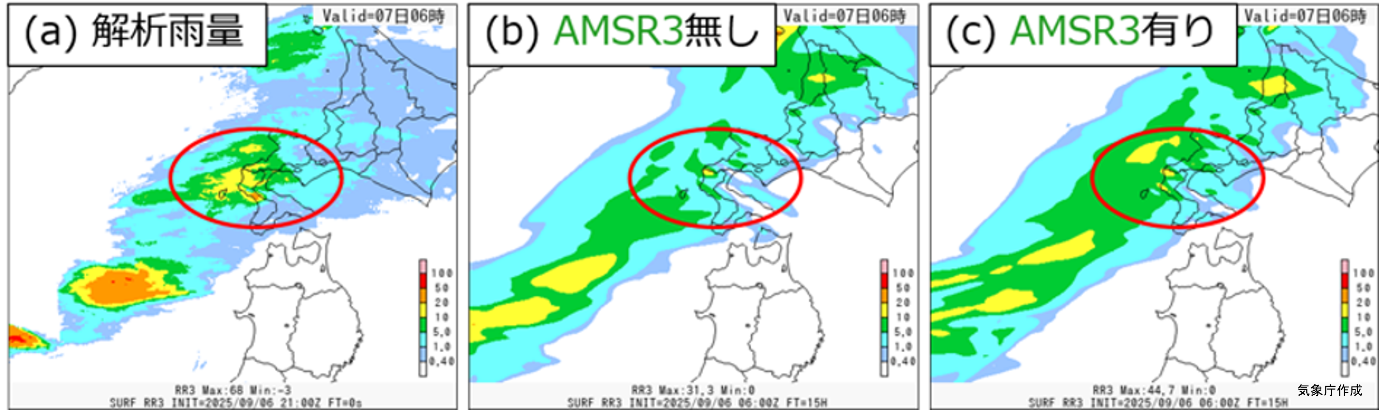
Examples of visualization improvements by using AMSR3 (far right). Source: JAXA/JMA
- Idemitsu Kosan has opened a space-grade CIGS solar cell development lab [SpaceMedia] on the UC Santa Barbara campus. The new facility will be located at the OASIS Innovation Hub, which is near a concentration of space companies. CIGS (copper-indium-gallium-selenide) solar cells have high durability to radiation, which extends their lifetime, as well as reduced rare-metal usage, an increasing concern as China cuts off access to rare earth metals. The lab will carry out prototyping and reliability testing with satellite manufacturers aimed at informing Idemitsu's R&D work in Japan. The company is also building a new production plant in Japan targeting mass-production of CIGS cells by 2027.
- Toshiba, Shin-Etsu Chemical, and Niigata University have developed a new perovskite solar cell that is 1.5x more durable [Nikkei Asia] than other similar solar cells. A more durable solar cell will have a longer lifetime and enable an initial investment in power generation to generate revenue longer. Toshiba developed the cell; Shin-Etsu made the casing that protects the cell; and Niigata developed the technology to improve the cell's durability. The cell is actually a tandem cell in which the perovskite element is surrounded by silicon cells. Perovskite cells, while providing greater energy generation capacity, are vulnerable to heat and humidity. The design will last for at least 3,000 hours in harsh environments 85C temperature and 85% humidity. The previous best perovskite cell developed by National University of Singapore and Chinese manufactures had a 2,000 hour lifetime under similar conditions. A lot of this technology is initially aimed at terrestrial power generation, but perovskite solar cells are beginning to be applied to orbital power as well.
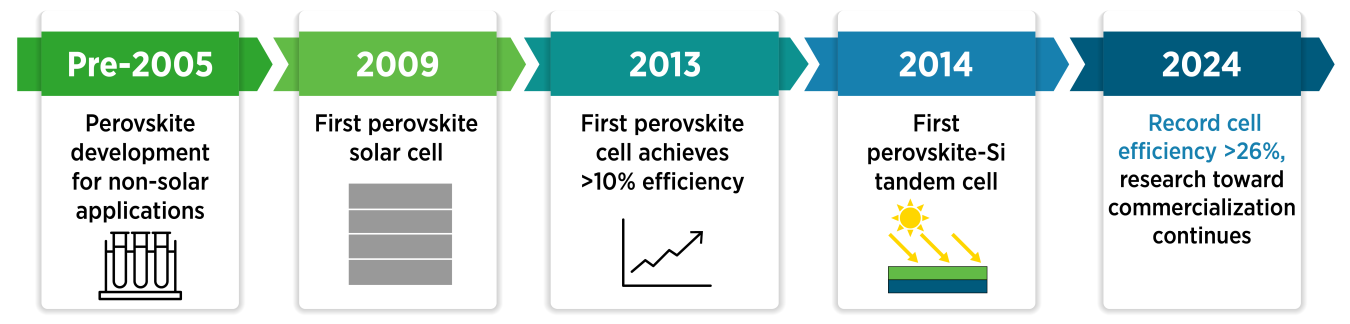
Perrovskite development since 2005. Source: U.S. Dept of Energy
- The Japanese Ministry of Defense (JMoD) plans AI-powered satellites to speed counterstrike decisions [Nikkei Asia]. I realize that AI satellites being used to launch missiles from orbit sounds like a science fiction doomsday trope, but in this case the AIs won't be launching missiles, at least not yet. The Japanese government already operates surveillance and communications satellites. The new satellites will be focused on analyzing surveillance data from orbit and thereby speed up decision-making regarding the location of adversaries. A key bottleneck for surveillance data observed from orbit is the time required for a satellite to pass over a ground station and deliver the data to the Earth. By transmitting data via optical connections to a nearby satellite with compute capacity, the imagery can be analyzed in orbit and a much smaller amount of data transmitted to the ground. This could speed decisions by several minutes, a critical amount of time when a decision needs to be made about a counterstrike. The Ministry of Defense plans to design and build test satellites in the FY2027 - FY2029 timeframe and then launch in FY2030. Japan's Self-Defense Forces rely on long-range "standoff missiles" as part of its deterrence strategy.
- Space BD has announced the launch of a rental service for satellite transport containers [SpaceBD] (人工衛星輸送用コンテナのレンタルサービス) certified for air transport of dangerous goods. Space BD has developed a lot of experience prepping satellites for launch and transporting them to their launch site. The new offering provides satellite operators with containers meeting IATA Dangerous Goods Regulations (DGR) requirements for lithium-ion battery packs and UN38.3 special approval, addressing a major cost and logistics burden when satellites are transported to overseas launch sites. By bundling container rental with export procedures, special-approval processes imposed by governments, and transport arrangements, Space BD aims to reduce both cost and administrative workload for satellite operators, as well as enabling faster and more flexible launch pre. Through the middle of 2026, Space BD has handled over 100 satellite integration and launch projects and more than 670 space experiment components sent to the ISS.
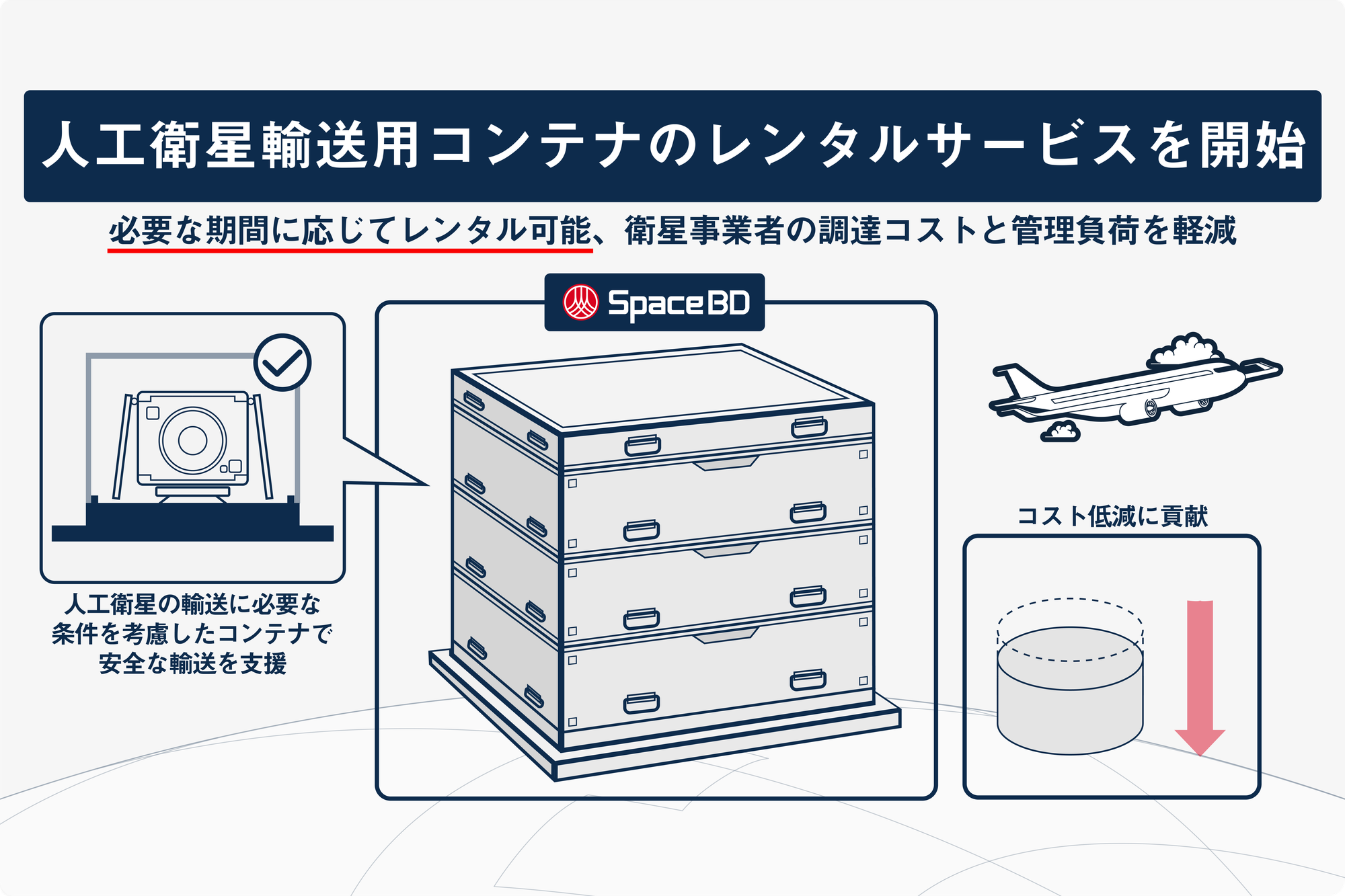
Diagram describing the rentable satellite transport containers. Source: Space BD
- Space One held a press briefing explaining the cause of the March 5, 2026 flight termination of its third KAIROS solid-fuel rocket, which was aborted 68.8 seconds after liftoff at ~29km altitude, despite the vehicle flying normally on its planned trajectory. The investigation found a communication anomaly in one of two redundant autonomous flight safety system channels, likely caused by electrostatic charge buildup generating electrical noise that reset the communication software between the flight safety monitor and stage-1 termination unit. Space One has been able to reproduce the phenomenon in ground tests. That's right folks, the system designed to ensure safety triggered the signal to blow up the rocket.
- For KAIROS flight 4, Space One will reinforce the electrostatic/noise countermeasures and improve communication reset recovery speed. Space One uses an autonomous flight safety system, rather than triggering an abort command from the ground. They are going to continue using the autonomous system, which they see as essential to their goal of 30 launches per year in the 2030s. No date has been set for the next launch
- The Annual JAXA Tanegashima Rocket Contest (種子島ロケットコンテスト2027年大会) has been scheduled for March 4-8 on the grounds of the Tanegashima Space Center. This will be the 23rd year of the competition with two main divisions - one for rocket launch and recovery; and one for CanSat development. A CanSat is a simulation of a real satellite built to fit inside the volume and shape of a standard 350ml drink can. The CanSat is dropped back to the ground using a parachute, collecting and transmitting data like air pressure and temperature in real time.

- iQPS announced that it will adopt the iodine-based electric thrusters [iQPS] from ThrustMe, a French firm starting with QPS-SAR 13. Satellites use thrusters like these to maintain their orbit and avoid collisions. iQPS has been testing the ThrustMe electric propulsion units on two of its operational satellites.
- Synspective announced a new product offering, called OMNIA, that will enable government and commercial customers to share access to SAR satellite constellation capacity. I've read three different articles on this, and I'm still not entirely understanding it. I mean, the whole point of a satellite constellation is shared capacity. As far as I understand it, OMNIA will enable customers to secure priority access to specific regions from satellites separate from Synspective's constellation, including unused capacity from "other participants" without owning satellites outright.
- What does this mean? We've recently seen a trend in nation-states purchasing dedicated access to satellites from Planet and ICEYE, in particular. This seems different - it's aimed at providing sovereign access with shared infrastructure in a manner that will reduce costs, increase observation frequency, and integrate Synspective's data analysis services. In addition, for defense and intelligence customers, Synspective will offer direct downlink as an option (bypassing Synspective's ground stations). But I'm still not sure how this is different from offerings from Umbra or Capella.
- Astroscale Japan and Danish satellite maker, Space Inventor, have developed a joint technology enabling satellite servicing, maintenance, and repair in orbit. Astroscale creates its own satellite servicing spacecraft. But in this case, in anticipation of future servicing needs, Space Inventor has developed a modular smallsat bus that now has Astroscale's rendezvous, proximity operations, and docking capabilities integrated. This capability consists of standardized mechanical and electrical interfaces that are part of the satellite manufacturing process, including a docking plate and interfaces for system diagnostics, delivering auxiliary power, and making orbital adjustments.
- What does this mean? Contemporary automobiles, agricultural equipment and other machines all have similar types of ports and interfaces for maintenance purposes, and Astroscale is extending this concept to satellites. The question will be whether it can make their standardized interface into the standard across the satellite industry.
- AstroX has signed a launch site agreement with Miyako City in Iwate Prefecture. This follows another such agreement AstroX had previously signed with Minamisoma in Fukushima Prefecture. Neither site is yet a full spaceport. But ASTRO GATE, a spaceport operator, has managed three small suborbital rocket launches from Minamisoma and the site is also being used for rocket testing by AstroX, SPACE WALKER, and Innovative Space Carrier.
- AstroX is developing the "Rockoon" technology, which involves launching a rocket from a high altitude balloon. The new agreement covers construction of testing and launch infrastructure, developing local business partnerships, and carrying out experiments expected to begin in October.
- The other nascent Japanese spaceport is at Oita Airport, which plans to have Sierra Space's reusable Dream Chaser spaceplane land there.
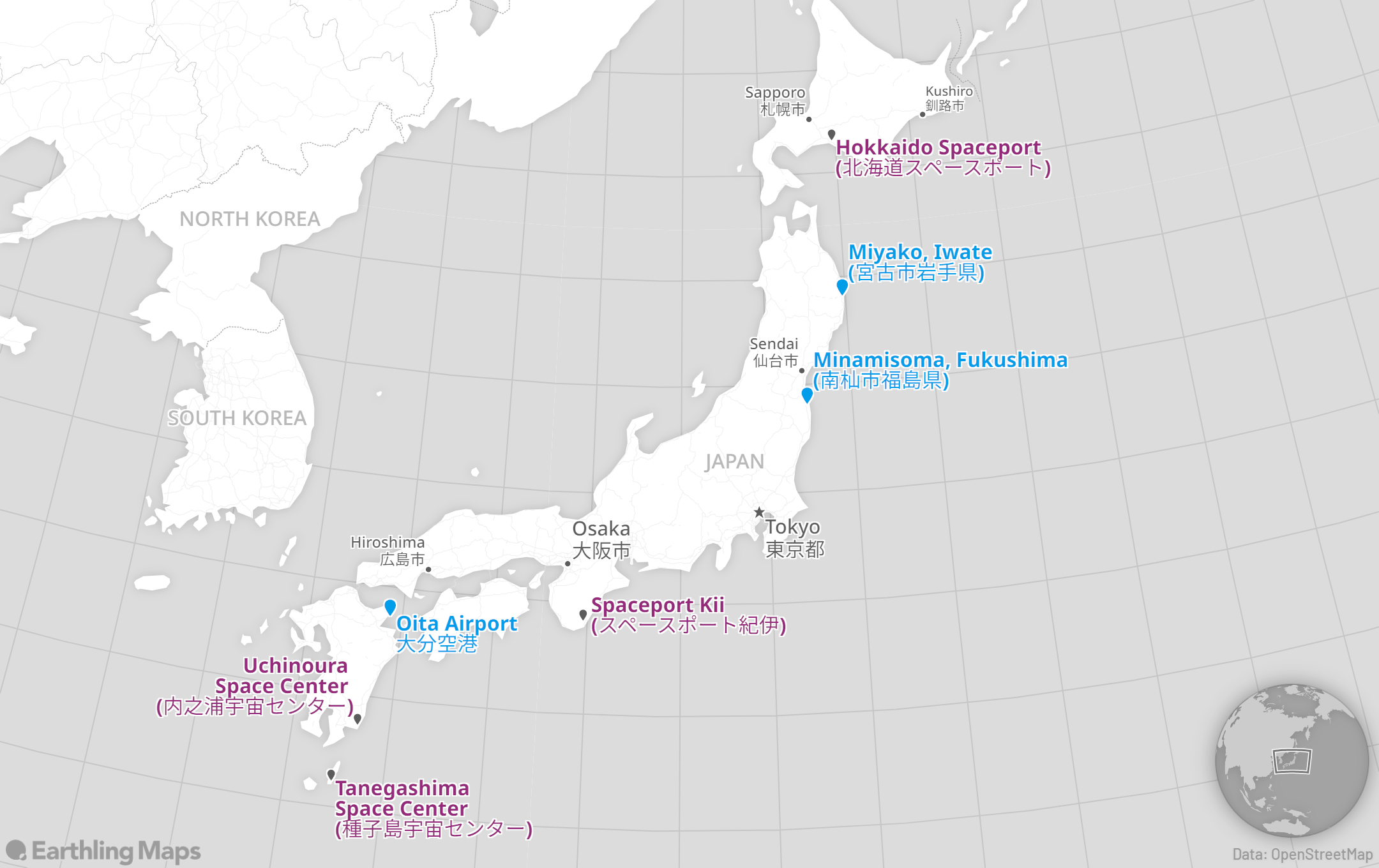
Map of active spaceports (in magenta) and up-and-coming spaceports (in cyan)
- The Space AI Robotics Association (SAIRA), a new organization founded in July Tokyo, is organizing a competition to be held on the International Space Station whereby teams will compete to control a robot using artificial intelligence [Nikkei Asia]. JAXA is planning to hold the event as soon as 2027 within Japan's Kibo experimental module on the ISS. The competition will be organized into two rounds. The first round will be held in a simulated environment replicating the ISS. The top teams will advance to the finals, which will take place on the station. The teams will develop physical AI models that will control the Int-Ball2, the spherical drone that already operates on the station, taking photos and videos on behalf of astronauts.
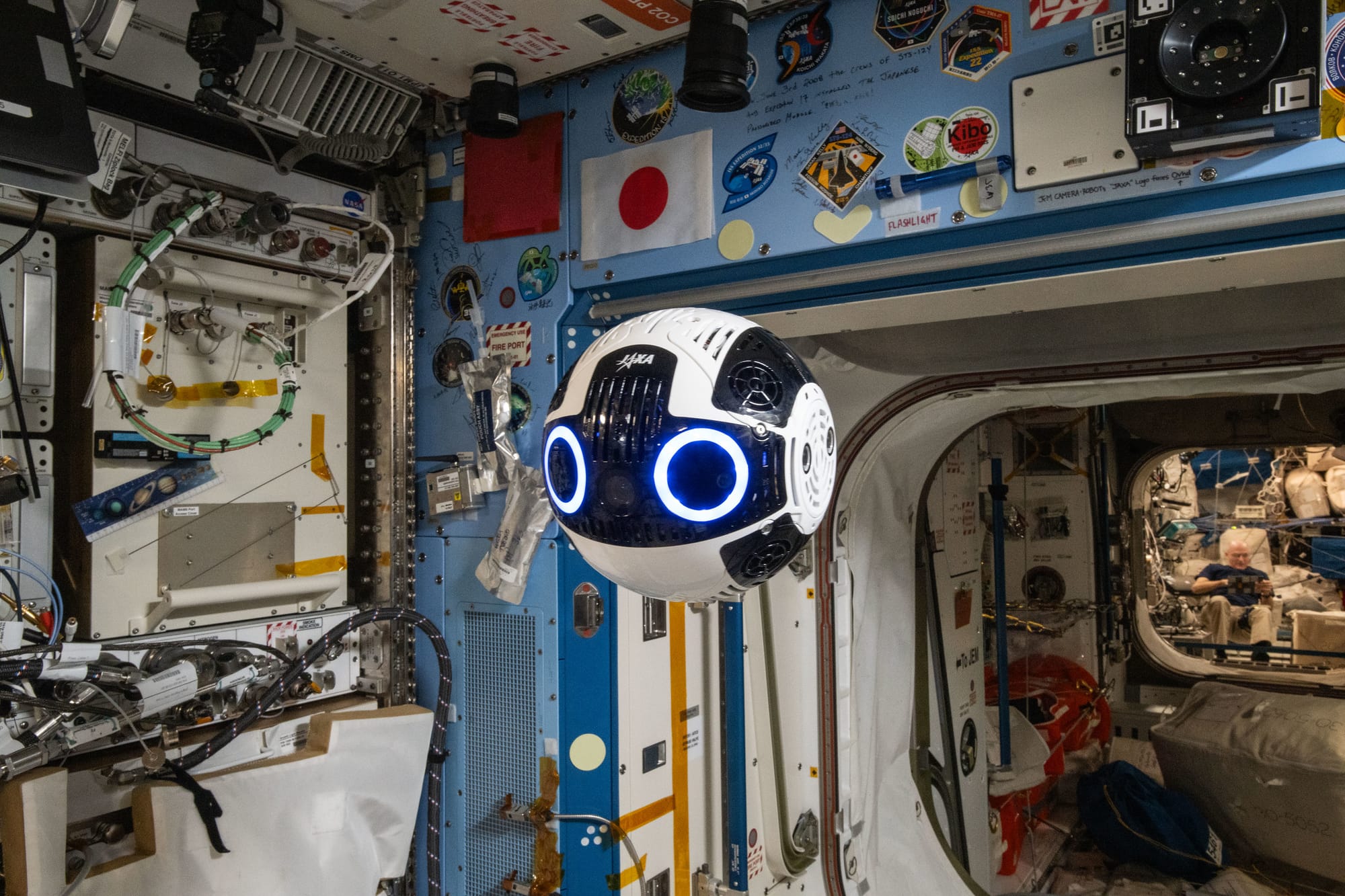
Int-Ball2 on the ISS that will be the target for competition teams. Source: JAXA
- EdgeCortix has unveiled a new chip, called Raiden, designed for physical AI [Nikkei Asia] and aimed at supporting both manufacturing and satellite applications. Alongside Rapidus, EdgeCortix is one of Japan's bets on reviving its semiconductor industry. With funding from both the Ministry of Economy, Trade and Industry (METI) and the New Energy and Industrial Technology Development Organization (NEDO), it has developed several specialized chips for AI computing on edge devices (outside a cloud data center). They've signed a multimillion-dollar deal with Kawasaki Heavy Industries (KHI) to integrate the Raiden chip in aerospace and defense systems. The Raiden predecessor, Sakura II, chips have also undergone radiation and other testing with NASA, the U.S. Defense Innovation Unit (DIU), and the U.S. Air Force.
- Raiden is designed as a modular "chiplet" that can be combined into more complex systems like building blocks. This makes it possible to rapidly design and build a scalable system as well as combine the EdgeCortix chips with other chips, like Google TPUs, NVIDIA GPUs, or the processors SpaceX is designing for orbital data centers.
💱 Contracts
- Axelspace announced a satellite imagery sales and distribution partnership [Axelspace] agreement with Airbus Defence and Space. Under the agreement, Airbus will sell medium-resolution optical imagery captured by Axelspace's GRUS Earth observation constellation. In addition to seven of the next-generation GRUS-3 satellites launched in July, some of the GRUS-1 generation of satellites continue to operate. The partnership combines Axelspace's high-frequency, wide-area imaging capabilities with Airbus's industry expertise and strong customer base to deliver imagery for agriculture, environment, and infrastructure sectors. It also obviously strengthens Japan-Europe space technology collaboration.
- Axelspace signed an MoU with Star Signal Solutions, a Tokyo-based startup specializing in space situational awareness (SSA) and space traffic management/coordination (STM/STC). Axelspace operates Earth observation constellations but can turn those cameras to orbital objects as well as having onboard positioning and attitude sensors. Star Signal is developing low-cost technology for cataloging small orbital debris under 10cm. The goal of the combined effort is to improve collision risk management as satellite traffic increases.
- Japan Space Imaging (JSI) announced the commercial launch of mid-wave infrared (MWIR) imagery and new tasking services [JSI] from UK-based SatVu's "HotSat-2" satellite. HotSat-2 carries a 3.5-meter resolution sensor capable of capturing high-precision thermal radiation data from ground surfaces and objects. Key use cases include monitoring of industrial facilities such as LNG plants and oil refineries, infrastructure and critical facilities, and environmental monitoring of water-bodies (e.g., temperature differentials in rivers, lakes, and thermal discharge from power plants). Because the MWIR sensor detects emitted thermal energy rather than reflected sunlight, it enables day-and-night observation capability.
- Orbital Lasers, a Tokyo-based developer of space laser and optical communications technologies announced a capital and business alliance with LogistLab, a Kyoto University-spinoff venture that does high-precision processing and measurement of large optical mirrors. Orbital Lasers has made an equity investment in LogistLab to deepen their existing collaboration and build a stable supply chain for large high-precision mirrors, the core components of satellite-mounted telescopes used in both laser transmission and reflected-light detection systems. LogistLab's expertise stems from its role in developing the 3.8m "Seimei" segmented-mirror telescope—the largest in East Asia and Japan's first of its kind—including large-scale free-form optical surface grinding, polishing, and measurement technology. The partnership aims to strengthen the manufacturing and development base supporting Orbital Lasers' core technologies - laser transmission, high-resolution reception, and satellite bus systems), accelerating commercialization of LiDAR satellites for precision terrain mapping and laser-based space debris removal.
- Mitsubishi Heavy Industries (MHI) and NEC have inked a strategic alliance to collaborate on domestic defense drones [Nikkei Asia] as well as command and control systems powered by AI. MHI and NEC already collaborate on defense projects with MHI destroyers and fighter jets integrating NEC's radars and sensors.
- What does this mean? Chinese companies manufacture more than 70% of drones sold worldwide. The Japanese government views cultivation of a domestic manufacturing capability as a national security priority.
- GMO Cybersecurity by Ierae, part of GMO Internet Group, signed a memorandum of understanding with Taiwan's National Taipei University of Technology (NTUT) and the Telecom Technology Center (TTC) to address LEO satellite cybersecurity [SpaceMedia]. The three-way partnership will analyze cyber threats affecting satellites, ground control systems, communication links, user terminals, and supply chains; develop security standards; and cultivate cross-disciplinary talent.
- Sompo Japan Insurance will use ICEYE's "Flood Insights" solution. ICEYE not only builds SAR satellites, it has developed "Flood Insights" for flood information and rapid damage assessment. Sompo Japan Insurance has signed a contract to ICEYE's solution [ICEYE] as part of their "HIKESHI DNA 2030 Project" resilience initiative. Japan is seeing an increase in flood and heavy rainfall damage across the country. The partnership reflects growing adoption of satellite data for rapid damage assessment and post-disaster response support in the insurance sector. That's got to sting for Japan's native SAR constellations - Synspective and iQPS - but ICEYE has been investing in a flood insurance solution for several years and has a good customer base and deep expertise.
- LAND INSIGHT has launched a satellite and terrain data analysis service across 18 municipalities [SpaceMedia] in Tochigi Prefecture aimed at supporting farmland preservation in mountainous and hilly areas. The national government offers a subsidy (中山間地域等直接支払制度) to support maintenance and continued use of hilly or mountainous land in danger of abandonment. The AI-driven service identifies farmland eligible for the subsidy but not currently receiving it, which, in turn, helps prefectural government staff to target outreach and reduce administrative burden. The project builds on LAND INSIGHT's prior work digitizing 700,000 farmland parcels across all 25 municipalities in Tochigi and includes 5- and 10-year forecasts of farmland abandonment based on terrain and geographic data.
- Sumitomo is one of Japan's largest trading companies. They have signed an agreement with Sakana AI to get the AI company's products into the hands of more than 100,000 companies that are Sumitomo clients [Nikkei Asia], most of which are small and mid-sized companies that may face significant challenges adopting and integrating AI into their operations. Much of Sakana AIs enterprise adoption has been in large companies, so this arrangement has the potential to significantly expand its footprint. Sumitomo would be in a position to generate services revenue by assisting firms with AI integration. Initially, the pair will focus on financial institutions and manufacturers with significant security concerns. Small and mid-sized firms will follow.
- What does this mean? Earlier this summer, the US government temporarily suspended access by foreign entities to the leading edge model from Anthropic. This alarmed both governments and enterprises among allied nations like Japan, and increased focus on efforts to develop domestic, sovereign alternatives.
- Kawasaki Heavy Industries and EdgeCortix are partnering to develop AI-enabled aerial defense platforms [SatNews].The new agreement will begin with a three-year plan to combine Kawasaki's defense engineering expertise with EdgeCortix energy-efficient AI processing semiconductors. EdgeCortix's work has already been tested with computing in military environments and its SAKURA-II AI coprocessor has been certified by NASA for its radiation resiliency
- BULL Co. has signed an MoU with India's Samtel Avionics to explore space debris mitigation solutions [SpaceMedia]. This would involve combining BULL's passive post-mission disposal (PMD) technology - a membrane extended from a satellite to increase its drag and accelerate reentry - with Samtel's satellite platforms and debris removal vehicles. The collaboration will assess technical requirements, system interfaces, and development milestones, with potential future phases including product development, manufacturing, licensing, and commercialization. This could eventually lead to retrofitting BULL's passive PMD devices to existing on-orbit debris using Samtel's removal vehicles. Samtel Avionics is an established defense and aerospace firm that has recently expanded into satellites, including opening a new manufacturing facility in Gurugram, Haryana in August 2026. They are planning a 72-satellite LEO constellation for IoT, ADS-B aircraft tracking, and AIS ship tracking as well as this debris removal vehicle concept that would likely compete with Japan's Astroscale.
- Tenchijin has signed a strategic MoU with French company U-Space to jointly develop next-generation thermal infrared Earth observation satellite systems [Tenchijin]. France and Japan signed a government level CNES-JAXA agreement in April 2026. Under this new partnership, U-Space will act as the prime contractor and integrator, organizing the design, manufacturing, and integration of the new satellites and future constellation. Tenchijin will lead commercialization of high-resolution thermal infrared data and the value-added services that often go alongside. The new Land Surface Temperature (LST) data is aimed at infrastructure monitoring, water resource management, agricultural optimization, and climate risk mitigation. This agreement potentially aligns with expansion of Tenchijin's satellite data application "Space Water Bureau" (宇宙水道局) which began with an ability to identify locations for prioritizing water system leak inspections and has more recently expanded to include a broader set of features for water utility infrastructure maintenance.
- Astroscale France announced that a consortium led by French satellite company Exotrail, alongside Eutelsat, has been selected under the French government's "France 2030" national investment program [Astroscale]. Under the contract with the French space agency CNES, Exotrail will serve as the prime contractor for a mission to demonstrate end-of-life deorbiting services for Eutelsat OneWeb satellites. Exotrail will leverage its "Spacevan" servicing vehicle, while Astroscale France will contribute rendezvous, proximity operations, and docking (RPOD) expertise drawn from its flight heritage. Eutelsat will obviously provide the targets: defunct OneWeb satellites. The new contract builds on the Astroscale France–Exotrail strategic partnership agreement signed in April 2026 in Tokyo aimed at establishing a repeatable, sovereign end-of-life satellite servicing capability. Astroscale France will be expanding its Toulouse technical center to support the program. The new contract plans for launch of the mission in the 2029 to 2030 timeframe.
- Astroscale France signed a similar partnership deal [SatNews] with HEMERIA, a French satellite firm, that, if successful, will result in a similar type of integration. HEMERIA has developed microsatellites for defense in geostationary (GEO) orbit. These so-called "agile" spacecraft are designed to move around in orbit in order to approach and inspect other orbiting spacecraft. That's a tricky proposition when you are moving at more than 3 km/sec, and Astroscale brings its experience approaching orbital debris. In addition to Space Inventor and HEMERIA, Astroscale has signed a bunch of similar strategic partnerships with SkyPerfect JSAT, Airbus, BAE Systems, Exotrail, Xona, and Honda, but there are a lot of satellite bus manufacturers out in the world, and it will need many more such agreements to build a dominant position.
- Axelspace has signed a business partnership MoU with Pacific Consultants aimed at using satellite data to address infrastructure challenges [Axelspace]. Pacific Consultants has more than 75 years of experience in civil engineering, including planning, surveying, design, construction management, and maintenance of physical infrastructure (roads, railways, rivers, and ports and harbors). Axelspace operates several 100kg-class optical satellites. Under the MoU, the two companies will use Axelspace's satellite imagery to develop and sell new services for infrastructure management and disaster response.
- iQPS, the SAR constellation operator, has agreed to a similar multi-year collaboration with Italy's e-GEOS (a joint venture of Leonardo Group's Telespazio (80%) and the Italian Space Agency (20%). Similar to the Axelspace/Pacific Consultants deal, this one will monitor infrastructure and do disaster response [iQPS]. However, e-GEOS also operates its own X-band SAR constellation, COSMO-SkyMed. The two firms will develop joint software and data solutions that combine the QPS-SAR and COSMOS-SkyMed imagery. The two constellations have complimentary orbital configurations that, when combined, improve the observation frequency and coverage they can achieve as well as expanding both firm's sales channels.
- Japan Manned Space Systems (JAMSS) and Nåva Space, a Norwegian firm, have signed an MoU to cooperate on future crewed lunar surface exploration [JAMSS], including EVA systems and astronaut health. JAMSS has more than two decades of experience supporting operations on the ISS Kibo module as well as JAXA astronaut health management. Nåva has been developing a next-generation EVA spacesuit that will integrate astronaut, suit, and mission operations into an integrated platform. The prototype is called "MK1" and it's currently being tested in ESA's lunar simulation facility, LUNA, in Cologne, Germany. JAMSS will begin by participating in Nåva's EVA test campaign at the LUNA facility.
- Solafune announced that they have been awarded a new contract by Japan's Ministry of Defense (JMoD) to support enhancement of data analysis models used for joint operations [Solafune]. Solafune will apply its AI-based "Planetary Intelligence OS" to support defense decision-making by combining geospatial, open source, and signals intelligence. This builds on Solafune's contracts with the Japan Ground Self-Defense Force (JGSDF) and its ongoing expansion into Africa, Europe, and SE Asia.
- Synspective's Board revised its launch insurance arrangements [Synspective] covering the next nine StriX satellite launches. The new agreement will add a deductible that will significantly reduce its insurance premiums. Under the new terms the first launch failure will not be compensated but a second or subsequent failure will be fully covered for manufacturing and launch costs. Essentially, Synspective will self-insure for the first launch loss. The insurance savings will be directed at accelerating manufacturing and launch of satellites.
- AstroX, Akashi Beer, and Kochi University of Technology have signed a three-way contract to launch the "Beer to Space Project" [SpaceConnect] which will transport Akashi-brewed beer in an 11cm aluminum bottle to space via AstroX's suborbital "Rockoon" (rocket-balloon) launch system after undergoing environmental testing at Kochi Univ of Technology. The same mission will also carry a research project that will use infrasound sensors developed by Kochi University of Technology to measure sub-20Hz sound propagation across space, stratosphere, and ground-level altitudes. AstroX is aiming to launch to 100+km flight in FY2026 but the timing for this Beer and infrasound flight is not clear.
💴 Equity Funding
- Power Laser Technology (株式会社パワーレーザー), a, spinout from the Osaka University Institute of Laser Engineering, closed a funding round totaling ¥1.2 billion (~US $8 million) through a third-party allocation of shares and other instruments. This brings their cumulative funding to roughly JPY 1.6 billion. Investors include Incubate Fund VI, IF Everlast, Frontier Innovations, Angel Bridge Unicorn Fund 3, DBJ Capital, Mori Building Innovation Fund, Aozora HYBRID Fund 3, Gogin Goen-Musubi Fund 1, Tsukuba Exceed Fund 2, forStartups Capital, SMBC Venture Capital Industry-Academia Collaboration Fund 3, Mizuho Growth Support Fund 5, and Japan Finance Corporation. The company plans to use the funding to develop a space situational awareness (SSA) business targeting small orbital debris and to advance development and application testing of a high-power laser source for laser fusion energy.
- Tellus Global completed a management buyout of Tellus Co, taking over the satellite data platform business [SpaceMedia], alongside a third-party allotment funding round of ¥900 million. Tellus Global was established in February 2026 and formally took over the business in August. The "Tellus" platform handles 45 types of government and private geospatial data. It was originally launched in 2018 under METI's open satellite data initiative and operated by Sakura Internet. It was spun off as a Sakura Internet subsidiary in 2024 before this buyout created an independent entity. Investors included Ant Innovations Fund 1, Mitsubishi UFJ Capital Fund 10, DEEPCORE Fund 3, DG Daiwa Ventures (DGDV Fund III), and Fusic Co. Funds will strengthen development, upgrade existing services, and pursue new business including expansion into security/defense and overseas markets.
- ispace secured a ¥3 Billion (~US $19 million) debt facility from Shizuoka Bank to secure working capital for the lunar mission development [ispace] and other related expenses. This is a 3 year floating interest rate loan. Working capital loans like this are not unusual, but it suggests that the timing of incoming revenue and investments are not aligned to support the firm’s financial stability.
- Stoke Space has not yet launched a rocket, but they've managed to raise another $1 billion in a Series E round [Payload], bringing the total capital raised to date to $2.3 billion. Point72 and Spark Capital co-led the round. Why is this relevant for Japan? Woven Capital, the investment arm of Toyota was a returning investor in the latest round. Stoke is developing the Nova Pathfinder rocket, an initial design that is aiming for 3,000 - 7,000 kg capacity and a fully reusable design out of the gate as well as an innovative second stage propulsion design. The SpaceX Falcon 9 only ever achieved first stage reusability and SpaceX is still struggling to achieve full reusability on its Starship design, so if Stoke can pull off all of these objectives, it will be an impressive feat.
- U.S. positioning firm Trimble has acquired [SpaceMedia] Terasat Japan (日本テラサット株式会社), a provider of GNSS correction services in Japan that uses the Japanese government's Geospatial Information Authority (GSI) network of over 1,300 Continuously Operating Reference Stations (CORS) stations. These correction services enable engineering and other firms that need highly accurate positioning measurements to avoid the need to set up their own base stations for each project.
- Terasat's virtual reference station (VRS) network, which already used Trimble technology, will now be owned and operated by Trimble, delivering real-time centimeter-level positioning. The acquisition expands Trimble's global VRS footprint (which already covers North America, Europe, Australia, and New Zealand) into Japan, providing access to the surveying, mapping, construction, automotive, and agriculture sectors.
- FWIW, I'm a bit surprised this wasn't flagged by Japan's new Japan Foreign Investment Committee (JFIC) (a similar body to CFIUS in the U.S). But maybe it was and it passed review. Terasat doesn't own the network of reference stations - that would remain with the Japanese government - so there isn't a loss of sovereign autonomy.
- Mitsubishi Heavy Industries (MHI) has signed a business and investment agreement [Nikkei Asia] with Japanese artificial intelligence startup Preferred Networks. MHI will invest ¥10 billion (~US $64.4 million) in Preferred Networks, strengthening the business partnership they signed in June to develop AI tools that will be integrated with defense and security equipment and systems developed by MHI.
- Synspective has signed a syndicated loan agreement with Mizuho Bank for ¥20 billion (~US $135 million) with participation from 13 major Japanese financial institutions (SMBC, MUFG, Shoko Chukin Bank, Sumitomo Mitsui Trust, Resona, Aozora, and regional banks). The funds will be used to support satellite manufacturing and launch costs tied to the large joint venture JMoD contract Synspective signed with other participants in early 2026. While Synspective recently reported its first profit, the loan-related expenses are likely to cut into that in the near term.
🔭 Science
- The ESA/JAXA BepiColombo mission, launched in 2018, has been in transit for 8 years and is finally approaching its goal. In September, the 3-part spacecraft was reduced to two parts when the two science modules separated from the transfer vehicle that had propelled them to their destination. The remaining two conjoined spacecraft have about 3.3 million km left to travel before they separate in November and begin their science missions. Mercury is the least studied of the inner planets and these two probes, one from JAXA and one from ESA, aim to unravel some of its mysteries.
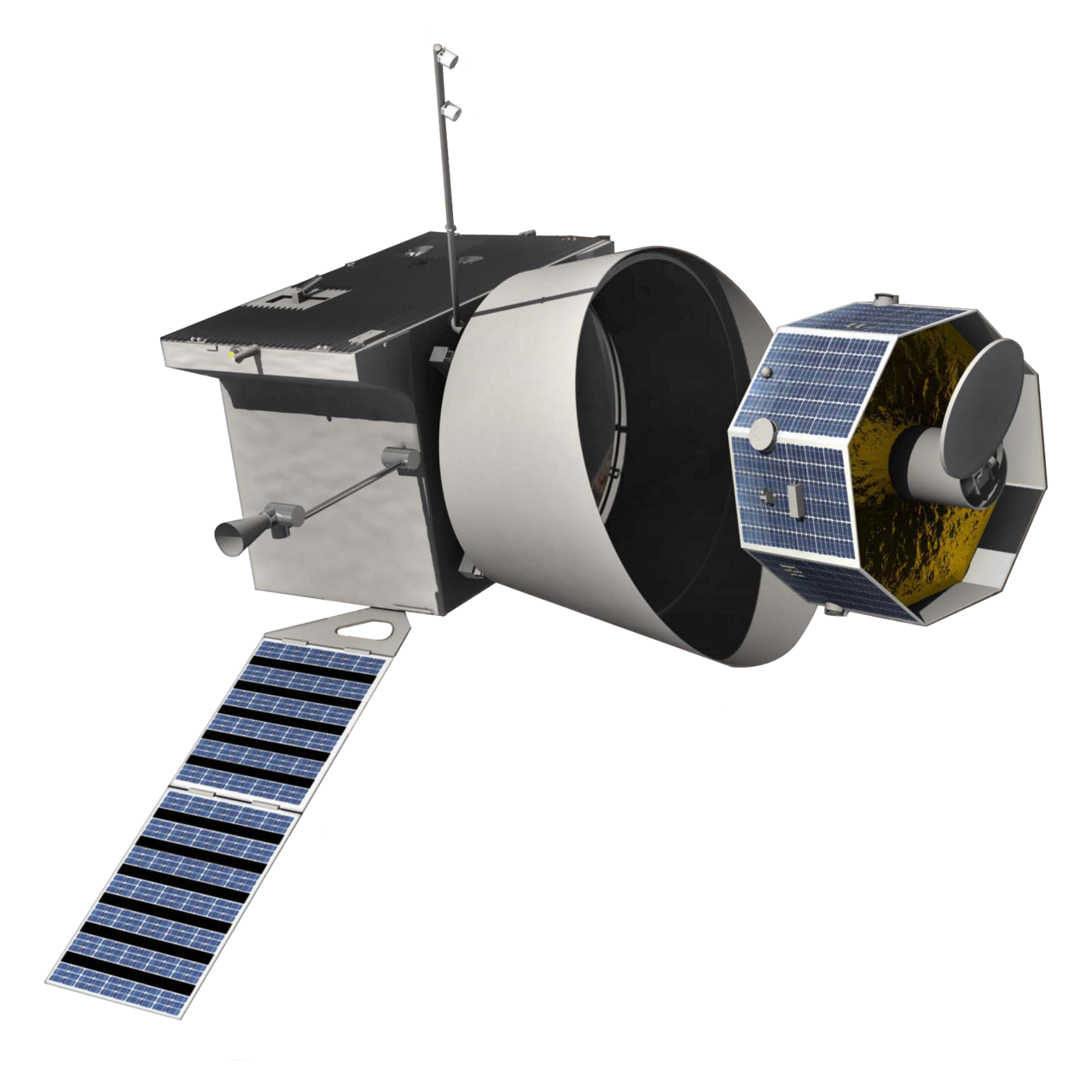
The remaining two modules are the Mercury Planetary Orbiter (MPO) on the left, developed by ESA, and the Mercury Magnetospheric Orbiter (MMO) on the right, developed by JAXA
- Researchers at the Japan Agency for Marine-Earth Science and Technology (JAMSTEC) have developed an artificial intelligence tool called DeepLitterAI that processes seabed imagery [Yenişafak] twice as fast as human analysis, aiming to enable real-time monitoring of marine pollution.

The seabed is a mess. Source: Yenişafak
🗺️ International Collaborations
- ESA/JAXA joint mission to Apophis, RAMSES, is progressing toward launch. ESA is building most of the spacecraft in two parts. The Core Module, containing all of the main electronics and the onboard computer, is being assembled by OHB Italia. This week, the power was turned on for the first time [ESA]. The Propulsion Module is being manufactured by ArianeGroup in Germany. The two parts will be brought together at ESA’s ESTEC Test Centre in the Netherlands in spring 2027.
- JAXA is contributing three key elements to the RAMSES mission. Meisei is building the Thermal Infrared Imager (TIRI) for scanning the surface temperature of the asteroid. NEC is developing lightweight solar array wings. Finally the mission will launch on an H3 rocket in spring 2028.
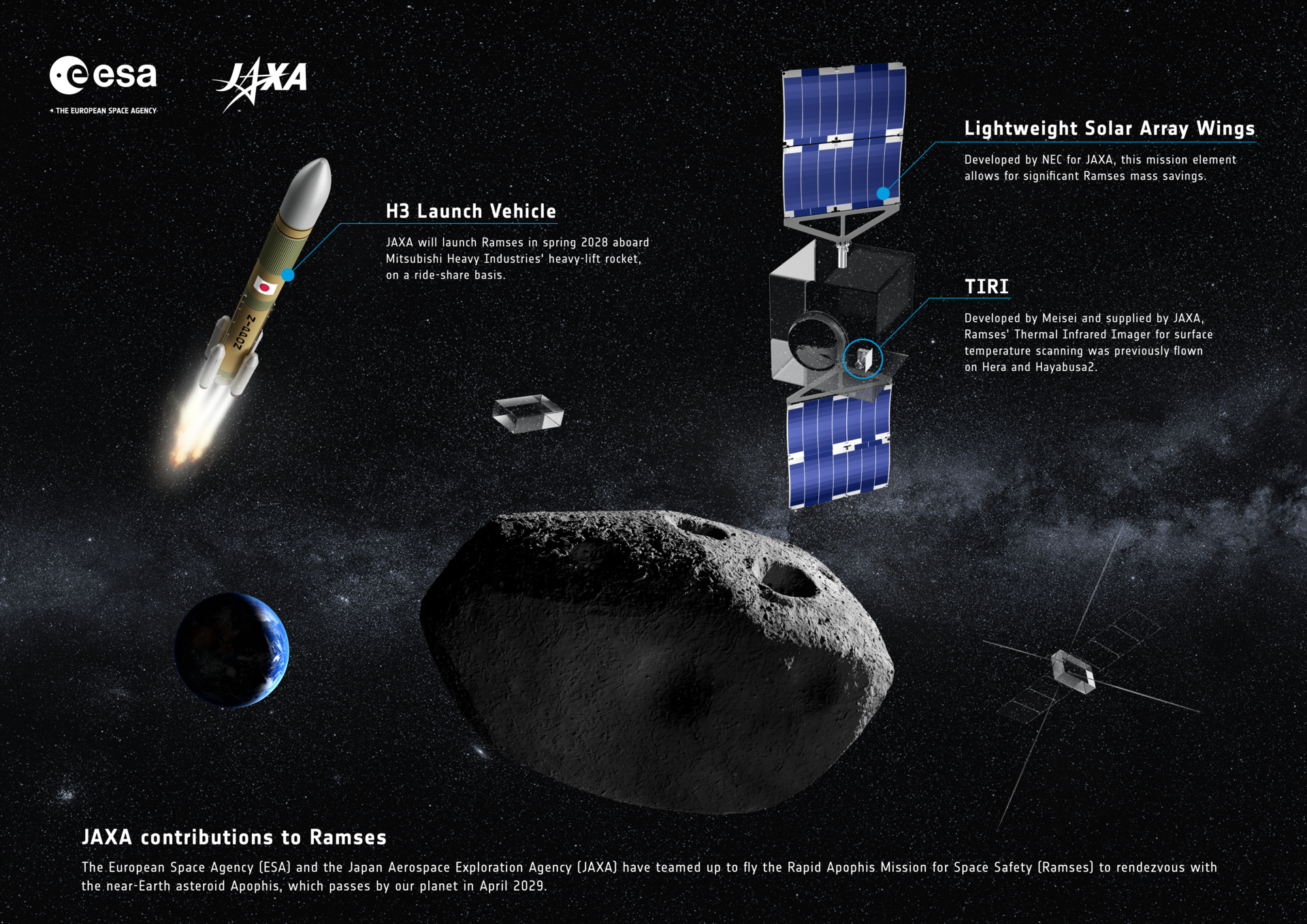
JAXA’s contributions to the RAMSES mission to Apophis. Source: JAXA
- Japan's Cabinet Office Secretariat for Space Policy and the U.S. Federal Aviation Administration (FAA) have signed a Memorandum of Cooperation on International Commercial Space Transportation. Under the new agreement, Japan and the U.S. will share best practices and align safety review procedures and risk management criteria when Japanese firms launch rockets from U.S. sites and vice versa [Kyodo News]. The agreement covers rocket launch/reentry, suborbital flight, human spaceflight, and spaceports. It will not immediately harmonize the two separate licensing regimes but it sets up recurring bilateral meetings to try to reduce the current burden faced by launch operators that have to pursue two separate approval processes when launching internationally.
🎥 Videos
JAXA
📆 Asia-Pacific Conferences & Events
This newsletter is mostly focused on Japan, but I also like to highlight events across the Asia-Pacific region. Some upcoming conferences include:
October 2026
- 32nd Asia-Pacific Regional Space Agency Forum (APRSAF-32) - 27 - 30 Oct - Bangkok, Thailand
- UN/Pakistan International Conference on Leveraging Space Technology for EW4All, Climate Action and Disaster Risk Assessment - 27 - 31 Oct - Islamabad, Pakistan
- JSASS Annual Meeting 2026 - 28 - 30 Oct - Sapporo, Japan
- Thailand Space Expo 2026 - 28 - 31 Oct - Bangkok, Thailand
November 2026
- IAU Symposium 409 - Innovative Research and Techniques in Astronomy Communication - 2 - 6 Nov - Mitaka, Japan
- Asia-Pacific Space Community Council (APSCC) - 3 - 5 Nov - Denpasar Bali, Indonesia
- Committee on Earth Observation Satellites (CEOS) 40th Plenary - 3 - 6 Nov - Hobart, Tasmania, Australia
- 12th UNISEC-Global Meeting - 4 Nov - Online
- OGC Asia Forum - 4 Nov - Taipei, Taiwan
- TASTI 2026 (TASA Taiwan) - 8 - 11 Nov - Tainan, Taiwan
- 2nd Nano-satellite IoT Constellation Program Workshop - 8 Nov - Tainan, Taiwan
- 3rd Deep Space Workshop - 8 Nov - Tainan, Taiwan
- 9th Asia-Oceania Space Weather Alliance Workshop - 8 - 11 Nov - Tainan, Taiwan
- 10th Mission Idea Contest Preliminary Workshop (PreMIC 10) - 9 Nov, Tainan, Taiwan
- 15th Nano-Satellite Symposium - 9 - 11 Nov - Tainan, Taiwan
- SPIE Asia-Pacific Remote Sensing 2026 - 9 - 12 Nov - Yokohama, Japan
- Advancing Earth Observation Forum 2026 - 9 - 12 Nov - Hobart, Tasmania, Australia
- 70th Space Science & Technology Conference (第70回 宇宙科学技術連合講演会) - 10 - 13 Nov - Utsunomiya, Japan
- China International Aviation & Aerospace Exhibition (Airshow China) - 10 - 15 Nov - Zhuhai, China
- International Workshop on ATM/CNS (IWAC 2026) - 17 - 19 Nov - Tokyo, Japan
- JAXA Space Debris Workshop 2026 (第12回スペースデブリワークショップ) - 18 - 20 Nov - Tokyo, Japan
- Indo Aerospace Expo and Forum - 18 - 21 Nov - Jakarta, Indonesia
- International Lunar Sample Research Symposium 2026 - 20 - 23 Nov - Hong Kong, China
- Locate26 - 24 - 26 Nov - Melbourne, Australia
- 10th Digital Earth Summit - 24 - 26 Nov - Melbourne, Australia
- 13th Hayabusa Symposium / Space Materials Science Symposium (第13回 宇宙物質科学シンポジウム) - 24 - 27 Nov - Sagamihara, Japan
- FOSS4G Hokkaido 2026 - 28-29 Nov - Kita Hiroshima, Hokkaido, Japan
- CEOS WGCV SAR Calibration & Validation Workshop 2026 - 30 Nov - 4 Dec - Perth, Australia
- Asian Microgravity Symposium 2026 (AMS2026) - 30 Nov - 4 Dec - Hyogo, Japan
- Nihombashi Space Week 2026 - 30 Nov - 12 Dec - Tokyo, Japan
December 2026
- IEEE India Geoscience and Remote Sensing Symposium (InGARSS 2026) - 1 - 4 Dec - Hyderabad, India
- Global New Space Forum 2026 - 4 - 5 Dec - Seoul, South Korea
- 16th Asia-Oceania Meteorological Satellite Users Conference - 6 - 11 Dec - Melbourne, Australia
- 8th Singapore Space Symposium - 7 - 9 Dec - Singapore
- Symposium on Space Flight Dynamics FY2026 (宇宙航行の力学シンポジウム) - 7 - 8 Dec - Sagamihara, Japan
- AEC Forum (Geospatial + BIM + Digital Twins) 2026 - 21 - 22 Dec - Bharat Mandapam, New Delhi, India
If you’ve made it this far, thank you for reading. Please be in touch via LinkedIn with any feedback, questions, comments, or requests for future topics. And if you have a friend or colleague that you think would enjoy JEO, please share it!
Until next time,
Robert
The full moon shines bright:
here upon the tatami floor,
shadows of the pines.
– Takarai Kikaku (宝井 其角, 1661–1707)
名月や
畳の上に
松の影
Meigetsu ya
tatami no ue ni
matsu no kage