JEO 17 - Japan’s Space Strategy Fund in 2026
JAXA has started the third funding cycle of the Space Strategy Fund, and it's time to check in on this key pillar of Japan's industrial policy and space R&D investment.
Welcome to Japan Earth Observer (JEO), a monthly newsletter about the space, Earth observation, and geospatial industries in Japan.
JEO 17 - Japan’s Space Strategy Fund in 2026
Welcome to Japan Earth Observer (JEO), a free newsletter about the space, Earth observation and geospatial industries in Japan. This month we'll take another look at the Space Strategy Fund, what was funded in Phase 2 and some observations now that the Phase 3 topics have been published.
JAXA’s Space Strategy Fund [JEO 3] was one of the first JEO topics that I wrote about in early 2025. At that time, JAXA had just finished announcing the funding awards from the first year. More than a year later, it has finished announcing the Year 2 funding awards, and the topics for Year 3, and I thought it might make sense to summarize where this major industrial policy instrument stands, particularly as it provides a potential template for Prime Minister Takaichi’s ambitions for major increases in government investment across 17 strategic technology sectors [Nikkei Asia] in which the Japanese government believes it has an edge and can build the globally competitive products and services of the future.
A Brief Background
Japan’s Space Strategy Fund (宇宙戦略基金) is a ¥1 trillion (~US$ 6.7 billion) investment fund that aims to advance Japan’s space industry over a 10 year period in three key priority areas - 1) space transportation (rockets, spaceports, etc.); 2) satellite technology, and 3) Earth/lunar exploration - plus a category for cross-cutting topics. The fund is an industrial policy response to several observations:
- The emergence of many new space industry actors - there are now nearly 80 space agencies around the world today, 16 of which theoretically have domestic launch capacity, but only a few are able to launch on a regular cadence.
- A sense that Japan’s space capabilities have seen a relative decline in international competitiveness. Japan is not alone on this concern; the rapid pace of developments in the U.S. and China as well as the deep pools of capital in these two countries are raising competitive and dependency concerns around the world.
- Given the smaller marketplace and smaller capital markets, maintaining an independent, sovereign space capacity will require supply chain autonomy, investment in technology innovation, and government support as both R&D funder and initial customer.
The Strategy Fund has three goals:
- Grow the Japanese domestic space market from about ¥4 trillion to ¥8 trillion by the early 2030s.
- Contribute to solving global and societal issues by utilizing space including societal challenges in energy, environment, agriculture, disaster management, and public health
- Frontier technology development - this isn’t funding to expand the status quo; it aims to advance the state-of-the-art
While JAXA is the funding conduit and operates the mechanics of soliciting proposals and selecting awardees, the topics and funding actually come from three ministerial agencies: Ministry of Economy, Trade and Industry (METI) (経済産業省), Ministry of Education, Culture, Sports, Science and Technology (MEXT) (文部科学省), and Ministry of Internal Affairs and Communications (MIC) (総務省). The whole effort is overseen by the Cabinet Office (CAO) (内閣府), which is responsible for handling the day-to-day affairs of the Cabinet and is overseen by the Prime Minister.
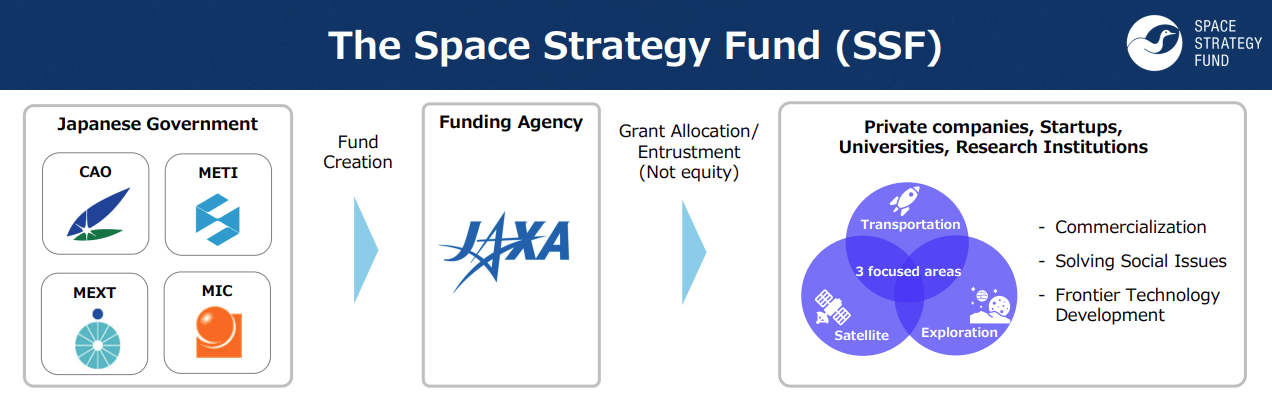
Overview of the Space Strategy Fund’s structure and goals. Source: JAXA
The ¥1 trillion fund is intended to be spent over 10 years and began operation in FY2024. However, the first three years of awards have already had ¥800 billion in funding allocated. This makes sense as most awards span 3-5 years, so most of the awards will need to have been made by the 5th year in order to allocate the funding. While the funding cycles are aligned with the Japanese fiscal year (April 1 - March 31), the Fund calls each funding cycle a “Phase”.
| Phase | Funding Amount | Themes / Projects | Transport | Satellites | Exploration | Cross- Cutting |
|---|---|---|---|---|---|---|
| Phase 1 (FY2024 - ) | ¥300 billion | 22 / 55 | ¥36 B | ¥165 B | ¥74 B | ¥16 B |
| Phase 2 (FY2025 - ) | ¥300 billion | 24 / 112 | ¥63 B | ¥134 B | ¥50 B | ¥44 B |
| Phase 3 (FY2026 - ) | ¥200 billion | 19 / 80 (est.) | ¥48 B | ¥50 B | ¥32 B | ¥24 B |
| Total | ¥800 billion | 65 / 247 | ¥147 B | ¥349 B | ¥156 B | ¥84 B |
JAXA manages the effort, so the President of JAXA, Dr. Yamakawa Hiroshi, is ultimately responsible, but the effort is overseen by an outside Program Director, SPACETIDE Foundation
President & CEO, Masayasu Ishida. Then there is a Program Officer for each domain (Transportation, Satellites, and Exploration) and a review committee for each theme/topic.
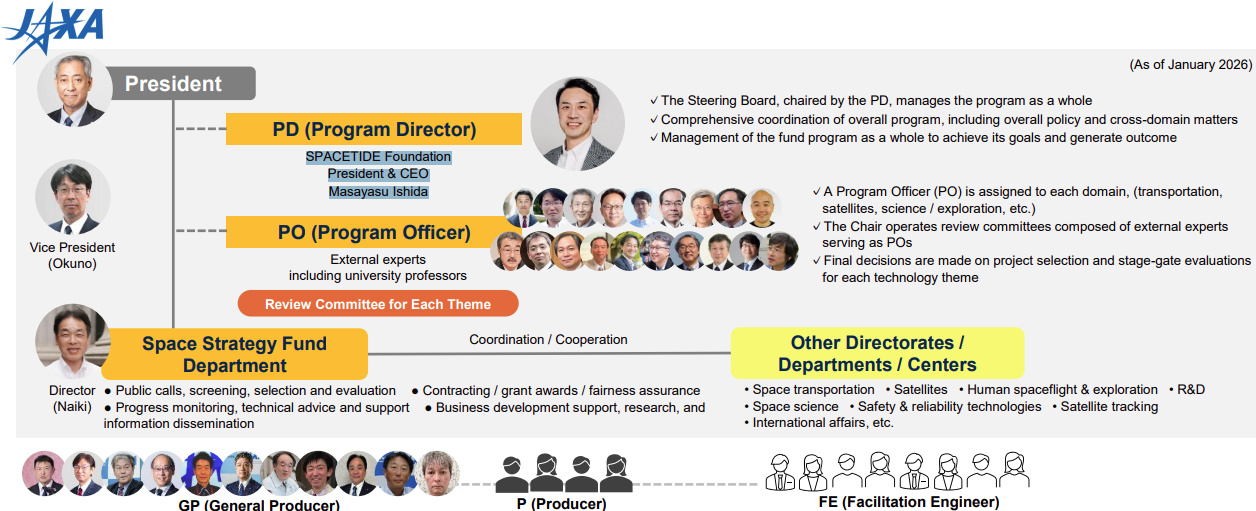
Space Strategy Fund org chart. Source: JAXA
| Theme | |
|---|---|
| 宇宙輸送 Space Transportation | Awards |
| Technologies for ensuring safety of human space transportation systems (MEXT) - ¥10B | |
| Iwatani Giken | Pressurized cabin and crew systems (ECLSS) for general purpose crewed spacecraft |
| Space Systems Development | Pressurized cabin ECLSS technology to ensure the safety of crewed space transportation |
| Innovative Space Carrier | Technologies for visualization, detection, and evacuation to support the safety of crewed space transportation |
| Mitsubishi Heavy Industries | Demonstration of anomaly detection and emergency evacuation to ensure the safety of crewed space transportation |
| System technology for smart launch sites (MEXT) - ¥8.5B | |
| None | None |
| Rocket Components for High-Frequency Launch Operations (METI) - ¥19.5B | |
| NEC Space Technologies | Enhancement of software-defined radios for rockets and LEO constellation satellites |
| Eagle Industry | Mass production of seals for rocket turbo pumps |
| Space BD | Multi-satellite transport adapter ("TOHRO" (Lantern)) |
| Air Water | High-efficiency liquefied biomethane production technology for rocket fuel |
| Symphonia Technology | Compact, low-cost TVC device with integrated electromechanical and electrical components |
| MJOLNIR SPACEWORKS | Technology and manufacturing process for ultralight air storage devices |
| SUIHO SPACE INNOVATIONS | Electric valves and pre-combustion injectors for reusable propulsion systems |
| Feasibility Study for Spaceport Facilities to Enable High-Frequency Launches (METI) - ¥0.5B | |
| IHI Aerospace | Design and feasibility study of general-purpose equipment for launch ranges |
| Rocket Manufacturing Processes for High-Frequency Launches (METI) - ¥24.5B | |
| UACJ | Innovation of manufacturing process for large aluminum forgings used in rocket structures |
| Toray Carbon Magic | Automated lamination technology for large-diameter and large 3D molded bodies |
| Tokuda Kogyo | Expanding production of thin-walled, high-precision, large parts |
| Fuji Seiko | Proximity effect of the manufacturing process of bellows for rockets and vacuum heat treatment furnaces |
| Hikari Seisakusho | Machining technology for space transport vehicle parts |
| Space One | Innovation of the manufacturing process for solid-fuel motors using robotics technology |
| Hokuto | Flexible assembly system for rocket structure assembly |
| Akahoshi Kogyo | Manufacturing process for cylinder components of rocket propellant tanks |
| IHI Corporation | Rocket engine manufacturing processes with integrated combustor design and manufacturing |
| 衛星等 Satellites | Awards |
| Technologies for flexible utilization of space (MEXT) - ¥16.5B* | |
| Mitsubishi Electric | Foundational technologies for on-orbit manufacturing |
| Toray Industries | High-performance resin materials for space and 3D additive manufacturing in orbit |
| Power Laser Technology | Adaptive predictive control debris removal technology using ground-based lasers |
| Star Signal Solutions | Demonstration of ultra-small debris detection technology and data utilization |
| IHI Corporation | Inverse synthetic aperture laser radar (ISAL) technology for high-resolution image acquisition from long distances |
| Power Laser Technology | Super-resolution monitoring technology for space debris using ground-based lasers |
| Technology to accelerate use of Earth observation data (MEXT) - ¥4B* | |
| Preferred Networks | Next-generation weather forecasting platform through integration of satellite data and AI |
| Tellus | Space information industry ecosystem through an AI-driven satellite data utilization platform |
| Space Data | Phase-free disaster response AI satellite observation and multimodal 3D digital twin platform |
| Technology for orbital transfer, in-orbit refueling, and space logistics (MEXT) - ¥30B* | |
| NEC Corporation | Develop of an inter-orbital transport vehicle |
| Pale Blue | Develop ultra-small inter-orbital transport vehicles for cislunar transportation |
| Mitsubishi Electric | Develop a general-purpose inter-orbital transport vehicle utilizing autonomous RPOD technology |
| Astroscale | Develop electric propellant refueling technology for geostationary orbital services |
| Yokohama National Univ. | Develop interdisciplinary analytical methods for space logistics decision support |
| Technology for next-generation Earth observation satellites (MEXT) - ¥10B* | |
| Axelspace | Monitoring CO2 emissions and absorptions by using satellite formation and passenger aircraft observation |
| Synspective | On-orbit demonstration of high-resolution, wide-area, small SAR satellite using frequency-scanning SAR |
| Innovative satellite mission technology demonstration support (METI) - ¥12B* | |
| Sarmony | DiskSat, an ultra-low altitude X-band SAR system that achieves low cost, high resolution, and wide observation width |
| Accelerate implementation of satellite data utilization systems - ¥17.6B* | |
| Sumitomo Forestry | Sustainable peatland management system integrating satellite observation and field measurements |
| Tokio Marine Resilience Co. | Integrated insurance and satellite solutions delivery model to strengthen disaster prevention infrastructure |
| Archeda | Asia-focused platform for nature-based carbon credits |
| Kokusai Kyogyo Co. | Using agentic AI to interpret variation factors in InSAR deformation maps |
| Green Carbon | National emissions management system in Vietnam |
| WESCO | Using multimodal AI to detect illegal/unauthorized embankments and assess landslide risk |
| Remote Sensing Technology Center of Japan (RESTEC) |
High resolution geospatial foundation model for government and public sectors |
| Space Tech Accelerator | Asia-based sustainable sourcing platform |
| OKI Electric Industry Co. | Next-generation infrastructure monitoring system through tight coupling of satellites and ground sensors |
| LocationMind | Temporary transport demand forecasting and planning via GNSS and event information text analysis |
| Feasibility study for satellite bus for optical comms (MIC) - ¥0.4B* | |
| NEC | Research and analysis for domestic production of optical communication terminal products |
| Mitsubishi Electric | Study on improving competitiveness of networks and satellite buses used in geostationary orbit |
| NICT | Feasibility sStudy for manufacturing of long wave optical communication terminals |
| Research, development, and demonstration of data relay services (MIC) - ¥23.5B* | |
| Space Compass | Spatiotemporal network control and monitoring technology for multi-orbit Communications |
| Internationally competitive communications payloads (MIC) - ¥5.8B* | |
| Mitsubishi Electric | Internationally competitive full digital communication payloads |
| Inter-terminal interconnection technologies for optical communications (MIC) - ¥3B* | |
| Warpspace | Interconnection technology and optical comms simulation technology |
| Frequency sharing technologies for satellite to ground comms (MIC) - ¥11B* | |
| Rakuten Mobile | Development and demonstration of dynamic spectrum sharing |
| Satellite component supply chain development (supplemental solicitation) | |
| Idemitsu Kosan | Mass production technology for CIGS solar cells |
| Taiyo Wire Cloth | Low cost metal mesh for large deployable antennas |
| Nanobridge Semiconductor | Low power FPGAs for space applications |
| 探査等 Exploration | Awards |
| Foundational technologies for lunar infrastructure (MEXT) - ¥8B | |
| Tohoku University | Foundational technologies for the construction of lunar infrastructure |
| Ritsumeikan University | Survey and ground investigation technologies for lunar gase construction |
| University of Tokyo | Flight model for water and metal element detection and measurement of lunar resource quantities |
| High-frequency cargo recovery systems (MEXT) - ¥2.5B | |
| ElevationSpace | High-Frequency material recovery services from LEO (ELS-RS) |
| Enhancing use of vacuum exposure (MEXT) - ¥6.5B | |
| Japan LEO Shachu | External (vacuum) platform with standard interfaces |
| High-precision landing technology in the lunar polar regions (MEXT) - ¥20B | |
| ispace | High-precision landing technology for lunar south pole and support for payload activities in the polar regions using a communications relay satellite |
| Orbital data center construction technology (MEXT) - ¥13.5B | |
| SpaceBlast | Build on-orbit data centers using high reliability edge computing |
| 分野共通 Common Areas | Awards |
| SX-CRANE, a space-transfer and new industry seeds creation center - ¥11B | |
| Tokyo Institute of Science | Develop environmental sensors and small payloads for future manned missions to Mars |
| Tokyo Univ. of Marine Science and Technology |
Develop next-generation positioning and navigation technology |
| Yamagata Univ. | Innovative Space Gastronomy Technology Development Center (STAR-MEALS) |
| Waseda Univ. | Space quality-of-life (QOL) R&D center for civilians living in space |
| Tokyo Institute of Science | Space medical and habitat development center |
| Solving environmental testing challenges for spacecraft - ¥23B | |
| IMV Corp | Establish an environmental test facility for spacecraft |
| High Energy Accelerator Research Organization (KEK) |
Develop a proton beam for single-event evaluation |
| Japan Atomic Energy Agency (JAEA) | Develop a spacecraft radiation test facility using the proton beam at J-PARC (a high intensity proton accelerator facility) |
| Japan Atomic Energy Agency (JAEA) | Develop radiation test facilities at the JAEA Tokai Tandem Accelerator |
| National Research and Development Agency (RIKEN) |
Develop advanced semiconductor testing environment with heavy ion beam delivery system |
| National Institutes for Quantum and Radiological Science and Technology (QST) |
Establish infrastructure for space radiation testing using particle beam therapy equipment |
| SEESE Corp. | Build a radiation testing facility |
| SX Core Area Development Research "SX-ARK" - ¥10B | |
| Thermal & Devices sub-topic | National Institute of Advanced Industrial Science and Technology (AIST) Waseda University Ehime University Osaka University Nagoya Institute of Technology Nagoya University (2) Hokkaido University Enecoat Technologies Co. Okuma Diamond Device Co. Kioxia Co. Chemitox Co. Daikin Industries Co. |
| Motion & Control sub-topic | National Institute of Advanced Industrial Science and Technology (AIST) National Astronomical Observatory Kyushu University Kyoto University Kobe University Nagoya University Shimane University University of Tokyo Tokyo University of Science Tohoku University Yokohama National University NEC Space Technologies Sanyo Chemical Industries Nippon Kayaku Co. Hatta & Yamamoto Space Propulsion Device Mfg. Co. Patched Conics Fukoku Co. |
Space Strategy Fund Year 3 Topics
In a recent information session [YouTube] (Japanese) JAXA announced that there will be 19 themes for Year 3 solicitations. In addition to the new solicitation topics, there are some other broad changes in the overall program for this third phase:
- Newly allocated funding will be reduced to ¥200 billion (~US $1.3 billion) in Year 3.
- The number of new themes is being reduced to 19
- Increased emphasis on:
- Adapting technology from other fields to the space sector
- Accelerating process of moving new technology from development to demonstration
- Accelerating private rocket launch capabilities
- Integrate lessons from Years 1 and 2
- More support for international collaborations
- Greater clarity on JAXA’s role
- Potential for adding additional funding from other ministries after a successful stage-gate evaluation
- JAXA is providing longer advance notice of likely solicitation release dates
Below is a summary of the topics for which funding has been allocated by each of the three agencies:
| Theme | Funding Agency | Budget | Approx. Duration | # of Awards |
|---|---|---|---|---|
| 輸送 Transporation | ||||
| Offshore launch system technology |
MEXT | ¥9 billion | 6 years | 1 |
| Thermal protection technology during atmospheric re-entry |
MEXT | ¥9.5 billion | 5 years | 4 |
| Accelerate commercial rocket launch |
METI | ¥12 billion | 5 years | 2 |
| Improve efficiency and functionality of rocket flight operations |
METI | ¥5 billion | 5 years | 2 - 3 |
| 衛星等 Satellites | ||||
| Optical and quantum sensing technology for satellite use |
MEXT | ¥15 billion | 6 years | 2 |
| Innovative space systems using physics AI, etc. (for orbital servicing) |
MEXT | ¥8 billion | 3 - 4 years | 2 - 5 |
| Accelerating commercialization of space traffic management systems that contribute to ensuring autonomy (includes cybersecurity) |
METI | ¥15 billion | 5 years | 4 |
| Digital technology for satellite d evelopment and manufacturing processes |
METI | ¥23 billion | 5 years | 3 |
| Mechanisms for low cost, high frequency demonstrations of new technology in LEO |
METI | ¥4.8 billion | 5 years | 1 |
| Compact, lightweight, general purpose ground antennas to expand satellite communications use |
MIC | ¥7 billion | 3 - 5 years | 2 - 3 |
| Satellite security technology (technology to deal with jamming and interception) |
MIC | ¥2.5 billion | 1 - 3 years | 1 - 2 |
| Communication equipment for using Q, V, E, W bands. |
MIC | ¥9.3 billion | 3 - 5 years | 1 - 2 |
| Innovative satellite-mounted antennas for next-generation satellite communications |
MIC | ¥6.3 billion | 3 - 5 years | 1 - 2 |
| 探査等 Exploration | ||||
| Technology promoting LEO usage | MEXT | ¥11.2 billion | 4 years | 4 - 6 |
| LEO orbital re-boost technology | MEXT | ¥6 billion | 5 years | 1 |
| Technology for utilizing space resources such as the moon and asteroids |
MEXT | ¥9.5 billion | 5 years | 2 - 3 |
| Ground station infrastructure to support communications between Earth and Moon |
MIC | ¥5 billion | 3 - 5 years | 1 |
| 分野共通 Common Areas | ||||
| SX technology seed integration and human resource development center |
MEXT | ¥11 billion | 5 years | 5 |
| SX foundational development research* | MEXT | ¥10 billion | 3 years | 20 - 40 |
* “SX” refers to “sustainability transformation” or the alignment of goals with long-term societal sustainability
Some Observations
Based on the various materials JAXA has made available, we can make a few observations.
Public, Transparent Process
JAXA has worked hard to describe each topic in depth with both online and in-person briefings during the spring and summer. Further, it has published selection criteria, results, and who sits on each selection committee. After each phase’s award announcements, JAXA has published compilations project summaries in English and Japanese
Finally, it has proactively participated in dozens of public outreach events across the country. Transparency helps to build trust, and JAXA invests a lot of effort in this.
Geographic Diversity
Despite the concentration of firms and population in the Tokyo and Osaka/Kobe/Kyoto regions, there has been some effort to distribute the funds to organizations located across the country.
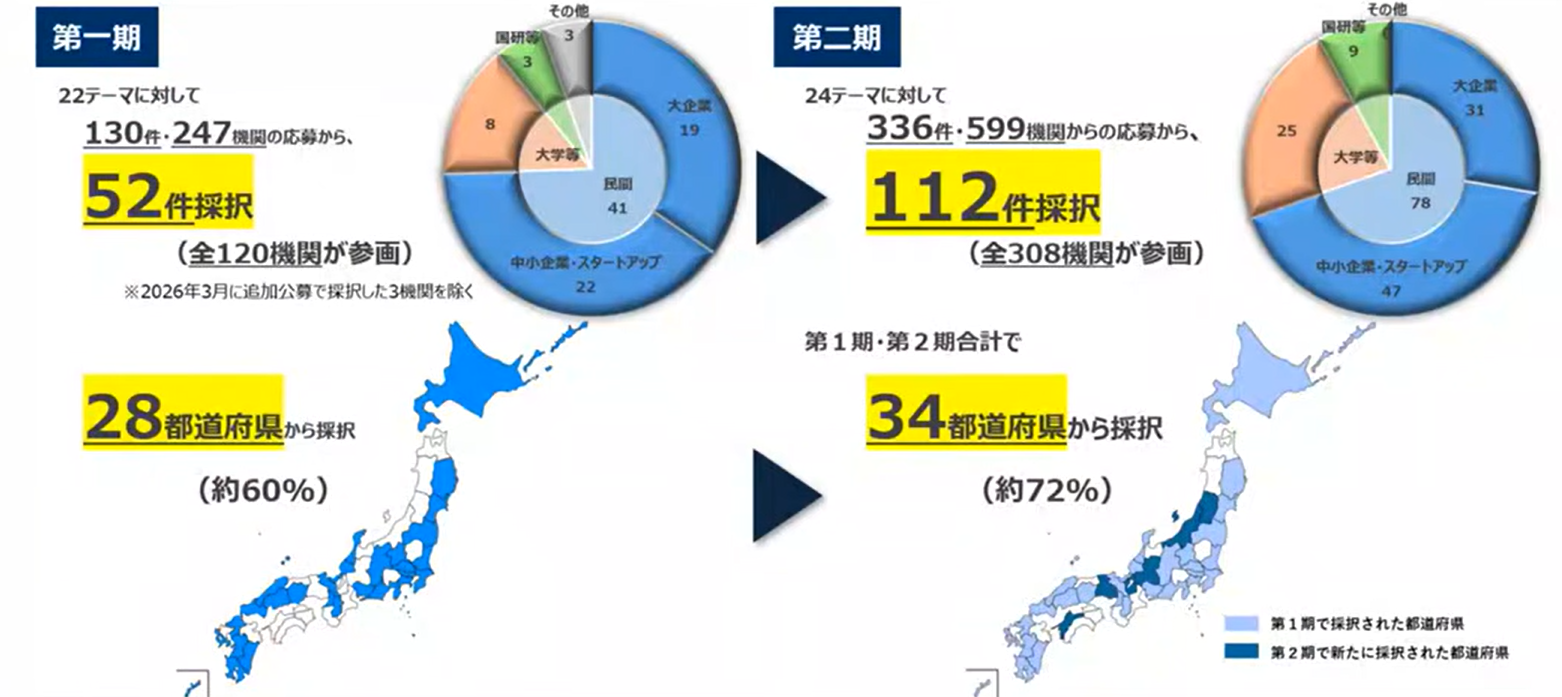
72% of prefectures have an organization among the awardees in Phases 1 and 2. Source: JAXA
Organizational DIversity
Lofting stuff into space and then operating it there tends to be among the most capital intensive activities humans engage in. Nonetheless, JAXA seems to be selecting small, mid-sized, and large organizations as well as organizations outside the conventional space sector.
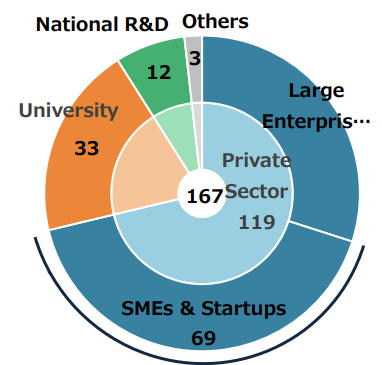
Space Strategy Fund awards broken down by organization type. Source: JAXA
Collaboration is Rewarded
Many projects have multi-firm project teams, and a significant number have at least one university as part of the team. This is important because university spinoffs are a common source of new technology company formation in Japan, and having faculty and students contributing to advanced work aimed at commercialization will help engage the next generation of founders and startup leaders.
Middle Powers Unite!
While the Strategy Fund can only provide direct funding awards to domestic Japanese organizations, JAXA recognizes that many successful firms will need to seek customers and partners internationally. Part of its approach includes active outreach to international space agencies and potentially co-funding collaborations between Japanese firms and those in other countries. JAXA has set up a “Co-Funded Business Promotion Framework (CBPF)” and already has agreements in place with the UK Space Agency, France CNES, and the National Space Agency of Singapore. In addition, JAXA is working with its foreign counterparts to organize matchmaking opportunities as well as sponsoring exhibit booths at an array of international conferences and expos.
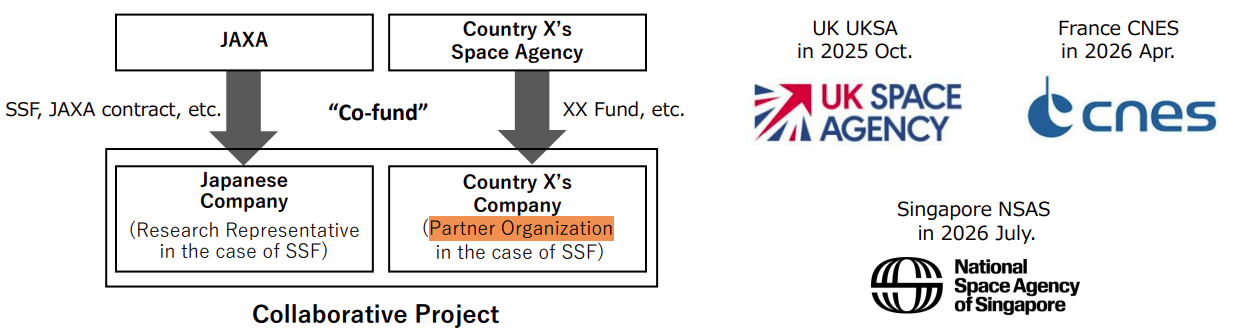
Funding structure for Co-Funded Business Promotion Framework (CBPF). Source: JAXA
Open to Feedback
The Strategy Fund is overseen by a Steering Committee that makes recommendations for changes. In January, JAXA published both the recommendations and their proposed actions. The January 2025 recommendations have already led to Year 2 improvements such as:
- Improve transparency and outreach with a more proactive industry engagement process and announcement of solicitation dates at the beginning of the fiscal year. JAXA has clearly acted on this in the Year 2 process.
- Set a broader array of themes - I don't see this in the themes, but JAXA is forecasting that they will make 140 awards in Year 2 (there were ~50 in Year 1). Many Year 2 awards have not yet been made, so the jury is out on this one
- Improve international collaboration - This led directly to the new international cooperation and co-funding program described above
- Strengthen government procurement coordination
The January 2026 Steering Committee recommendations have repeated some similar themes, including better government procurement communication and coordination, more support for securing overseas market access, and developing mechanisms to attract private capital. As Year 1 awardees are approaching their first formal “stage-gate” evaluations, the steering committee is also urging discipline in terms of terminating contracts that are not seeing results and concentrating funds on the most promising efforts.
Low Risk Tolerance
There are some exceptions, but the majority of the recipients are established firms, prominent research universities, or well-funded startups. The Space Strategy Fund has three key goals: 1) expand the domestic space market by supporting startups, innovation, and commercialization of space; 2) address societal challenges in energy, environment, agriculture, disaster management, and public health; and 3) pioneer science and technology frontiers. Bold innovation rarely arises in established, incumbent firms. Japan has suffered for decades from sclerotic science and technology development, and if it is going to increase the productivity of its economy while facing a declining population, it will have to make a lot of bold bets on young, fast-growing innovators. An anemic venture capital ecosystem means that the government is often a key source of funding for innovative startups. Growing the space ecosystem will require disruption of the status quo industry. Some will fail, but some will become the large companies of the future. The Strategy Fund awards thus far look like safe stewardship of public funds, but they also look like they are reinforcing the status quo industrial structure, rather than betting on potentially risky startups that will help pioneer the frontiers.
Hard Infrastructure Predominates
If we think about the space industry structure as including three layers - Infrastructure, Distribution, and Applications - most of the Fund’s investment in Years 1 and 2 is going to infrastructure: rockets, satellites, and the components and materials used to make them. Again, there are exceptions - Ocean Eyes, Umitron, Marble Visions, Pacific Consultants, Space Tech Accelerator in Year 1 and Archeda, WESCO, Tellus, Green Carbon, Preferred Networks, and Space Data in Year 2. These all clearly fall into the Applications layer. However, funds for this type of work were all grouped under a single feasibility study theme in Year 1, and there are no themes or awards focused on building the Distribution platforms that often become the hubs around which high value applications are built.
One of the Fund’s goals is “address societal challenges in energy, environment, agriculture, disaster management, and public health” and this is also getting short shrift in the selection of both themes and awards.
Conventional wisdom is that Japan excels at “making things” (mono-tsukuri 物創り) and that is certainly true, but Japan also boasts an incredible track record for services innovation and a great deal of future societal value will be in Applications and Distribution. By short-changing these layers of the value chain, I believe the Space Strategy Fund is demonstrating an incomplete strategy.
Making Good Bets is Hard
I guess the elephant in the room is whether this type of industrial policy (essentially, subsidies for favored industries or products) actually works. There was a time in the 1990s and early 2000s when many economists would have argued that governments picking and choosing which industries or companies should be successful was not a good policy - after all, it seems like governments are rarely in a position to know on which companies it's worth placing bets. And there are plenty of examples of technology bets gone wrong - like Japan’s bet on 5th generation computers and advanced semiconductors - where governments made the wrong bet and tax dollars were squandered. But despite many free marketeers' insistence that industrial policy doesn’t work, the U.S. government’s support for electrifications, the internet, solar power cells, nuclear energy, satellites, GPS, rockets, electric cars, autonomous driving, and a slew of other technologies have unleashed waves of prosperity. As Noah Smith says “for rich countries, technology policy is industrial policy.” This can be particularly important when it comes to major technological revolutions - the early decisions made around taxation, regulation, financial support, and competition usually have substantial long-term impact.
Japan, South Korea, Taiwan, and China have generations of evidence that public investments in advanced technology can both succeed and result in the establishment of one or more national champions that become internationally competitive firms and industries. So Japan’s development of the Space Strategy Fund and Takaichi’s recent commitment to invest ¥370 trillion (~US $2.3 trillion) across 17 strategic sectors through FY2040 is a return to a playbook that Japan has found successful in many contexts in the past.
But there are a bunch of risks.
What could go wrong?
How do you know when to stop investing in a particular direction or a specific firm?
Once the government picks a particular sub-industry it wants to support, ideally there would be multiple firms pursuing different ideas, and the government might be able to make multiple bets in the same domain. For example, there are now two established SAR constellations - iQPS and Synspective - and a third under development by IHI in partnership with ICEYE. There are also multiple firms designing and manufacturing satellite bus components. But for re-entry capsule technology, there is really only one Japanese firm so far: ElevationSpace, so if the Japanese government wants to make a strategic investment in this technology, it may have only one firm that is a viable target for support. What happens when that firm stumbles or has failures? Do you continue supporting it or withdraw support? This is a very difficult judgement call, and it has to be one that JAXA has considered with its ongoing support for ispace. ispace’s lunar lander has had multiple failures as well as setbacks with its U.S. engine supplier and other partners. Most recently, it lost a contract with NASA under the CLPS program, due to delays. Should JAXA stop betting on ispace? Maybe. But it does not really have another lunar lander firm.
Will government-as-first-buyer slow or distort the development of a commercial market?
Space industry startups in every economy benefit from government agencies becoming the first and often most important customer. Aside from R&D grants and other support, the government customer has enabled countless firms to develop initial revenue, fund technical development, and begin growing. However, the government customer, particularly the defense and intelligence customer, is an idiosyncratic one that can easily distract a firm from pursuing relevant commercial opportunities. Aravind Ravichandran at Terrawatch has written effectively on the “defense paradox”, in which the government agency customers initially help startup space and EO firms grow, but because their procurement patterns are very different from the commercial sector, firms that rely on them risk learning the wrong lessons and investing in the wrong products and services. Government agencies tend to engage in open-ended, multi-year contracts, have high reliability requirements, require adherence to standards that may or may not be relevant, and often have security and sovereignty requirements that do not help a company win commercial customers. Defense and intelligence agencies, in particular, pay for capability and readiness, requiring satellites to be ready but potentially idle, while commercial customers will generally only want to pay for a specific location or insight that is directly relevant to their business and has a clear financial return. Commercial customers require a company to demonstrate value one customer at a time and one use case at a time. Winning these commercial customers requires a different mindset, different product delivery architectures, and different sales processes. Government contracts are a major source of revenue and startups with appropriate products naturally pursue them, but this shapes and reinforces assumptions and processes that will not generally support commercial success. Commercial companies that are aware of this potential pitfall can mitigate this effect by ensuring that both the satellite/ground segment architecture can support both commercial and government customers. But government agencies can also play a role. In How Asia Works, Joe Studwell outlines how Japan, Korea, Taiwan, and China have enforced “export discipline” on firms by requiring that they demonstrate foreign customer sales and purchase orders in order to continue to receive government subsidies. The Space Strategy Fund leadership clearly aims to support global sales and partnership efforts, but it will be interesting to see if they have the fortitude to impose this kind discipline on the firms they are subsidizing.
Will Japan’s subsidies be enough to create internationally competitive firms?
The Japanese government could make an accurate assessment of the potential for a Japanese startup to build a competitive enterprise in a key area, but if the combined government and private firm can’t or don’t move with sufficient speed, other overseas market entrants may jump ahead. And if they have raised more capital, they may be able to build bigger or move faster. ElevationSpace has had multiple successful demonstrations of its reentry capsules and has been successful at raising new capital and developing useful partnerships internationally. But there are now several companies seeking to develop orbital re-entry technology, including Varda’s Winnebago and Reditus Space’s ENOS. Reditus is at an early stage with only $7.1 million of seed funding, but Varda has already raised $329 million, with the most recent Series C round of $187 million. ElevationSpace successfully raised a $40 million Series C for a total of $63.5 million, less than 20% of Varda’s raise. But there are other firms developing point-to-point cargo delivery services - SpaceX Starfall, ATMOS Space Cargo, Inversion Space, Outpost Space - that have even deeper pockets. While point-to-point cargo delivery is a different service, it requires similar re-entry capabilities, so all of these firms will be building similar functionality while being able to return more weight to the ground. Can Japanese firms, however successful in their development phase, compete against U.S. and Chinese firms with much deeper capital resources? Having asked that question, though, I am not necessarily a believer in the “more capital is better” message. In general, I think constraints cultivate creativity. We’ve seen this play out in China’s AI ecosystem, where limited access to both financial capital and the most advanced chips has led to creative solutions that have rapidly caught up with the huge U.S. companies. Sometimes, plenty of cash prevents a company from making good decisions.
If a company demonstrates success, it could be acquired by an overseas rival
All of that subsidy, technology transfer, and hard-charging domestic entrepreneurship might succeed but then be targeted for acquisition by a better capitalized foreign rival. This could be a good thing. If the acquiring company continues to invest in domestic manufacturing and operations, using Japan as a base to expand operations across Asia, the infusion of additional capital and related technology could make it possible to grow and scale better than the Japanese company could have done on its own. That is what Nippon Steel promised in its acquisition of U.S. Steel and it seems to be playing out that way. That is the positive scenario. But it is also possible that the acquiring firm could suck up the technology and customers, and then shut down domestic operations and lay off the workers. These things are hard to predict, and it might be good for the Japanese government to have a say in the matter. In light of these risks, Japan has recently updated its Foreign Exchange and Foreign Trade Act (FEFTA) (外国為替及び外国貿易法 or 外為法, for short) to enable a more robust screening of foreign direct investments (FDI). This is similar to the Committee on Foreign Investment in the United States (CFIUS) and, indeed, the new interagency framework has been dubbed “J-CIFIUS” [Fresh Fields]. The new system will be able to scrutinize indirect acquisitions, have post-closing intervention powers, and the ability to consult across several agencies before making a decision.
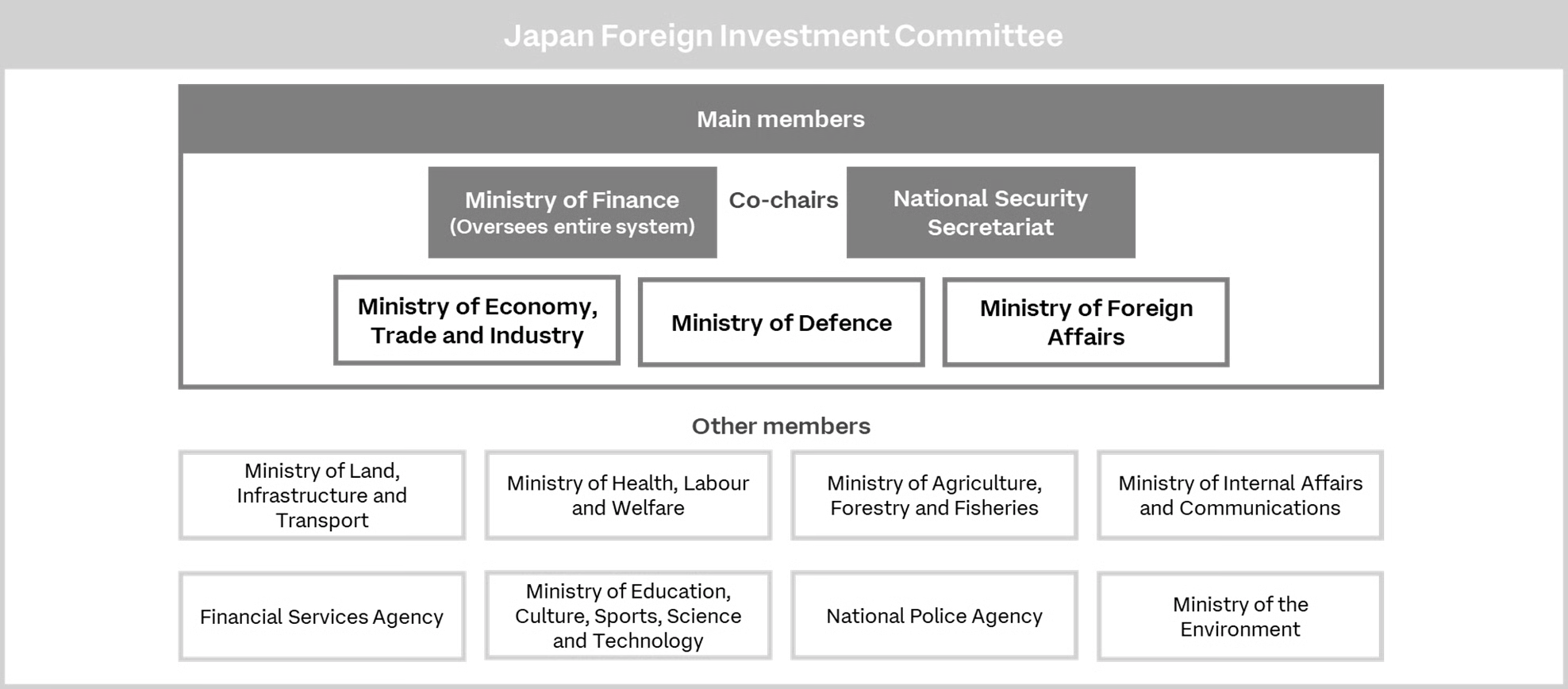
Japan Foreign Investment Committee org chart. Source: LDP
Given the current geopolitical context, this seems like a wise move, and I hope the new framework proves effective. However, it’s also worth pointing out that domestic acquisitions could also have negative consequences for related reasons. For example, Mitsubishi Electric (MELCO) just announced it is acquiring Infostellar, a Japanese ground station startup. That could make a lot of sense from a vertical integration perspective. MELCO, a long-time incumbent building complex satellites, gains a ground station infrastructure division. But “long-time incumbent” and “agile startup” are not always a synergistic combination. Large, legacy firms are often slower and less agile, and if MECO ends up controlling the domestic ground station market, it might be cushy for them, but not good for the international competitiveness of the Japanese satellite industry as a whole.
Will the workers be there?
Even if you pick the right industries and make the right investments, will Japan have the necessary entrepreneurs and workers to enable new firms to start and grow? There is reason to be concerned about Japan on this front. Japan has a highly literate population and it excels at primary, secondary, and tertiary education. However, not only is Japan in steep demographic decline with a rapidly declining cohort of young people, it has a poor track record of allowing defunct companies to go bust and enter bankruptcy or reorganization. So-called “zombie companies” soak up people and capital that could potentially be better applied to new endeavors. Zombie firms are those that carry debt equal to 9.5 times their monthly sales. By that definition, Japan had 210,000 such companies - about 14.3% of Japanese firms - in 2024. So as many as one in six Japanese companies are struggling to sustain their operations due to losses and excessive debt. These firms could keep recycling their debt when interest rates were low (or negative), but interest rates are now rising, which may force more firms into bankruptcy or reorganization, and that may free up some employees. However, the other source of potential employees is immigrants. Japan needs more skilled immigrants - both entrepreneurs and technical staff - but the government is in the midst of increasing the legal barriers for both non-Japanese entrepreneurs and other workers who want to live in Japan, and this seems incredibly counterproductive. Japan faces a shortfall of 6.4 million workers by 2030. AI, upskilling, and longer work careers are unlikely to make up this gap. Japan will need more immigrants, rather than fewer, and the new immigration crackdown is unlikely to be helpful.
What could go right?
Despite the many pitfalls, the Space Strategy Fund has demonstrated many attributes that will contribute to its success.
- Japan is not trying to do everything - JAXA and its partner agencies are selecting a few topics in which they see either a necessity or a strategic opportunity. They are pursuing technologies like rocket launch (sovereignty), high efficiency solar cells (opportunity), lunar exploration (opportunity), LEO manufacturing/re-entry (opportunity), and satellites (sovereignty). But they are not trying to build their own space station, super-heavy launch capacity, lunar base, or crewed launch capacity. In other words, they are looking for strategic advantage, rather than attempting to do everything.
- Diversity of firms - The SSF is selecting a broad array of firms - established/legacy firms, startups, manufacturers, services, and non-space firms with relevant ideas.
- Encouraging collaboration - The SSF is encouraging both domestic and international partnerships and is providing resources to make such collaborations possible.
- JAXA is working with external experts to select firms - The selection panels for each topic are made up of outside experts that combine the private sector and academic researchers. This won’t eliminate blind spots, but it will likely reduce them. This is a responsible approach, but there are also tradeoffs. It is probably less likely that a committee will award funds to bold, iconoclastic approaches that run against the status quo consensus.
Finally, while the Space Strategy Fund is a key tool for promoting Japan’s priorities, JAXA and it’s partners continues to leverage a broad range of other industrial policy tools, including:
- DIverse funding programs - While the the Space Strategy Fund is a big gun, JAXA also uses a variety of other innovation and research funding programs, often in combination:
- K Program - The Cabinet Office (CAO) operates a Key and Advanced Technology R&D through Cross Community Collaboration Program (K Program). The Japan Science and Technology Agency (JST) and the New Energy and Industrial Technology Development Organization (NEDO) together manage a JPY 500 billion (~ US$ 3.3 billion) fund aimed at research and development of key technologies critical for maintaining Japan’s global competitiveness.
- J-SPARC: JAXA operates its own program called JAXA Space Innovation through PARtnership and Co-creation (J-SPARC), and, as the name implies, the emphasis is on partnership and co-creation. Commercial businesses are able to propose joint R&D ideas to JAXA, which, if approved, will bring human resources and funds to collaborate with business to demonstrate feasibility for a concept.
- JAXA-SMASH: The JAXA-Small Satellite Rush Program (JAXA-SMASH) was launched in 2022 and is aimed at accelerating the entry and commercialization of small- and medium-sized businesses developing rockets for small satellite (<50kg) missions. Recipients have so far included BD Space, Space ONE, Interstellar, and Mitsui Bussan Aerospace.
- Public-Private Investment Funds: Frontier Innovations Fund was established in 2024 as an independent commercial venture capital fund. JAXA is the “anchor” limited partner (LP) with additional LPs from financial institutions and institutional investors. Frontier Innovations operates the fund as a General Partner with a focus on seed and early-stage investments.
- Small Business Innovation Research (SBIR) is an innovation funding program originally developed in the United States and has since been extended to most federal research agencies in the U.S. as well as inspiring similar programs around the world. Japan established its own SBIR program in 1999 to support innovative technology development in small businesses. It differs significantly from the U.S. SBIR program that inspired it. Rather than independent SBIR programs operated by each agency, Japan’s SBIR is an inter-ministerial program operated by the Cabinet Office and administered by the New Energy and Industrial Technology Development Organization (NEDO). SBIR awards have played a fairly significant role supporting Japan’s space program over the past several years, including awards to Astroscale for a debris inspection, ispace for the Mission 6 lunar lander, and Tenchijin for a land surface temperature feature for its COMPASS product.
- J-StarX SpaceTech Acceleration Program: a joint initiative between JAXA, the Japan External Trade Organization (JETRO), and global aerospace accelerator Starburst. The initiative is designed to fast-track and scale Japanese space startups into global markets. It helps domestic commercial space companies expand internationally, with a primary focus on navigating the European space ecosystems in the UK and France.
- Regulatory reform - The Japanese government is good at generating both regulation and legislative reforms to ensure domestic industry can grow and adapt to changing conditions.
- Expanded licensing scope to cover test vehicles and dummy payloads
- New licensing systems for reusable rockets and capsules that return experimental results or materials from orbit to ensure safety and mitigate legal risks with return-to-earth missions
- Expansion of government indemnity for launches whereby government compensates for losses that exceed commercial third-party insurance coverage.
- Mandatory post-mission satellite disposal measures support integration of debris mitigation components like Bull’s membranes and Astroscale’s docking plates.
- Regulatory constraints on competition - Japan has never been shy about protecting its domestic industries from foreign competition when it’s in its strategic interest, particularly when industries are nascent and need room to grow. J-CFIUS (see above) is one example, but others include things like requiring special licenses or domestic domiciling in order to participate in programs. This is not unique to Japan and is a common mechanism for nurturing domestic industries until they reach a critical size to be internationally competitive.
In order to be perceived as successful, the Space Strategy Fund will have to navigate a variety of shoals. It will have to (mostly) pick the right companies; it will have to help them succeed both domestically and internationally; it will have to avoid very large mistakes that would undermine public support; it will probably have to end projects that are not succeeding; and it will need to do this in a context in which the Takaichi government is trying to accomplish similar objectives across seventeen different technology domains. JAXA does not have control over all of these variables, so this will require courage and fortitude.
If you’ve made it this far, thank you for reading. Please be in touch via LinkedIn with any feedback, questions, comments, or requests for future topics. And if you have a friend or colleague that you think would enjoy JEO, please share it!
Until next time,
Robert
Faraway fireworks
making a noise, then
nothing.
– Kawahigashi Hekigodo (1873-1937) - translated by William Scott Wilson
遠花火
音して何も
なかりけり
toohanabi
oto shite nanimo
nakarikeri